
There is a dish I first encountered not on Kos, but on a short ferry crossing to Cyprus many years ago — golden, torpedo-shaped parcels of bulgur wheat, sizzling straight from the fryer, handed to me wrapped in paper by a vendor near the Limassol harbor. One bite and I understood immediately why Cypriots treat koupes the way people from Kos treat fresh octopus: something you do not rush, something you eat standing up with salt spray in the air, something that tastes like the sea even when there is no seafood involved.
The koupes recipe is deceptively simple. Fine bulgur wheat is soaked, kneaded into a pliable dough, shaped into shells, stuffed with warmly spiced minced meat, and deep-fried until the outside is deeply golden and faintly crunchy while the interior stays tender. The spicing — cinnamon, allspice, a whisper of cumin — is the fingerprint of the Eastern Mediterranean, a reminder that Cyprus sits at a crossroads between Greek, Levantine, and Ottoman culinary traditions.
Back on Kos, I spent time perfecting my own version of this koupes recipe, learning from a Cypriot friend whose grandmother made them every week. The shell consistency is everything: too dry and it cracks during frying; too wet and it slides apart. The filling must be completely cool before you assemble, or the steam will soften the dough from inside. These are the lessons that take patience to learn — and that I will save you the trouble of discovering the hard way.
This recipe makes 12 koupes, enough for a generous mezze spread or a satisfying snack for four people.
Table of Contents
What Are Koupes?
Koupes (singular: koupa) are a traditional Cypriot street food and mezze dish made from fine bulgur wheat shells stuffed with seasoned minced meat, then deep-fried until golden. Their distinctive torpedo shape and crispy-yet-tender texture make them instantly recognizable at any Cypriot market, bakery, or street stall.
The dish shares clear ancestry with the Levantine kibbeh — itself one of the oldest recorded meat-and-grain preparations in the Arab world — brought to Cyprus through centuries of trade and migration across the Eastern Mediterranean. The Cypriot version developed its own character: a heavier hand with cinnamon, a preference for pork alongside beef, and the deep-frying technique that gives koupes their distinctive crunch.
Koupes are eaten warm, often with a squeeze of lemon and fresh mint alongside. They appear on every Cypriot meze table and at village festivals across the island.
Why This Recipe Works
- Fine bulgur (#1 grind) is non-negotiable. Coarser grinds will not bind properly when kneaded, leaving a shell that cracks during frying. The fine grind absorbs moisture evenly and becomes smooth and workable — closer to dough than grain.
- Cold hands, wet hands. Forming the shells requires your hands to be cold and damp at all times. Warm hands soften the dough too quickly, making it sticky and difficult to shape cleanly.
- The filling must be fully cooled. Steam from a warm filling softens the shell from the inside during assembly, causing it to crack or collapse when it hits the hot oil. Make the filling ahead and refrigerate it.
- Oil temperature matters more than timing. At 175°C / 350°F, the shell sets quickly on the outside before the inside can absorb excess oil. Too cool and the koupes become greasy; too hot and the outside burns before the center is cooked through.
Ingredients
For the Bulgur Shell
- 500g (3 cups) fine bulgur wheat (#1 grind)
- 300ml (1¼ cups) boiling water
- 1 teaspoon fine sea salt
- 2 tablespoons olive oil
For the Meat Filling
- 400g (14 oz) ground pork, or a 50/50 mix of pork and beef
- 1 medium onion, finely diced
- 2 tablespoons fresh flat-leaf parsley, finely chopped
- 1 tablespoon fresh mint, finely chopped
- ½ teaspoon ground cinnamon
- ½ teaspoon ground allspice
- ¼ teaspoon ground cumin
- Salt and freshly ground black pepper, to taste
- 2 tablespoons olive oil (for sautéing)
For Frying
- 1 litre (4 cups) vegetable or sunflower oil
Step-by-Step Instructions
1. Prepare the Bulgur Shell Dough
Place the fine bulgur in a large heatproof bowl. Pour the boiling water over it, add the salt and olive oil, and stir to combine. Cover tightly with a plate or plastic wrap and leave to soak for 25–30 minutes until all the water is fully absorbed and the bulgur is soft throughout.
Once the bulgur has cooled enough to handle comfortably, knead it with your hands for 3–4 minutes. You are looking for a smooth, slightly tacky dough that holds together when pressed. If it feels dry and crumbly, work in cold water one tablespoon at a time. Set the dough aside, covered.
2. Make the Meat Filling
Heat the olive oil in a wide skillet over medium heat. Add the diced onion and cook gently for 5–6 minutes until softened and translucent but not browned.
Add the ground meat and cook through, breaking it up with a wooden spoon, about 7–8 minutes. If there is excess fat in the pan, drain it off — too much fat in the filling prevents the shell from sealing properly.
Stir in the cinnamon, allspice, cumin, parsley, and mint. Season well with salt and pepper. Cook for another 1–2 minutes to bloom the spices into the meat. Taste and adjust seasoning — the filling should be aromatic and well-seasoned, since it will be enclosed in a relatively plain shell.
Transfer the filling to a plate, spread it out, and refrigerate for at least 20 minutes until completely cold. Do not use warm filling.
3. Shape the Koupes
Fill a small bowl with cold water. Wet your hands thoroughly.
Take a portion of bulgur dough roughly the size of a golf ball (about 75–80g). Cup it in your palm and press your thumb into the center to begin forming a hollow shell. Work the dough outward from the center, rotating it in your hand, until you have an oval cup roughly 8–9cm long with walls about 5mm thick.
Place a heaped teaspoon of the cooled filling into the hollow. Bring the open end of the shell up and over the filling, pressing the edges together firmly to seal. Shape the finished koupes into a smooth torpedo — pointed at both ends, about 10–11cm long. Set it on a tray and rewet your hands before forming the next one.
Refrigerate the formed koupes for 15–20 minutes. This brief chill firms the shell and reduces cracking during frying.
4. Fry the Koupes
Pour the vegetable oil into a deep, heavy-bottomed pot to a depth of at least 8–10cm. Heat over medium-high to 175°C / 350°F. Use a thermometer — guessing oil temperature is the most common reason koupes turn out greasy.
Slide 3–4 koupes into the oil without crowding the pot. Fry for 3–4 minutes, turning gently with a slotted spoon every minute or so, until they are deeply golden-brown on all sides.
Remove with a slotted spoon and drain on a wire rack or paper towels. Allow the oil to return to 175°C before frying the next batch. Serve immediately, with lemon wedges and fresh mint.
Recipe Card
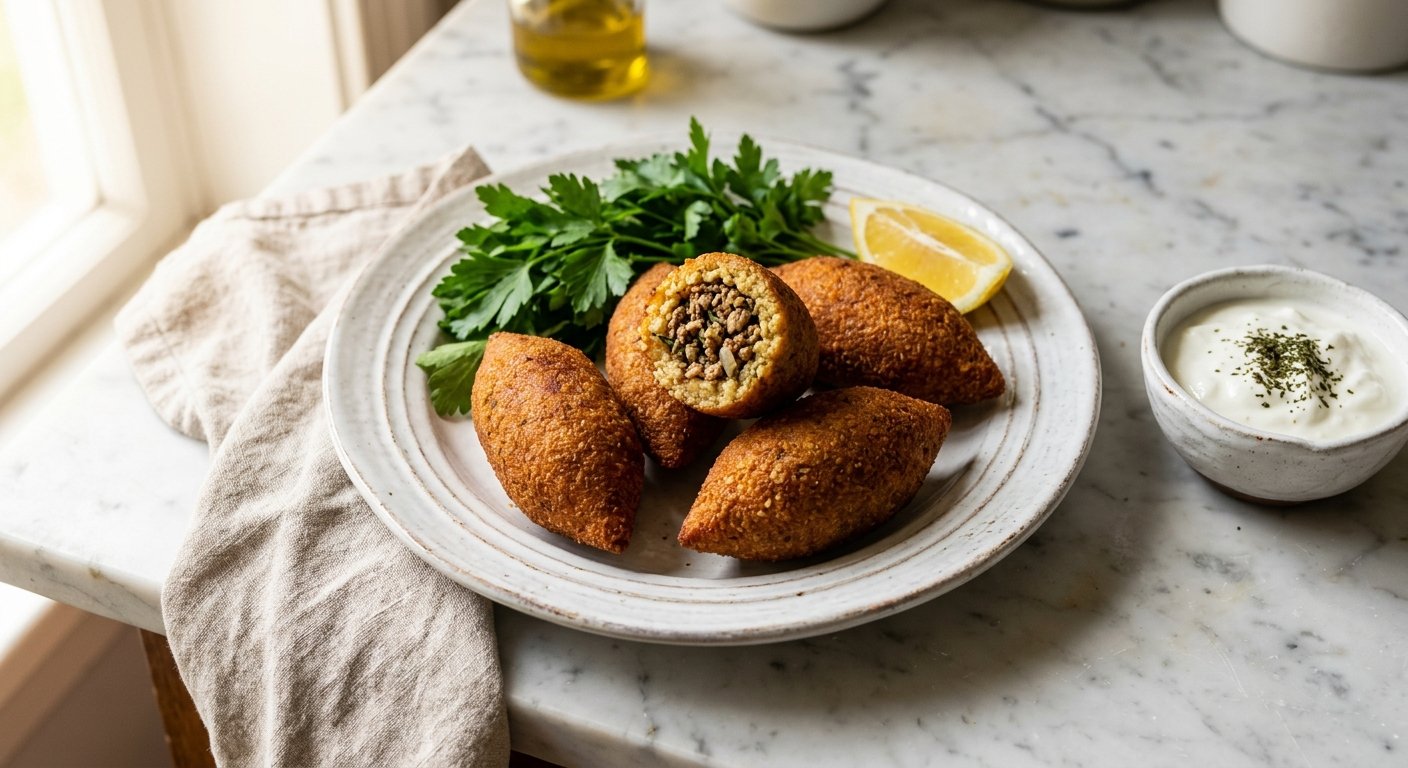
Koupes (Cypriot Bulgur Meat Shells)
Ingredients
For the Bulgur Shell
- 500 g fine bulgur wheat #1 grind (3 cups)
- 300 ml boiling water 1¼ cups
- 1 tsp fine sea salt
- 2 tbsp olive oil
For the Meat Filling
- 400 g ground pork 14 oz; or a 50/50 mix of pork and beef
- 1 medium onion finely diced
- 2 tbsp fresh flat-leaf parsley finely chopped
- 1 tbsp fresh mint finely chopped
- ½ tsp ground cinnamon
- ½ tsp ground allspice
- ¼ tsp ground cumin
- salt and freshly ground black pepper to taste
- 2 tbsp olive oil for sautéing
For Frying
- 1 litre vegetable or sunflower oil 4 cups
Instructions
Prepare the Bulgur Shell Dough
- Place the fine bulgur in a large heatproof bowl. Pour the boiling water over it, add the salt and olive oil, and stir to combine. Cover tightly and leave to soak for 25–30 minutes until all the water is absorbed and the bulgur is soft throughout.
- Once cool enough to handle, knead the bulgur for 3–4 minutes into a smooth, slightly tacky dough that holds together when pressed. If dry and crumbly, work in cold water one tablespoon at a time. Set aside, covered.
Make the Meat Filling
- Heat the olive oil in a wide skillet over medium heat. Cook the diced onion gently for 5–6 minutes until softened and translucent but not browned.
- Add the ground meat and cook through, breaking it up, about 7–8 minutes. Drain any excess fat — too much fat prevents the shell from sealing properly.
- Stir in the cinnamon, allspice, cumin, parsley, and mint. Season well with salt and pepper and cook 1–2 minutes more to bloom the spices. The filling should be aromatic and well-seasoned.
- Spread the filling on a plate and refrigerate at least 20 minutes until completely cold. Do not use warm filling.
Shape the Koupes
- With wet hands, take a golf-ball portion of dough (75–80 g). Press your thumb into the center and work the dough outward, rotating, into an oval cup 8–9 cm long with 5 mm walls.
- Fill with a heaped teaspoon of cooled filling, seal the open end, and shape into a smooth torpedo pointed at both ends, 10–11 cm long. Rewet hands between each.
- Refrigerate the formed koupes for 15–20 minutes to firm the shells and reduce cracking during frying.
Fry the Koupes
- Heat vegetable oil at least 8–10 cm deep in a heavy pot to 175°C / 350°F. Use a thermometer — guessing oil temperature is the most common reason koupes turn out greasy.
- Fry 3–4 koupes at a time, turning gently every minute, for 3–4 minutes until deeply golden brown. Drain on a wire rack; let the oil return to 175°C between batches.
- Serve immediately with lemon wedges and fresh mint.
Chef’s Notes
On the bulgur
This is not a recipe where you can substitute medium or coarse bulgur. Fine bulgur — sometimes labeled #1 grind or “extra fine” — behaves almost like a dough once properly hydrated. It has enough surface starch to hold together under heat, which keeps the shell intact during frying.
On the filling
The spice balance matters. Cinnamon and allspice are the dominant notes; cumin plays a supporting role. Do not add garlic or chili — these are not part of the traditional Cypriot flavor profile, which is subtler and more aromatic than a Lebanese kibbeh filling.
Serving suggestions
Koupes are a natural part of a Cypriot mezze alongside my Authentic Sheftalies. They also sit happily next to a crisp Traditional Greek Village Salad — the cool, sharp vegetables cut through the richness of the fried shell. Lemon is mandatory; the acid brightens everything.
On frying
A thermometer is not optional if you want consistent results. The difference between 165°C and 175°C is the difference between greasy koupes and properly crisped ones.
Make-ahead strategy
I often prepare the filling a day ahead and refrigerate it overnight. Formed (unfried) koupes freeze well on a parchment-lined tray — once solid, transfer to a freezer bag and fry directly from frozen, adding about 90 seconds to the frying time.
FAQ
What is the difference between koupes and kibbeh?
Koupes are the Cypriot descendant of kibbeh, the ancient Levantine dish of ground meat and cracked wheat. Both use a bulgur shell stuffed with spiced meat, and both are often fried. The key differences are in the spicing (Cypriot koupes lean toward cinnamon and allspice rather than the pine nuts and dried fruit found in some Lebanese kibbeh styles) and the use of pork, which appears in Cypriot versions but not in traditionally Muslim or Jewish kibbeh preparations.
Can I bake koupes instead of frying them?
You can, though the result is noticeably different — a matte, softer exterior rather than the crackling golden crust that defines the street-food version. If baking, brush each koupes generously with olive oil and bake at 200°C / 390°F for 25–30 minutes, turning once halfway through.
Why did my koupes crack open during frying?
There are three common causes: the filling was not fully cold before assembly (steam breaks the seal from inside), the shell walls were too thin, or the dough was too dry and did not seal cleanly at the seams. Refrigerating the formed koupes for 15–20 minutes before frying helps firm the shell and significantly reduces cracking.
What bulgur do I need for this koupes recipe?
Fine bulgur, also called #1 grind or extra-fine bulgur. It is widely available in Middle Eastern grocery stores, Turkish and Greek food shops, and online. Do not substitute medium or coarse bulgur — the texture will be wrong and the shell will not bind properly.
Can I use lamb instead of pork?
Yes. Ground lamb gives a richer, more gamey flavor that some prefer. A mix of lamb and pork also works well. If using all lamb, reduce the cinnamon slightly — lamb is already quite aromatic and can taste heavy with too much spice.
Koupes are one of those dishes that reward patience. The first time you make them, expect imperfect shapes and maybe a cracked shell or two. By the third time, your hands will remember what to do — and that is when this koupes recipe becomes something you make without thinking, just as it has been made in Cypriot kitchens for generations.