
There are dishes that arrive at the table and silence the conversation. Bouyiourdi is one of them.
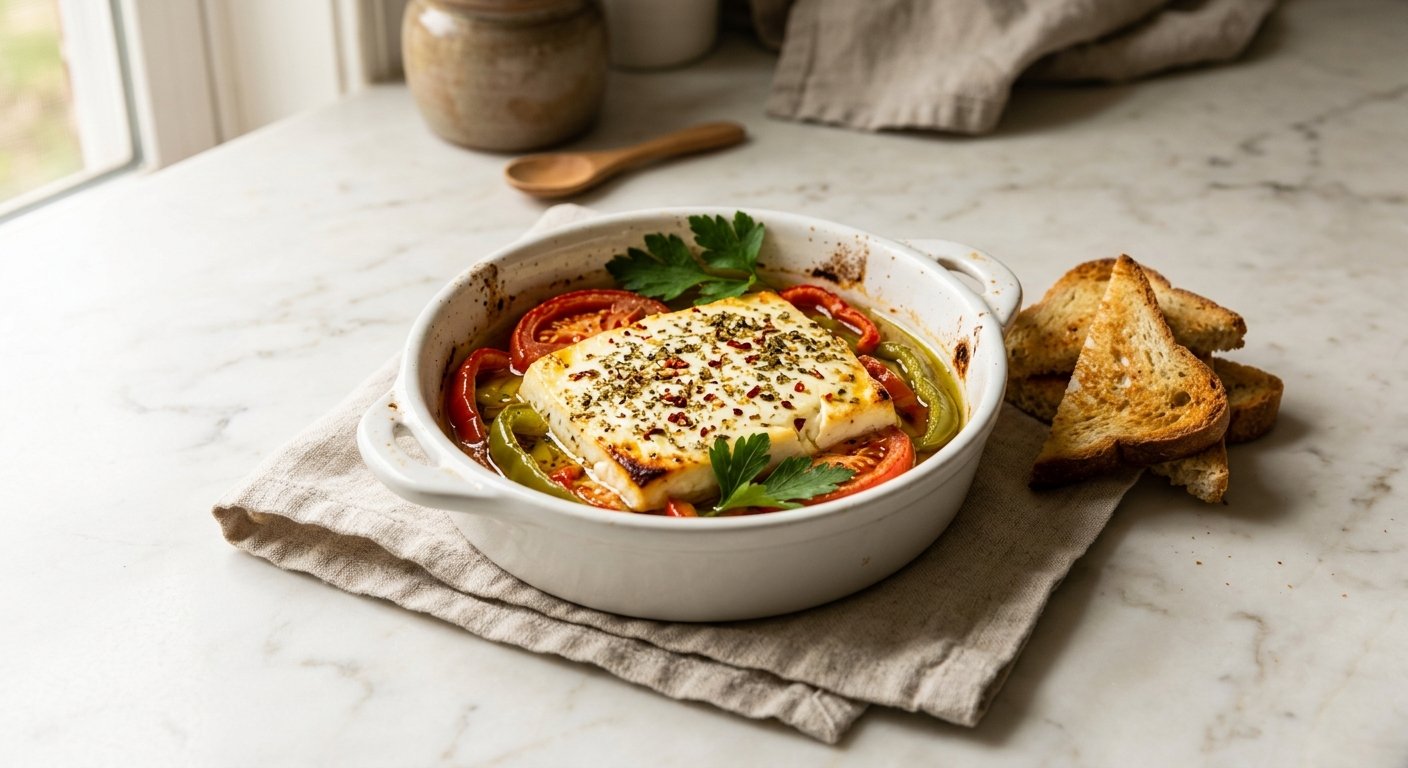
The first time I encountered this dish properly — not a softened tourist version, but the real thing — I was at a harbor-side taverna on a summer evening that refused to cool. A friend who had spent years cooking in northern Greece ordered it without asking anyone at the table. What arrived was a small clay pot, still spitting from the oven: a thick slab of feta half-submerged in collapsed tomato, draped with sweet florina pepper and crowned with enough fresh green chili to give you pause. There was bread. That was all you needed.
Growing up on Kos, we had our own versions of this kind of meze. My mother made something close in the heat of August — whatever was ripest from the garden laid over a block of feta with olive oil, into the oven until everything softened and began to smell of oregano and char. But bouyiourdi baked feta, as the northern Greeks do it, is something more specific. The name comes from the clay vessel traditionally used to bake and serve it — just as saganaki takes its name from the two-handled pan in which the cheese is fried. The vessel is the dish.
What makes this meze endure is its ratio: a single block of feta, ripe tomato, sweet pepper, fresh chili, good olive oil, and a hot oven. Four core ingredients, twenty-five minutes, and something that tastes as though far more effort went into it.
Table of Contents
What Is Bouyiourdi?
Bouyiourdi (also written bougiourdi or mpougiourdi, pronounced boo-YOO-dee) is a classic Greek meze from northern Greece — particularly associated with Thessaloniki — in which a block of feta cheese is baked in a small clay pot with tomato, sweet red peppers, and fresh chili. It arrives at the table still bubbling and is eaten directly from the dish with nothing but bread.
The name refers to the traditional clay vessel used for baking and serving. Bouyiourdi shares this naming logic with saganaki — the famous pan-fried cheese dish that takes its name from its own two-handled sagani. When the vessel becomes the name of the dish, you know something has earned its permanent place in the repertoire.
The defining element of bouyiourdi is heat. Every version begins with feta, tomato, and pepper, but the fresh chili is what makes it bouyiourdi rather than simply baked cheese. The florina pepper — a long, sweet red pepper from the Florina region of northern Greece — provides the fruity base. The green chili provides the fire. Together they balance the saltiness of the feta and give the dish its characteristic warmth.
Feta itself is a PDO-protected cheese, produced exclusively in designated regions of Greece from sheep’s and goat’s milk under traditional methods. For bouyiourdi, always use a proper block of Greek feta stored in brine.
Why This Recipe Works
- The feta bakes as a whole block. Keeping the cheese intact means the outside develops a slight golden crust while the inside softens toward melting. The tomato and pepper juices that pool around the base become a rich sauce for the bread. Crumbled feta dries out rather than softening.
- Florina peppers balance the fire. These sweet, slightly fruity red peppers are essential to the architecture of the dish. They soften and caramelize in the oven, providing a counterpoint to both the salt of the feta and the sharp heat of the chili.
- One chili is the minimum, not the maximum. Bouyiourdi needs heat to be itself. A single green chili gives warmth and flavor; two or three gives you the proper northern Greek version.
- High heat and short time. Baking at 200°C (400°F) for twenty to twenty-five minutes gets the edges golden and the tomato blistered without turning the feta rubbery.
- Serve the moment it leaves the oven. The texture, the temperature, the way the bread tears across the bottom of the dish — all of it depends on immediacy.
Ingredients
Serves 4 as a meze
- 200g (7 oz) block of Greek feta cheese, in one intact piece
- 1 medium ripe tomato, thinly sliced
- 2 florina peppers (or piquillo peppers), thinly sliced, seeds removed
- 1–3 fresh green chilies, thinly sliced
- 2 tablespoons extra virgin olive oil
- 1 teaspoon dried Greek oregano
- 1/2 teaspoon sweet paprika
- Freshly ground black pepper, to taste
- Crusty bread, for serving
How to Make Bouyiourdi Baked Feta
Step 1 — Preheat.
Preheat the oven to 200°C (400°F). If you are using a clay pot, place it in the cold oven and allow it to heat up with the oven — never transfer a cold clay vessel into a fully preheated oven, as the thermal shock can crack it. A small cast-iron dish or shallow gratin dish works equally well.
Step 2 — Place the feta.
Place the feta block in the center of your baking dish. Leave some room around the sides so the tomato and pepper can nestle alongside and baste the cheese as everything cooks.
Step 3 — Add tomato.
Layer the tomato slices over the top of the feta and around the sides. Season the tomato lightly and scatter a little oregano across it.
Step 4 — Add florina peppers.
Arrange florina pepper slices over the tomato so they cover the top. They will soften and take on color in the oven.
Step 5 — Add chilies.
Scatter the chili slices over everything. One chili for warmth, two or three for the full northern Greek experience. Remove the seeds to keep the flavor while reducing the fire.
Step 6 — Drizzle olive oil.
Drizzle olive oil generously over the entire surface — two full tablespoons. The oil bastes the feta, softens the peppers, and combines with the tomato juices to create the sauce that makes the bread worth fighting over at the end.
Step 7 — Season.
Sprinkle the sweet paprika across the top, add a few grinds of black pepper, and add a little more oregano.
Step 8 — Bake.
Bake for 20–25 minutes, until the edges of the feta have taken on color, the tomato has collapsed and released its juices, and the peppers are soft with slightly charred tips. Everything should be actively bubbling when you pull it from the oven.
Step 9 — Serve.
Serve immediately in the baking dish with the bread already torn and ready. Drag a piece of crust across the bottom of the dish where the tomato, oil, and feta have merged into something close to a sauce.
Bouyiourdi Baked Feta
Ingredients
- 200 g Greek feta cheese 7 oz, in one intact block stored in brine
- 1 medium ripe tomato thinly sliced
- 2 florina peppers or piquillo peppers, thinly sliced, seeds removed
- 1-3 fresh green chilies thinly sliced, adjust to heat preference
- 2 tbsp extra virgin olive oil
- 1 tsp dried Greek oregano
- 0.5 tsp sweet paprika
- freshly ground black pepper to taste
- crusty bread for serving
Instructions
- Preheat oven to 200°C (400°F). If using a clay pot, place it in the cold oven to preheat together -- never put a cold clay vessel into a fully preheated oven.
- Place the feta block in the center of a small ovenproof dish, leaving room around the sides for the tomato and peppers.
- Arrange tomato slices over and around the feta. Season lightly and scatter a pinch of oregano across them.
- Layer florina pepper slices over the tomato, covering the top of the feta.
- Scatter chili slices over everything. Remove seeds for less heat; keep them for the full northern Greek experience.
- Drizzle olive oil generously over the entire surface.
- Sprinkle sweet paprika, black pepper, and remaining oregano over the top.
- Bake 20–25 minutes until feta edges are golden, tomato has collapsed and released its juices, and the dish is actively bubbling.
- Serve immediately in the baking dish with crusty bread ready for tearing and dipping.
Notes
Nutrition
Chef’s Notes
On the heat level: One chili delivers warmth and the aromatic note that makes this dish itself. Two or three delivers the full Thessaloniki version. What there is not is zero — bouyiourdi needs heat to be itself.
The loukaniko variation: Some tavernas add thin slices of loukaniko — a Greek pork sausage seasoned with orange peel and fennel — on top of the feta before baking. The fat renders slowly, adding a smoky richness that plays well against the sweet pepper and salty cheese. The dish is complete without it, but better with it.
On pepper substitutes: Florina peppers are elongated sweet red peppers from northern Greece and the first choice for authenticity. Piquillo peppers — jarred and drained before use — are the closest widely available substitute. A thinly sliced red bell pepper is the most accessible option, though it carries less of the fruity depth that makes florina peppers worth seeking out.
On the vessel: A small clay pot is ideal and traditional. A small cast-iron cocotte, an individual gratin dish, or any shallow ovenproof vessel works. Avoid deep dishes; you want the feta, tomato, and peppers all at roughly the same level so everything bakes evenly.
Storage: Bouyiourdi does not keep well. The feta texture changes noticeably once it cools and is reheated, becoming dense instead of soft. This is a dish to finish at the table.
Building a meze spread: Pair it alongside Tirokafteri (Spicy Greek Feta Spread) and Quick Tzatziki Sauce for a spread that covers the full range — spicy and sharp, cool and creamy, and bubbling hot from the oven.
FAQ
What does bouyiourdi mean?
Bouyiourdi is the name of the small clay pot traditionally used to bake and serve this dish. The dish takes its name from its vessel — exactly as saganaki takes its name from the sagani pan used to fry the cheese. The word itself has Ottoman Turkish roots, reflecting centuries of culinary exchange in northern Greece and the broader Aegean.
What kind of feta should I use for bouyiourdi?
Use a proper block of Greek feta stored in brine — barrel-aged if you can find it. The texture should be firm enough to hold together in the oven while soft enough to begin to yield at the center. Pre-crumbled feta dries out rather than softening, and the block form is essential to how the dish works.
Can I use regular bell peppers instead of florina peppers?
Yes. A thinly sliced red bell pepper is a practical substitute. Florina peppers are sweeter and more intensely flavored than standard bell peppers. Piquillo peppers (jarred, drained) are the closest widely available alternative and worth using if you can find them.
How spicy is bouyiourdi?
Entirely adjustable. One small green chili gives warmth without serious heat; three gives a proper northern Greek experience. Remove the seeds to keep the chili flavor while reducing the fire. The florina pepper is sweet, not spicy, so the chili alone controls the heat level.
What do you eat with bouyiourdi?
Crusty bread is essential — for mopping the dish as much as for eating alongside it. The tomato juices and olive oil that pool at the bottom are as valuable as the cheese itself. Bouyiourdi fits naturally into a meze spread with dishes like Horiatiki (Greek Village Salad), tzatziki, and olives. A glass of dry white wine is the right accompaniment.
Can I prepare bouyiourdi ahead of time?
You can assemble the dish — feta in the vessel, tomato and peppers layered on top, covered — and hold it in the refrigerator for several hours before baking. Add the olive oil and seasonings just before it goes into the oven. Do not bake ahead and reheat; the dish must go directly from the oven to the table.