
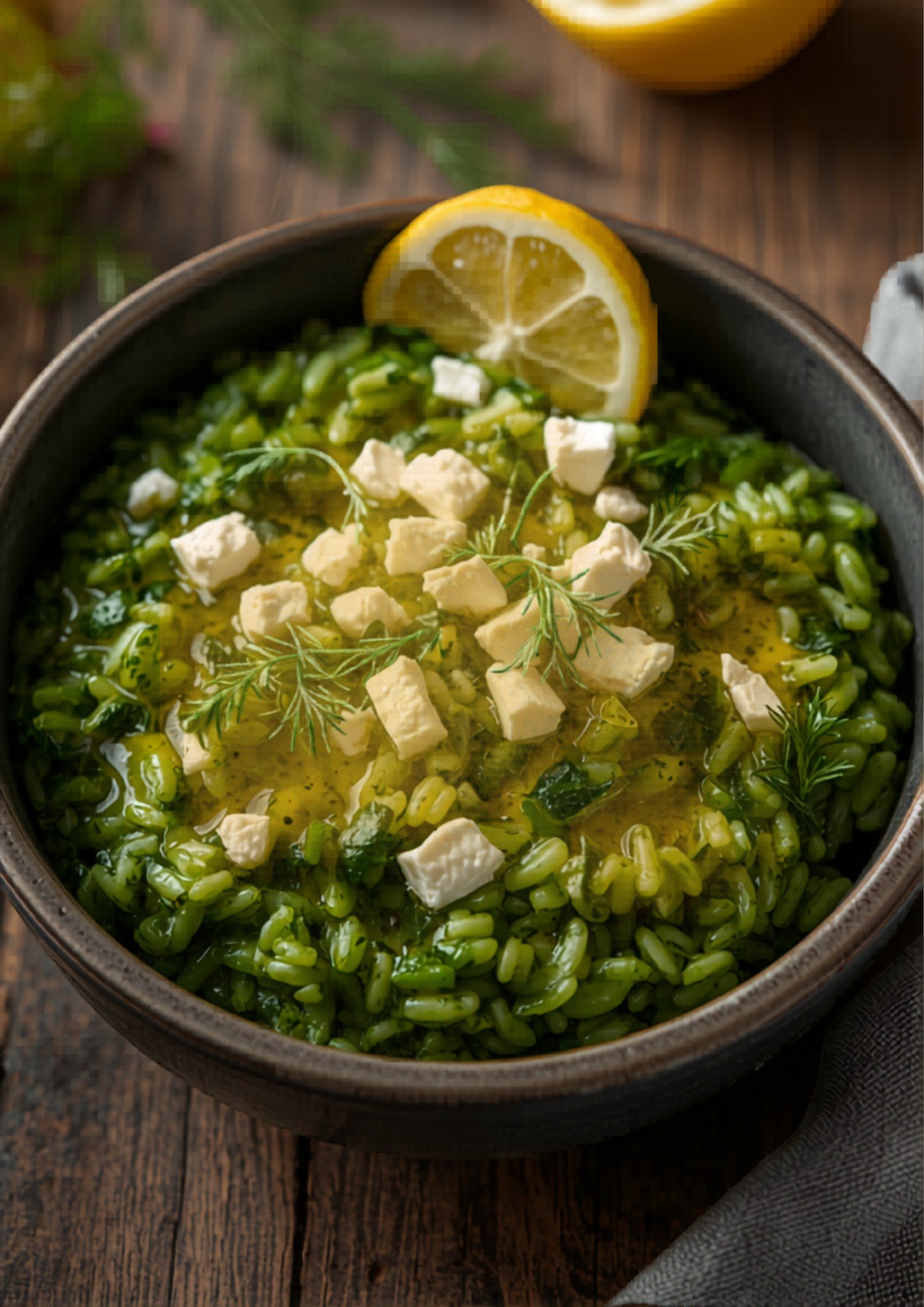
There is a category of Greek cooking that does not have a direct equivalent in other culinary traditions. Ladera — the olive-oil-braised vegetable dishes that form the backbone of the Greek home table — are not quite a side dish and not quite a main course. They are a meal in themselves, and spanakorizo is one of the finest examples.
Spanakorizo is spinach and rice cooked together with olive oil, onion, garlic, tomato, and a generous amount of fresh dill, finished with a squeeze of lemon. The dish is vegetarian by nature, not by compromise. No meat, no apology. It is filling, deeply flavored, and nutritionally complete.
My mother made spanakorizo on Kos two or three times a week in winter, when the spinach was right and the garden had given everything else it was going to give. It was not considered a lesser meal because there was no protein. It was considered a complete meal because the olive oil made it rich, the lemon made it bright, and the dill made it unmistakably Greek. We ate it with a block of feta on the table, torn bread, and nothing else.
I have made versions of this dish in professional kitchens from Kos to New York, and the core principle never changes: wilt the spinach properly, maintain the right rice-to-liquid ratio, add the dill at the end where its fragrance is preserved, and never skip the lemon before serving.
This is one of those recipes that improves with repetition. The first time you make it, you follow the steps. The tenth time, you do it by feel. Serve it alongside my Traditional Greek Village Salad (Horiatiki) for a light, complete Greek meal that does not require anything else.
Table of Contents
- What Is Spanakorizo?
- The Ladera Tradition
- Why Fresh Dill Matters
- Ingredients
- Step-by-Step Instructions
- Recipe Card
- How to Serve Spanakorizo
- Chef’s Notes
- FAQ
What Is Spanakorizo?
Spanakorizo combines the Greek words for spinach (spanaki) and rice (ryzi). It is a one-pot dish in which rice is cooked directly with the spinach and aromatics rather than prepared separately. The result is a unified dish where the rice absorbs all the flavor of the spinach, olive oil, tomato, dill, and lemon — not a bed of rice with spinach on top.
The dish appears in Greek home kitchens across the country and is especially common in the colder months when spinach is at its best. It is eaten as a main course with bread and feta, or served as a side dish alongside grilled fish, lamb, or meatballs. It is naturally vegan when served without cheese.
According to the Oldways Mediterranean Diet foundation, dishes like spanakorizo are central to the Mediterranean dietary pattern — vegetables cooked in olive oil as a primary meal, not a supporting role. That tradition is what makes Greek vegetable cooking distinctive from Italian or French approaches where vegetables more often play a supporting role to protein.
The Ladera Tradition
Ladera means “olive oil dishes” in Greek — a category of vegetable preparations where the cooking fat is the main source of richness and depth. No butter, no cream, no meat stock. The olive oil does the work.
This tradition reflects both the Mediterranean climate and the economics of historical Greek cooking. Olive oil was abundant. Meat was expensive. The ladera category developed as a way to create satisfying, flavorful meals from vegetables, legumes, and grains without relying on animal protein for depth.
What makes ladera dishes work is technique: the vegetables are cooked low and slow enough that they absorb the oil and become tender, concentrated, and sweet in a way that fast-cooked vegetables never achieve. Spanakorizo follows this model — the onion and garlic are sweated properly before anything else goes in, and the spinach is added in stages so it wilts into the rice rather than sitting on top of it.
The most important thing to understand about ladera cooking is that the olive oil is not a flavoring — it is a structural element. Do not reduce the quantity. Three tablespoons is the minimum for a four-serving dish, and finishing with an additional drizzle at the table is entirely appropriate.
Why Fresh Dill Matters
Dill is the defining herb of spanakorizo. It is what separates this dish from generic spinach rice. But timing matters: fresh dill should be added at the very end of cooking, not during the braise.
Dill is volatile. The aromatic compounds that give it its distinctive flavor are delicate — extended heat destroys them. If you add dill at the beginning of cooking, you will have a faint background note at best and nothing at worst. Added in the final minutes, or just before serving, the dill stays fragrant and fresh, cutting through the richness of the olive oil and complementing the lemon.
The same principle applies when using dried dill: it is a weaker substitute, and if you must use it, add a small amount during cooking and a larger amount at the end. Fresh is strongly preferred — there is no comparison.
Flat-leaf parsley can be used as a secondary herb alongside the dill for depth, but do not replace the dill entirely. This dish’s identity is dill and lemon.
Ingredients
- 3 tablespoons olive oil, plus more for drizzling at the table
- 1 large Spanish onion, peeled and small-diced
- 2 teaspoons garlic, minced
- 1 tablespoon tomato paste
- 1 can (14 oz) diced tomatoes
- 1 cup long-grain white rice
- 1 cup dry white wine
- 3 cups vegetable stock, hot
- 3 bunches fresh spinach (about 2 lbs), stems removed, roughly chopped, washed well
- ½ bunch fresh dill, finely sliced
- Salt and freshly ground pepper, to taste
- 1 lemon, for serving
- Feta cheese, crumbled, for serving
- Crusty bread alongside
Step-by-Step Instructions
Step 1: Prepare the base.
Heat the olive oil in a large, wide skillet or Dutch oven over medium heat. Add the diced onion and cook, stirring occasionally, until soft and translucent — about 8 minutes. Do not rush this step. The onion needs to fully soften and become sweet; if it browns, reduce the heat. Add the minced garlic and tomato paste. Stir and cook for 2 minutes until the tomato paste darkens slightly and the garlic is fragrant.
Step 2: Add rice and deglaze.
Add the rice to the pan and stir to coat it in the oil and onion mixture. Cook for 2 minutes, stirring, until the rice is slightly translucent at the edges. Pour in the white wine and scrape up any bits from the bottom of the pan. Let the wine bubble and reduce for about 1 minute.
Step 3: Add tomatoes and stock.
Add the diced tomatoes and the hot vegetable stock. Stir to combine. Bring to a simmer over medium heat.
Step 4: Wilt the spinach in stages.
Begin adding the spinach in large handfuls, pressing each addition down into the liquid as it wilts before adding the next. The spinach will seem like far too much at first — it is not. It will reduce dramatically as it wilts. Once all the spinach is incorporated, stir to mix it through the rice mixture.
Step 5: Simmer until rice is cooked.
Keep at a steady simmer, stirring occasionally and scraping the bottom of the pan to prevent sticking. Cook for approximately 10 to 12 minutes until the rice is tender and the liquid has reduced by about three-quarters. The finished dish should be moist but not soupy — spoonable, not pourable.
Step 6: Finish with dill and season.
Remove from heat. Add the sliced fresh dill and stir through. Taste and adjust salt and pepper. Cover the pan and let the dish rest for 5 minutes — the rice will finish absorbing the remaining liquid.
Step 7: Serve.
Uncover, stir, and serve. At the table: a squeeze of lemon over the top, a drizzle of olive oil, and crumbled feta. Crusty bread alongside.
Recipe Card

Classic Spanakorizo (Greek Spinach Rice)
Equipment
- (Help support our site!)Large Skillet
- Lettuce Washer
- (Help support our site!)Wooden Spoon
- (Help support our site!)Chefs Knife
Ingredients
- 1 whole Spanish Onion Peeled Small Dice
- 1 cup Rice
- 3 bunch Spinach Rinsed, Rough Chop
- 3 tbsp. Olive Oil
- 1 tbsp. Tomato Paste
- 14 ounce Tomato Diced
- 3 cup Vegetable Stock
- 1 cup White Wine
- ½ bunch Fresh Dill Finely Sliced
- 2 tsp Garlic Minced
- 1 To Taste Salt & Pepper
Instructions
- Gather ingredients and cut the stems of the fresh spinach. Throw out the spinach stems.

- Give a rough chop to the spinach and wash thoroughly.

- Place vegetable stock on stove and bring to boil.

- Place a large skillet on stove and add olive oil. Once your pan is heated add and sweat the onions.

- Add minced garlic and tomato paste and sweat down for about two minutes with onions.

- Add rice and incorporate into mixture. cook rice for two minutes.

- Once all together deglaze pan with white wine. Mix with wooden spoon scraping bottom of pan.

- Begin adding hands full of spinach at a time and incorporate into rice mixture.

- Once all spinach is incorporated add the hot vegetable stock and stir.

- The spinach will welt into liquid rice mixture. Keep stirring scraping the bottom of pan till liquid begins to boil.

- Bring to a simmer and stir occasionally till all spinach has mixed in. Begin finely slicing the dill.

- Once mixture has cooked down for about ten minutes, add salt, pepper and dill.

- Mix and scrap bottom of pan to ensure rice isn't sticking. Once the liquid has incorporated into mixture and reduced by ¾ shut off stove and cover.

- After about ten minutes uncover and stir. The rice should have absorbed most of the liquid. Check seasoning and serve. Once plated feel free to add some Reggiano cheese or crumbled feta cheese.

Notes
Nutrition
How to Serve Spanakorizo
As I noted above, spanakorizo is a complete meal in the Greek tradition — not a side dish that needs a main course. Here is how to serve it properly:
As a main course: Serve in deep bowls with crumbled feta over the top, a generous squeeze of lemon, and a drizzle of good olive oil. Crusty bread for the bowl. Nothing else is required.
As part of a Greek meal: Spanakorizo alongside my Classic Greek Moussaka is a meal that covers every flavor register — the rich, layered moussaka alongside the bright, simple rice dish works as a contrast. Or serve it as the green component of a meze table with Tirokafteri (Spicy Feta Spread) and pita.
For a light summer meal: Spanakorizo at room temperature with extra lemon and a simple salad is excellent in warm weather. It is one of those dishes that is good hot, warm, and room temperature — never cold from the refrigerator.
Chef’s Notes
Which rice to use: Long-grain white rice works best here. Arborio or risotto rice will turn the dish too starchy and creamy — that is not what spanakorizo should be. Short-grain rice can work but requires attention to the liquid ratio. Long-grain gives the right separate, tender texture.
Fresh vs. frozen spinach: Fresh is strongly preferred. Frozen spinach releases too much water and makes the rice mushy. If you must use frozen, thaw completely and squeeze out as much liquid as possible before adding.
Olive oil quantity: The three tablespoons in the recipe is a minimum. Traditional ladera cooking uses more — the olive oil is part of the flavor, not just a cooking medium. A finish of raw olive oil at the table adds freshness and richness.
Leftovers: Spanakorizo keeps refrigerated for up to 3 days. The rice will absorb any remaining liquid and the texture will tighten. Reheat on the stovetop with a small splash of water or vegetable stock. Add fresh dill and a squeeze of lemon when reheating if the flavor has faded.
Scaling: This recipe scales easily. For a larger batch, keep the ratios consistent: 1 cup rice per 3 cups liquid. The spinach can be generous — it reduces significantly.
FAQ
What does spanakorizo mean in Greek?
Spanakorizo is a compound word from spanaki (spinach) and ryzi (rice). It literally means spinach-rice. The name is descriptive and accurate — this is a dish defined by two ingredients.
Is spanakorizo the same as spanakopita?
No. Spanakopita is the phyllo pastry pie filled with spinach and feta. Spanakorizo is a rice dish cooked in one pot. They share spinach as a primary ingredient but are entirely different preparations. Spanakorizo has no pastry, no egg, and no baked component.
Can you make spanakorizo without tomatoes?
Yes. Some versions, particularly those from the islands, omit the tomato entirely and rely only on olive oil, onion, dill, lemon, and stock for flavor. The result is a paler, more delicately flavored dish. The tomato version is more common on the mainland and has more body and color.
Is spanakorizo vegan?
The dish itself is naturally vegan — no animal products in the recipe. The feta served on top is optional. For a fully vegan meal, simply serve without the feta or use a vegan cheese alternative.
How do you stop the rice from sticking in spanakorizo?
Stir the dish regularly while it simmers, especially in the final 5 to 7 minutes, and scrape the bottom of the pan each time. If it begins to stick, add a small splash of water or stock. A heavy-bottomed pan helps significantly — thin pans create hot spots that cause sticking.