
There is a particular kind of dip that stops a meze table cold — the kind where everyone reaches twice before the pita is even warm. Htipiti is that dip.
I first encountered htipiti not on Kos, where I grew up, but years later during a long winter I spent cooking in Thessaloniki. A friend’s mother made it for us one Sunday afternoon — charred peppers, crumbled feta, a thread of olive oil, and just enough dried chili to make you reach for another piece of bread before you had swallowed the first. She called it “htipiti” and told me the name comes from the verb htipo — to beat, to whip. She demonstrated: no food processor, just a fork and her wrist, working the ingredients together until the mixture was rough and spoonable but not smooth. “Smooth is for baby food,” she said.
I have been making htipiti — this Greek roasted red pepper and feta dip — ever since. Over the years I have refined the method, tested the pepper-to-feta ratio, and learned exactly how long to char the peppers before the flesh turns silky without tasting like ash. The version I am sharing here is what I now serve at the start of every dinner party: simple enough to prepare the day before, assertive enough to hold its own on a table crowded with tzatziki and melitzanosalata, and honest enough that the quality of two ingredients — the peppers and the feta — is everything.
If you have never made htipiti before, you are about to understand why the Greeks could eat roasted red peppers every single day of their lives.
Table of Contents
Why This Recipe Works
- Charring is the flavor. The blackening of the pepper skin is not incidental — it creates the smoky sweetness that makes htipiti taste completely different from a pepper that has only been roasted. Direct flame or a high broiler gets you there. A gentle oven roast does not.
- The texture should be rough, not smooth. “Htipiti” means beaten, not blended. Working the ingredients together with a fork preserves irregular texture — some chunks of pepper, some crumbles of feta — that a food processor would destroy. The mouthfeel is part of the dish.
- Block feta in brine, always. Pre-crumbled feta is drier and blander than block feta stored in its brine. For a dip where feta is half the character, this is not negotiable. Greek feta carries a Protected Designation of Origin and must be made in specific regions of Greece from sheep’s and goat’s milk — that salinity and tang is what balances the pepper sweetness.
- Chili is a whisper, not a shout. A pinch of dried chili flakes adds warmth that rounds out the sweetness. Too much and you lose the pepper. Too little and the dip tastes flat. Start with less; you can always add.
Ingredients
For the Htipiti
- 4 large red bell peppers (about 1 kg / 2.2 lbs)
- 200g (7 oz) Greek feta cheese, block in brine, drained
- 3 tablespoons extra-virgin olive oil, plus more to finish
- 1/2 teaspoon dried chili flakes (Aleppo pepper or standard red chili)
- 1 small clove garlic, optional (see Chef’s Notes)
- 1 tablespoon red wine vinegar
- Salt and freshly ground black pepper, to taste
To Serve
- Warm pita bread or village bread (horiatiko psomi)
- Extra olive oil for drizzling
- A few crumbles of feta and fresh thyme or oregano
Step-by-Step Instructions
Step 1: Char the Peppers
If you have a gas stove: place each pepper directly on the burner grate over a high flame. Rotate with tongs every 2-3 minutes until the skin is blackened and blistered on all sides — about 10-15 minutes total. The pepper will soften and begin to collapse. This is correct.
If you are using a broiler: place the peppers on a foil-lined baking sheet under a very hot broiler (as close to the element as your oven allows). Turn every 5 minutes until charred on all sides, about 20 minutes total.
Chef tip: Do not fear the black. Many recipes say “roast until slightly charred” — ignore this advice for htipiti. You want the skin completely blackened. That is where the smokiness lives.
Step 2: Steam and Peel
Transfer the charred peppers to a bowl and cover tightly with plastic wrap, or place them in a zip-lock bag and seal. Leave for 15-20 minutes. The steam will loosen the skin.
Once cool enough to handle, peel off and discard the blackened skin. Do not rinse the peppers under water — you will wash away the smoky flavor. Work over a bowl to catch the juices; those juices go into the dip.
Remove and discard the seeds and core. Tear the flesh into rough strips.
Chef tip: A few dark bits of skin left on the pepper are fine — they add flavor and character.
Step 3: Beat the Dip
Place the pepper strips and any collected juices in a medium bowl. Add the drained feta in large crumbles.
Drizzle over the olive oil and add the chili flakes, the garlic (if using, grated or pressed), and the red wine vinegar.
Using a fork, work the mixture together with a pressing and folding motion. You are not mashing — you are integrating. The goal is a rough, spoonable mixture with visible texture, not a smooth paste. Stop when the ingredients are fully combined but still have character.
Taste and adjust: more chili, more vinegar, more salt. The feta brings considerable salt on its own, so taste before you add.
Chef tip: If you want a slightly smoother texture for spreading, use a hand blender with two or three short pulses. But keep it rustic.
Step 4: Rest and Finish
Cover the bowl and refrigerate for at least 30 minutes before serving — this allows the flavors to settle and the dip to firm up slightly.
To serve: transfer to a serving bowl, make a shallow well in the center with the back of a spoon, drizzle generously with olive oil, scatter over a few crumbles of feta and fresh thyme leaves. Serve with warm pita or thick slices of crusty bread.
Recipe Card
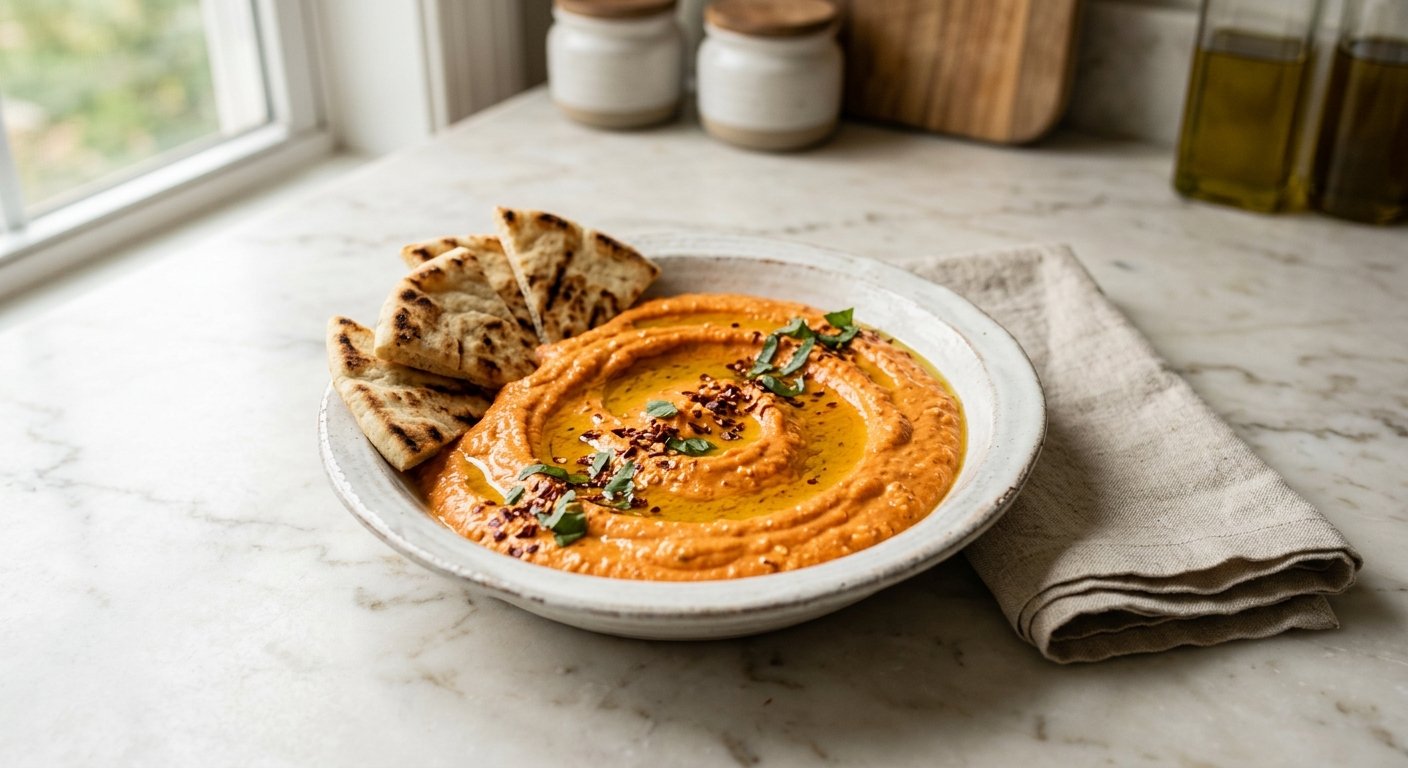
Classic Htipiti (Greek Roasted Red Pepper and Feta Dip)
Ingredients
For the Htipiti
- 4 large red bell peppers about 1 kg / 2.2 lbs
- 200 g Greek feta cheese block in brine, drained
- 3 tablespoons extra-virgin olive oil plus more to finish
- 1/2 teaspoon dried chili flakes
- 1 small clove garlic optional, grated
- 1 tablespoon red wine vinegar
- salt and freshly ground black pepper to taste
To Serve
- warm pita bread or village bread
- extra olive oil for drizzling
- crumbled feta and fresh thyme or oregano
Instructions
- Place whole peppers directly over a gas flame or under a very hot broiler. Turn every 2–3 minutes (gas) or 5 minutes (broiler) until the skin is completely blackened on all sides, 10–20 minutes.
- Transfer charred peppers to a covered bowl or sealed bag. Steam 15–20 minutes. Peel off all blackened skin without rinsing. Remove seeds and core; tear flesh into rough strips. Reserve the juices.
- In a bowl, combine pepper strips and their juices, crumbled feta, olive oil, chili flakes, garlic (if using), and red wine vinegar.
- Use a fork to work the mixture into a rough, textured dip. Do not overwork — some chunks are the point. Taste and adjust seasoning.
- Cover and refrigerate at least 30 minutes.
- Transfer to a serving bowl, drizzle with olive oil, top with crumbled feta and thyme. Serve with warm pita.
Notes
Nutrition
Chef’s Notes
On garlic: Traditional htipiti does not always include garlic — the pepper and feta are the stars, and garlic can overpower both. I use a very small amount, grated fine, when I want a little more depth. Leave it out entirely for a cleaner, sweeter dip.
Can you use jarred peppers? Yes, and I will not judge you for it on a weeknight. Drain them thoroughly and pat dry, then proceed with the recipe from Step 3. You will lose some of the smokiness, but the dip is still very good. If you want to add smoke back in, a pinch of smoked paprika helps.
Pairing with other meze: Htipiti belongs on a full meze spread. Serve it alongside my Melitzanosalata (Greek Eggplant Dip) and Tzatziki — the contrast of smoky-sharp htipiti against the cool yogurt of tzatziki and the earthy softness of melitzanosalata is the whole point of a Greek meze table. For a complete spread, add a Horiatiki (Greek Village Salad) on the side and let people eat the way Greeks actually eat: slowly, with bread, with wine, without hurrying.
Storage: Covered in the refrigerator, htipiti keeps well for 4 days. The flavor actually improves overnight as the pepper, feta, and olive oil settle together. I often make it the day before a gathering. Before serving, bring to room temperature for 20-30 minutes and stir briefly.
Variations
- Add sun-dried tomatoes: 2-3 oil-packed sun-dried tomatoes beaten in add a deeper savory note.
- More heat: Swap standard chili flakes for Turkish red pepper paste for a more complex heat.
- Creamier version: A tablespoon of Greek yogurt beaten in loosens the texture and softens the sharpness — good if you find straight feta a little intense.
FAQ
What is htipiti?
Htipiti is a Greek dip made by beating together roasted red peppers and feta cheese with olive oil and chili. The name comes from the Greek verb htipo, meaning to beat or whip. It is a specialty of Northern Greece, particularly Thessaloniki, though it is now enjoyed across the country. The texture is deliberately rough and rustic — not smooth — which is what distinguishes it from many other pepper-based dips.
How do I roast the peppers for htipiti?
The best method is direct-flame charring over a gas burner, which creates a deep smokiness that oven-roasting cannot fully replicate. Place the whole pepper on the grate over a high flame and turn until completely blackened on all sides. If you do not have a gas stove, a very hot broiler placed as close to the element as possible achieves a similar result. After charring, steam the peppers in a covered bowl for 15-20 minutes before peeling.
Can I use jarred roasted red peppers?
Yes. Drain and dry them thoroughly, then proceed from Step 3. The flavor will be milder and less smoky than flame-charred peppers, but the dip is still very good. A pinch of smoked paprika added with the chili flakes can help compensate for the lost smokiness.
How long does htipiti keep?
Covered in the refrigerator, htipiti keeps for up to 4 days. The flavor deepens overnight, so making it a day ahead is recommended. Remove from the refrigerator 20-30 minutes before serving and stir briefly. Do not freeze — the texture of the feta deteriorates.
What do you serve with htipiti?
Warm pita bread is the classic accompaniment, but thick slices of village bread (horiatiko psomi) work just as well. Htipiti is typically served as part of a Greek meze spread alongside other dips and salads. Crudites — cucumber, carrot, radish — are a lighter alternative if you want to skip the bread. A glass of chilled ouzo or dry white wine alongside is strongly encouraged.