
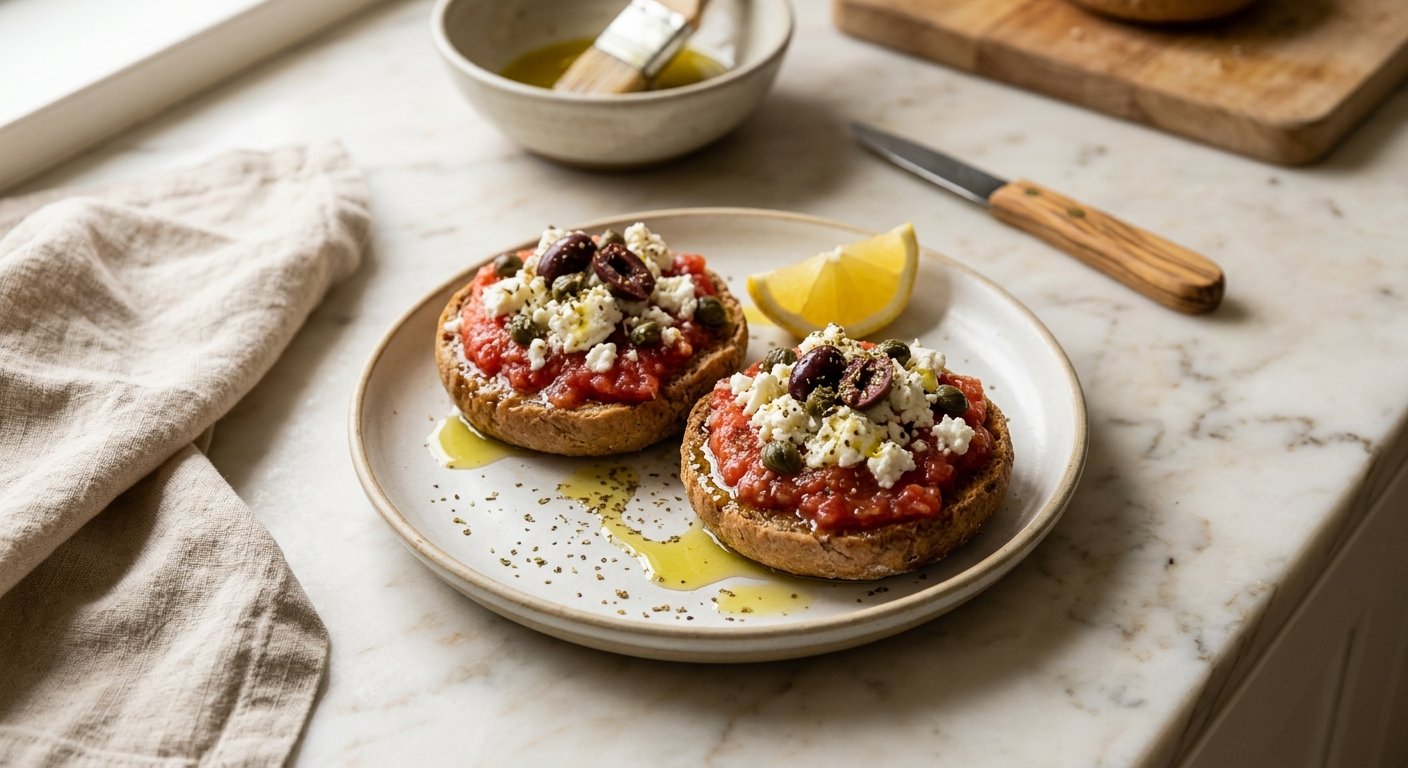
There is a kafeneio in Heraklion where I sat once on a Tuesday morning with nothing but an espresso and time. The owner placed a plate in front of me without asking — a single dakos, the barley rusk gleaming under a cascade of grated tomato, a rough handful of soft white cheese, a thread of dried oregano, and olive oil poured without hesitation or measure. I did not order it. She simply knew.
I grew up on Kos, in the Dodecanese, where the pantry philosophy is the same even if the names differ. We built meals around what the garden and the sea offered that morning. The dakos recipe is the Cretan expression of that same idea — and it may be the purest. There is no heat involved, no technique to master. The only craft is sourcing: a proper Cretan barley rusk (paximadi), a ripe summer tomato worth grating, good crumbled mizithra or feta, dried mountain oregano, and an olive oil you would drink straight from the tin if your table manners allowed.
People sometimes call dakos the Greek bruschetta, and while I understand why, it sells the dish short. Bruschetta is bread that needs to become something else. Dakos starts as something already complete — the twice-baked barley rusk has its own depth — and the toppings simply extend it. The result is filling, beautiful, and ready in ten minutes. It belongs at every table from late June through September, when tomatoes are worth grating.
This post walks through every element of the dakos recipe: the right rusk, why grating the tomato matters, how to apply the olive oil in two stages, and what to do when perfect Cretan paximadia are not available.
Why This Recipe Works
- The rusk does the work. A genuine Cretan barley paximadi has a density and grain depth that absorbs tomato liquid without disintegrating. Standard wheat rusks or grocery-store rounds collapse or turn gluey.
- Grate the tomato, do not chop it. Grating a halved tomato against a box grater produces a concentrated pulp with almost no skin. It soaks into the rusk evenly and carries more sweetness than diced tomato.
- Olive oil goes on twice. The first pour, before the tomato, creates a barrier that controls how quickly the tomato liquid penetrates. The second pour is for flavor and shine.
- Dried oregano, not fresh. On this dish, dried Greek mountain oregano — rubbed between the palms before scattering — releases more fragrance than fresh and holds its presence through the olive oil.
Ingredients
For the Dakos (Serves 4)
- 8 Cretan barley rusks (paximadia) — approximately 50–60g each
- 4 large very ripe tomatoes (about 700g total)
- 200g feta cheese or soft mizithra, crumbled
- 6 tablespoons extra virgin Greek olive oil, divided
- 1 teaspoon dried Greek mountain oregano
- Flaky sea salt, to finish
Optional Garnish
- A few black olives (Kalamata or Cretan variety)
Step-by-Step Instructions
1. Source your rusks. If you can find Cretan barley paximadia at a Greek deli or import shop, buy them. Do not use standard croutons or melba toast — the density and flavour are not comparable.
2. First pour of olive oil. Place the rusks on your serving plates or a wide platter. Drizzle approximately half the olive oil (3 tablespoons) evenly over the rough upper surface of each rusk. Let it soak for two to three minutes while you prepare the tomatoes. This step matters — it creates the moisture barrier that keeps the rusk from becoming heavy.
3. Grate the tomatoes. Halve each tomato across its equator. Hold one half cut-side down against the large holes of a box grater, set over a wide bowl. Grate firmly in circular strokes until only the skin remains in your hand. Discard the skin. The result should be a thick, bright pulp.
4. Spoon the tomato over the rusks. Distribute the tomato pulp evenly over the rusks, allowing it to run to the edges. Do not drown them — a generous but contained layer is the goal.
5. Add the cheese. Crumble the feta or mizithra generously over the tomato layer. Feta gives a saltier, firmer bite. Mizithra — soft, fresh Cretan sheep’s milk cheese — is traditional and milder. Do not be restrained here.
6. Season and finish. Scatter the dried oregano over each dakos, rubbing it lightly between your palms as you do. Add a small pinch of flaky salt. Finish with the remaining 3 tablespoons of olive oil, poured in a slow thread across each piece.
7. Serve immediately. Dakos should be eaten as soon as assembled. It is not a dish that improves with time. If your guests are not at the table, call them now.
Authentic Dakos Recipe (Cretan Barley Rusk with Tomato and Feta)
Ingredients
For the Dakos
- 8 Cretan barley rusks (paximadia) approximately 50-60g each
- 4 large very ripe tomatoes about 700g total
- 200 g feta cheese or soft mizithra crumbled
- 6 tablespoons extra virgin Greek olive oil divided
- 1 teaspoon dried Greek mountain oregano
- flaky sea salt to finish
Optional Garnish
- black olives Kalamata or Cretan variety
Instructions
- Arrange the rusks on a serving platter or individual plates.
- Drizzle 3 tablespoons of olive oil evenly over the rough upper surface of each rusk. Let rest 2-3 minutes while you prepare the tomatoes.
- Halve each tomato across its equator. Hold one half cut-side down against the large holes of a box grater over a wide bowl. Grate firmly in circular strokes until only the skin remains in your hand. Discard the skins.
- Spoon the tomato pulp generously over the oiled rusks, allowing it to run to the edges.
- Crumble the feta or mizithra generously over the tomato layer.
- Rub dried oregano lightly between your palms and scatter over each dakos. Add a pinch of flaky salt.
- Finish with the remaining 3 tablespoons of olive oil, poured in a slow thread across each piece.
- Serve immediately – dakos does not improve with time.
Notes
Nutrition
Chef’s Notes
On sourcing paximadia: Cretan barley rusks are stocked at most Greek specialty food shops and can be ordered online. In the United States, they sometimes appear under the brand Misko or in packages labeled simply “barley rusks.” If you cannot find them, whole-grain sourdough bread, sliced thick and toasted at 160°C for 25 minutes, gives a reasonable facsimile.
Feta versus mizithra: Mizithra is the traditionally correct choice — a soft, unsalted or lightly salted fresh sheep’s milk cheese from Crete. Outside Greece, use good-quality Greek feta packed in brine, not the pre-crumbled variety in plastic tubs.
Make-ahead: Assemble immediately before serving. If you need to prep ahead, grate the tomatoes and crumble the cheese up to a few hours in advance. Apply the first olive oil pour to the rusks, then assemble at the last moment.
Dakos as part of a mezedes spread: This pairs naturally alongside my Greek salad (horiatiki) and melitzanosalata (eggplant dip) for a complete summer meze table. Add a bowl of my tzatziki and some good olives and you have a full meal without any cooking at all.
FAQ
What does dakos mean?
Dakos is the Cretan name for this dish. It derives from the word for the barley rusk itself — the paximadi — and by extension refers to the assembled meze. In other parts of Greece you may see it called koukouvayia or simply “barley rusk salad,” but in Crete, dakos is the only name that matters.
Where can I buy paximadia (Cretan barley rusks)?
Greek specialty food shops carry them, as do many Mediterranean grocery stores. Online retailers that stock Greek imports — including Amazon and specialty Greek food sites — often carry Cretan paximadia. They are shelf-stable and will last months in a sealed package.
Can I use feta instead of mizithra in dakos?
Yes — and outside of Crete, feta is the standard substitute. According to the European Commission’s PDO registry, feta is a protected designation of origin cheese from Greece; use Greek feta packed in brine for the best result.
Is dakos gluten-free?
Traditional Cretan dakos is made with barley paximadia, which contain gluten. Barley is not gluten-free. If you need a gluten-free version, use certified gluten-free rye crispbread or a thick rice cake as the base.
Can I make dakos ahead of time?
Dakos is best assembled immediately before eating. The rusk begins absorbing liquid from the tomato within minutes of assembly. Prep your components in advance and assemble at the table.