
Every summer on Kos, my mother would come home from the market with a paper bag of fresh okra — the small, ridged pods that arrive in late July when the sun has been at its fiercest. We ate a lot of ladera in that kitchen: green beans in tomato, stuffed tomatoes, roasted vegetables. But bamies was always the one that divided the table.
My yiayia would eat it without a word, mopping up the orange-tinged olive oil with torn bread. My sister would push the pods around her plate. And I would watch my mother work — trimming the tops with a paring knife, covering them with white wine vinegar, carrying the tray out to the balcony to sit in the sun. I didn’t understand it as technique then. I just thought it was one of her rituals.
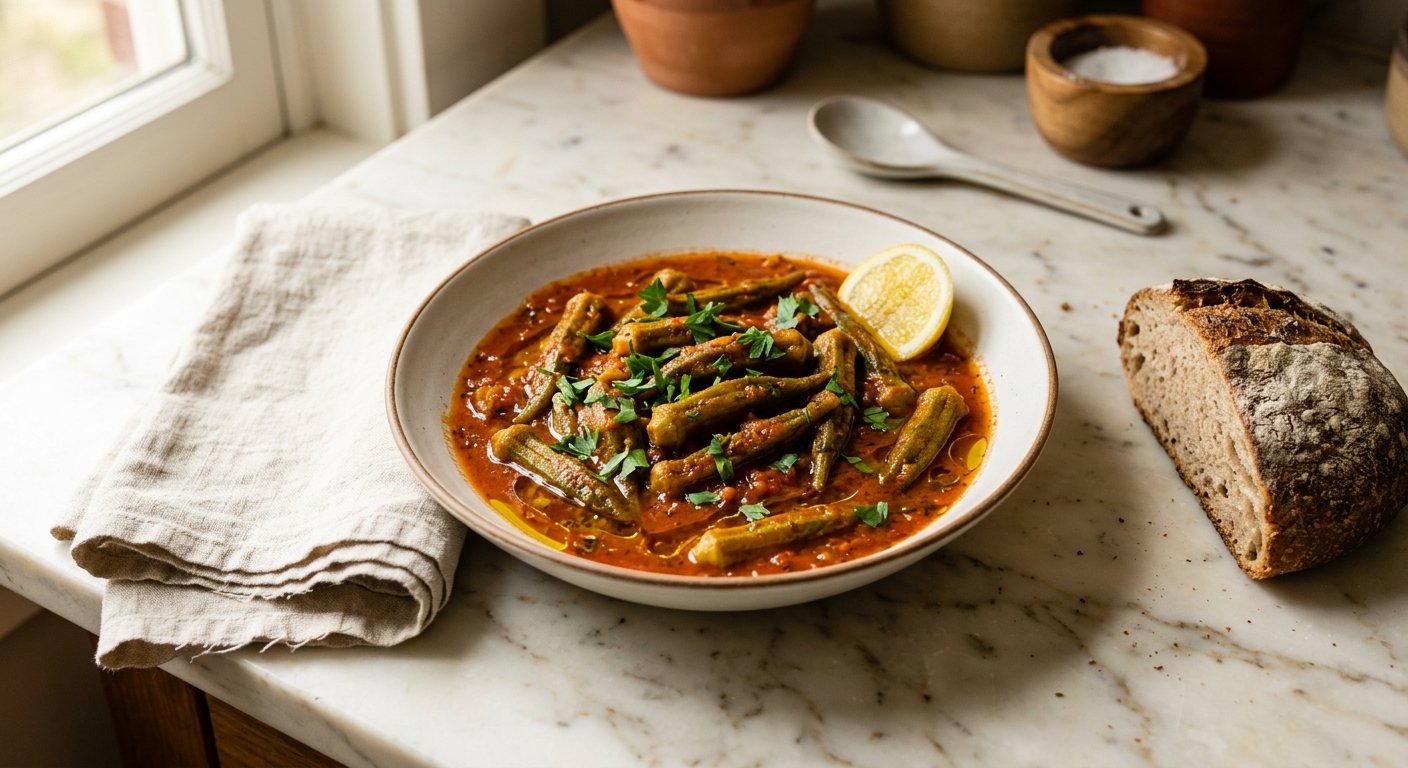
It was technique. That vinegar soak is the reason bamies — Greek okra stew — works. It draws out the mucilaginous compounds before the okra ever meets the heat. What you get on the other side is a tender, distinct pod that holds its shape in a rich, herb-scented tomato sauce, with absolutely no trace of slime.
This is one of the most misunderstood vegetables in Greek cooking. It is also one of the most rewarding when you understand how to treat it. This post explains the full process: the vinegar soak, the no-stir rule, and the long, gentle simmer that makes all the difference.
Bamies (Greek okra stew) is a traditional ladera dish — vegetables cooked low and slow in olive oil and tomato — and it belongs in your summer rotation.
Table of Contents
Why This Recipe Works
- The vinegar soak eliminates sliminess before it starts. Coating trimmed okra in white wine vinegar — either in the sun for 30 minutes or indoors for a full hour — pulls moisture and draws out the mucilage before the heat activates it. This single step is the reason most people fail with okra, and most recipes skip it.
- The no-stir rule preserves the pods. Once the okra goes into the tomato sauce, you do not stir. Movement breaks the pods open, which releases the sticky interior compounds. A gentle shake of the pan is all you need.
- Low, steady heat keeps the sauce from scorching. This is a ladera dish — it wants patience, not urgency. A moderate simmer over medium-low heat lets the tomato reduce slowly, concentrating flavor without burning at the bottom.
- Fresh tomatoes in season are worth it. Ripe summer tomatoes grated on a box grater give a sauce with brightness and body that canned tomatoes cannot replicate. Outside of peak season, good-quality whole canned tomatoes are a completely acceptable alternative.
Ingredients
For the Bamies
- 700g (1-1/2 lbs) fresh okra, small to medium pods preferred
- 4 tablespoons white wine vinegar
For the Sauce
- 4 tablespoons extra-virgin olive oil, divided, plus more for finishing
- 1 medium yellow onion, finely diced
- 4 garlic cloves, thinly sliced
- 500g (about 3-4 medium) ripe summer tomatoes, grated — or one 400g can whole peeled tomatoes, crushed by hand
- 1 teaspoon dried oregano
- 1/2 teaspoon sweet paprika (optional)
- 1 teaspoon sea salt, or to taste
- Freshly ground black pepper
- Small handful of fresh flat-leaf parsley, roughly chopped, for serving
Step-by-Step Instructions
Step 1: Trim and Soak the Okra
Rinse the okra pods and pat dry. Trim a thin sliver off the stem end, taking care not to cut into the pod itself — puncturing the pod releases more of the sticky interior. Arrange the trimmed okra in a single layer on a tray or baking sheet. Pour the white wine vinegar over the pods and toss gently to coat. Leave in a sunny spot outdoors for 30 minutes, or at room temperature indoors for 1 hour. After soaking, rinse the okra under cold running water and pat thoroughly dry.
Step 2: Build the Sauce Base
Warm 3 tablespoons of the olive oil in a wide, heavy-bottomed pan or saute pan over medium heat. Add the onion and cook gently, stirring occasionally, until soft and translucent — about 8 minutes. Add the garlic and cook for 1 minute more, until fragrant. Do not let the garlic color.
Step 3: Add the Tomatoes and Seasonings
Pour in the grated or crushed tomatoes. Add the oregano, paprika if using, salt, and several grinds of black pepper. Stir to combine and let the sauce simmer for 5 minutes, until it begins to reduce slightly and the raw tomato smell has cooked off.
Step 4: Add the Okra — Then Do Not Touch It
Nestle the okra pods into the tomato sauce in a single layer, stem ends up if possible. Drizzle the remaining tablespoon of olive oil over the top. Reduce the heat to medium-low. Cover with a lid slightly ajar and cook for 35-40 minutes. Do not stir. If the sauce seems to be reducing too quickly, lower the heat further and add 2 tablespoons of water. A gentle shake of the pan is fine if needed.
Step 5: Check for Doneness and Serve
The okra is ready when the pods are tender throughout — a paring knife should meet no resistance — and the sauce has thickened to a glossy consistency. Taste and adjust salt. Scatter fresh parsley over the top and finish with a thread of extra-virgin olive oil. Serve warm or at room temperature, with crusty bread to mop up the sauce.
Recipe Card
Bamies (Greek Okra Stew)
Ingredients
For the Okra
- 700 g fresh okra 1-1/2 lbs, small to medium pods preferred
- 4 tablespoons white wine vinegar
For the Sauce
- 4 tablespoons extra-virgin olive oil divided, plus more for finishing
- 1 medium yellow onion finely diced
- 4 clove garlic thinly sliced
- 500 g ripe summer tomatoes grated, or one 400g can whole peeled tomatoes crushed by hand
- 1 teaspoon dried oregano
- 1/2 teaspoon sweet paprika optional
- 1 teaspoon sea salt or to taste
- freshly ground black pepper
- fresh flat-leaf parsley small handful, roughly chopped, for serving
Instructions
- Rinse okra and pat dry. Trim a thin sliver from each stem end, being careful not to puncture the pod. Arrange on a tray in a single layer. Pour white wine vinegar over the okra and toss gently to coat. Leave in the sun for 30 minutes or at room temperature for 1 hour. Rinse under cold water and pat thoroughly dry.
- Heat 3 tablespoons olive oil in a wide, heavy-bottomed pan over medium heat. Add the onion and cook, stirring occasionally, until soft and translucent, about 8 minutes. Add the garlic and cook 1 minute until fragrant.
- Add the tomatoes, oregano, paprika (if using), salt, and pepper. Stir and simmer for 5 minutes until the sauce reduces slightly.
- Arrange the okra in the sauce in a single layer, stem ends up. Drizzle remaining 1 tablespoon of olive oil over the top. Reduce heat to medium-low. Cover with lid slightly ajar and cook 35-40 minutes without stirring. Shake the pan gently if needed. Add 2 tablespoons of water if the sauce reduces too quickly.
- When the okra is completely tender and the sauce is thick and glossy, remove from heat. Taste and adjust salt. Scatter fresh parsley over the top and finish with a drizzle of olive oil. Serve warm or at room temperature with crusty bread.
Notes
Nutrition
Chef’s Notes
On okra size: Smaller pods (5-8 cm) are more tender and cook more evenly. If you can find them, choose these. Larger pods can work but may need a few extra minutes.
On fresh vs. frozen okra: Fresh okra in season is the clear choice. Frozen okra can work — thaw it completely, pat it very dry, and do not skip the vinegar step. The texture will be softer, but the flavor holds up.
On canned tomatoes: Outside summer, a 400g can of whole peeled San Marzano tomatoes, crushed by hand, is what I use. Skip the paprika and let the tomato speak.
On olive oil: Ladera dishes are not shy with olive oil. It is not a garnish here — it is part of the sauce. Use an oil you would want to eat with bread.
Storage: Bamies keeps well in the refrigerator for up to 3 days. The flavor deepens overnight. Reheat gently on the stovetop with a splash of water. It is also very good cold the next day, eaten straight from the container with bread.
The ladera tradition: Bamies belongs to the same family of dishes as Fasolakia (Greek Green Beans) and Briami (Greek Roasted Vegetables) — all of them slow-cooked in olive oil, all of them best eaten at room temperature, all of them tied to the rhythms of a Greek summer. If you love this category of cooking, Gigantes Plaki — giant baked beans in tomato sauce — follows the same logic and is just as satisfying.
According to the USDA FoodData Central database, okra is a meaningful source of dietary fiber, vitamin C, and folate — one more reason ladera cooking has sustained Mediterranean families for generations.
FAQ
How do I make okra not slimy?
The vinegar soak is the most reliable technique. Coat trimmed okra in white wine vinegar and let it rest for at least 30 minutes in the sun or 1 hour at room temperature, then rinse and pat dry before cooking. The second critical step is not stirring once the okra is in the pan — movement breaks the pods and releases sticky compounds into the sauce.
What is bamies?
Bamies is the Greek word for okra, and also the name of the classic ladera dish made by simmering okra in olive oil and tomato sauce. It is a staple of Greek summer cooking, found in homes and tavernas across the country. The dish is vegan, gluten-free, and typically served at room temperature alongside bread.
Can I use frozen okra for bamies?
Yes, with adjustments. Thaw the okra completely, drain it well, and pat it very dry before the vinegar soak. Frozen okra will be softer than fresh and the pods may not hold their shape as neatly, but the flavor of the finished dish is still very good. Avoid using okra that has been pre-cut — whole pods hold up much better.
Is bamies vegan?
Yes. The dish contains only vegetables, olive oil, and tomato — no meat, dairy, or eggs. It is also naturally gluten-free. This makes it a useful dish for tables with mixed dietary needs.
What do you serve with bamies?
Bread is the essential accompaniment — the tomato-olive oil sauce demands something to mop it up. Beyond that, bamies is served in Greek homes as a main dish alongside feta, olives, and salad. It also works as a side to grilled fish or meat, or as part of a meze spread. A glass of chilled white wine from the Aegean islands is, in my view, not optional.