
There is a particular heat on Kos in July that slows everything down to a pleasant crawl. The harbor shimmers, the boats barely move, and by midday the only sensible thing to do is find shade and eat something cold and sweet. Growing up on that island, summer meant watermelon — whole halves eaten with a spoon at the kitchen table, or thick wedges passed around after lunch until the juice ran down your arms. It was my mother who first placed slices of our creamy, salty barrel feta across a platter of deep-red karpouzi one hot afternoon, and scattered a handful of torn spearmint over the top. I must have been eight or nine years old. I remember thinking it was the best thing I had ever tasted.
That combination — Greek watermelon feta salad, or karpouzi me feta as we have always called it — has never left me. It is not a formal dish with a fixed recipe. You will not find it written up in most cookbooks. But across the Aegean islands, from Kos to Naxos to Paros, you will find it on almost every summer table. It is the kind of recipe that lives between people rather than on paper: a block of good feta, a ripe melon, some mint, a drizzle of olive oil. That is essentially all you need.
This Greek watermelon feta salad is ready in ten minutes and requires no cooking. It is built entirely on the quality and contrast of its three main ingredients. If you choose them well — an ice-cold watermelon at the peak of ripeness, a proper block of Greek PDO feta, and fresh spearmint — the result is something that tastes like a Greek summer. Let me show you how to make karpouzi me feta exactly the way I learned it growing up on Kos.
Table of Contents
- What Is Karpouzi me Feta?
- Why This Greek Watermelon Feta Salad Works
- Ingredients
- How to Make Karpouzi me Feta — Step by Step
- Recipe Card
- Chef’s Notes
- FAQ
What Is Karpouzi me Feta?
Karpouzi (καρπούζι) is the Greek word for watermelon, and feta — Greece’s most famous and fiercely protected cheese — needs little introduction. Together, karpouzi me feta is one of the most beloved combinations in Greek summer eating. It is technically a salad, though the word barely captures what it is: a platter of cold, sweet fruit balanced against the assertive saltiness of aged sheep’s milk cheese, tied together with fresh mint and, when you want it, a drizzle of extra virgin olive oil.
This Greek watermelon feta salad does not belong to any particular chef or region. It belongs to the culture of Greek summers. In Greece, watermelon season runs from roughly June through September. During those months, pyramids of karpouzi appear outside every produce shop, on farm trucks parked at the roadside, and at waterfront tavernas that open only when the weather turns warm. The two ingredients are everywhere at the same time, and Greeks have been pairing them for as long as anyone can remember.
The pairing works because of contrast. Watermelon is cold, sweet, and almost 90% water. Feta is dense, salty, and richly tangy. Mint bridges them with its cooling aromatics, and a drizzle of good olive oil pulls the whole composition together. When you eat karpouzi me feta, you are not tasting complexity — you are tasting balance. And that balance, when you get it right, is deeply satisfying.
Why This Greek Watermelon Feta Salad Works
- It is built on contrast, not complexity. The appeal of karpouzi me feta lies entirely in the opposition of its main elements: sweet against salty, cold against dense, delicate against assertive. When those contrasts are sharp and well-balanced, the result is more satisfying than dishes with ten times the ingredients. There is nothing to hide behind here — which means quality matters more than it ever does in a recipe with a sauce or a long ingredient list.
- Block feta makes an enormous difference. Pre-crumbled feta sold in supermarkets is drier, sharper, and lacks the moisture of a block kept in its brine. For a proper Greek watermelon feta salad, you want cheese with a still-creamy interior — firm enough to slice into slabs, moist enough to contrast with the crunchy watermelon flesh. Breaking it by hand into irregular pieces gives you edges and cavities that catch the mint and hold the olive oil in a way that clean crumbles simply cannot.
- Temperature is everything. The watermelon must be ice-cold, straight from the refrigerator. Cold fruit sharpens the perceived sweetness and makes the contrast with the room-temperature feta even more striking. If your melon has been sitting at room temperature, cut it and refrigerate for at least an hour before assembling the salad.
- The olive oil is optional but transformative. Many families serve karpouzi me feta without any oil at all, and it is delicious that way. But a thin drizzle of a grassy, high-quality extra virgin olive oil adds silky richness and a welcome bitterness that rounds the whole dish. Do not use a mild, neutral oil. You need the flavor present, not just the fat.
Ingredients
For the Greek watermelon feta salad (serves 4):
The salad:
- 1 small seedless watermelon (about 1.8 kg / 4 lbs), refrigerated until very cold
- 200 g (7 oz) Greek feta cheese, block form, kept in its brine (PDO preferred)
- 1 small bunch fresh mint (spearmint preferred), leaves picked and roughly torn
- 2 tablespoons extra virgin olive oil, high quality
- Fleur de sel or coarse sea salt, to taste
- Freshly cracked black pepper, to taste
Optional additions:
- 1 teaspoon aged balsamic vinegar or pomegranate molasses
- Small handful of Kalamata olives
- 2–3 rings thinly sliced red onion, soaked in cold water for 10 minutes to mellow
How to Make Karpouzi me Feta — Step by Step
Step 1 — Prepare the watermelon. Remove the watermelon from the refrigerator. Cut it into large triangles or thick rectangular slabs, roughly 3–4 cm (about 1½ inches) thick. You can remove the rind entirely or leave it attached — leaving it on makes for a more dramatic presentation and makes the pieces easier to hold. Arrange the cold watermelon slices in a single layer on a large, wide platter or shallow serving bowl. Work quickly to keep the fruit cold.
Step 2 — Prepare the feta. Remove the feta block from its brine and pat it gently dry with a clean kitchen towel. Do not over-dry it — a little moisture is desirable. Using your hands, break the feta into large, irregular chunks roughly the size of a generous tablespoon. Scatter these pieces generously over and between the watermelon slices. Resist the urge to crumble the cheese finely. You want substantial, chunky pieces that hold their own against the fruit and give each bite something to find.
Step 3 — Dress and serve immediately. Tear the mint leaves directly over the platter — tearing rather than chopping releases the aroma without releasing bitterness. Drizzle the olive oil evenly over everything. Finish with a very light pinch of fleur de sel — the feta is already quite salty, so taste before adding any — and several cracks of black pepper. Carry the platter to the table and eat at once, before the watermelon begins releasing liquid.
Recipe Card
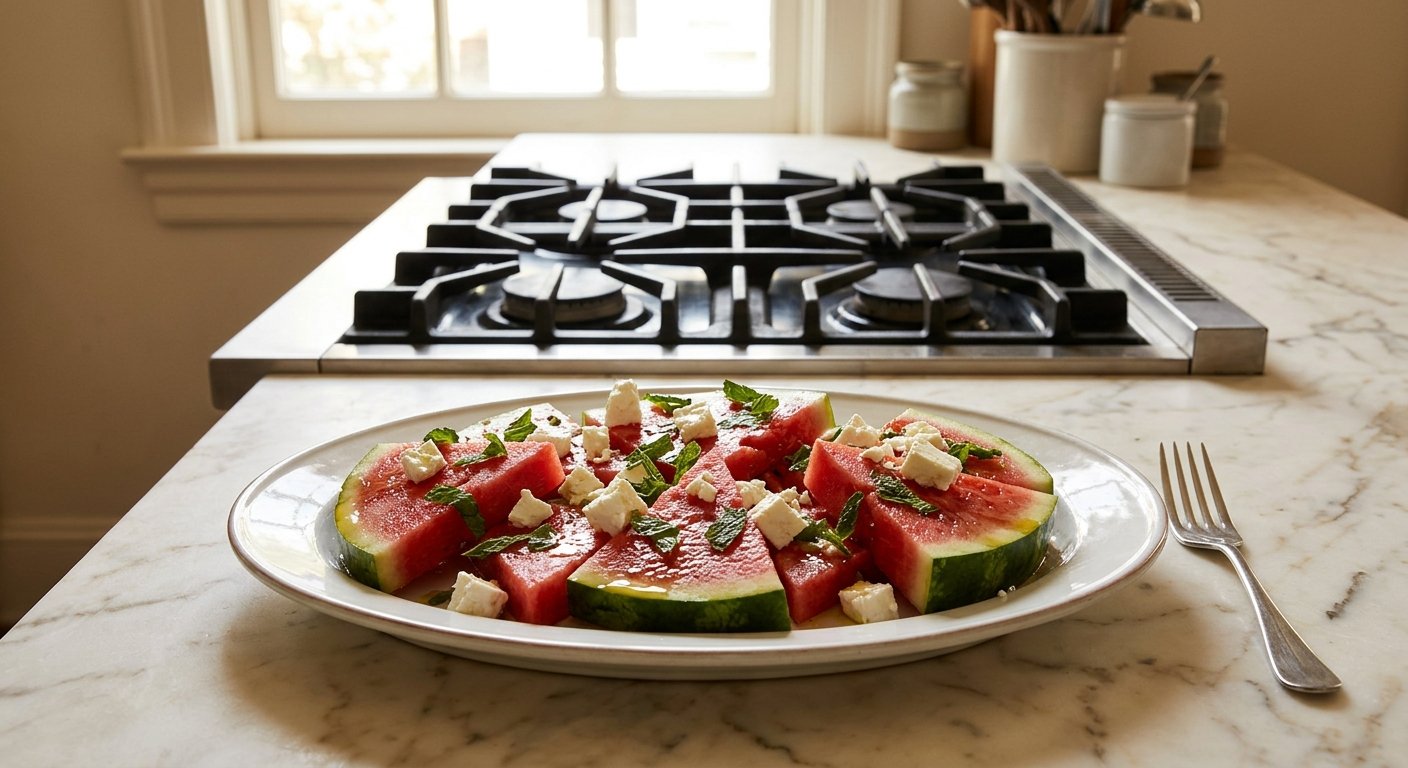
Greek Watermelon Feta Salad (Karpouzi me Feta)
Notes
Nutrition
Chef’s Notes
Choosing the Right Watermelon
On Kos we always tapped the melon before buying it. A hollow, resonant sound tells you the flesh is dense and full of juice. A dull, flat thud usually means the melon is either overripe and beginning to turn mealy, or underripe and still pale inside. Look for a deep yellow cream-colored field spot — the patch where the melon rested on the ground — rather than a white or greenish one. That yellowing deepens as the fruit ripens in the sun. The rind should feel firm and slightly waxy under your fingers.
For this Greek watermelon feta salad, look for the darkest, most saturated red flesh you can find. Deep color generally means higher sugar content and more intense flavor. If you are buying from a market that will cut the melon open for you to inspect, always ask. You want flesh that is bright, dense, and free of pale streaks near the center.
Choosing the Right Feta
Feta is a Protected Designation of Origin (PDO) cheese, which means that under EU law, only cheese produced in specific regions of Greece — primarily Epirus, Macedonia, Thrace, Thessaly, Central Greece, the Peloponnese, and Lesbos — using milk from local sheep or a blend of sheep and goat milk, can be called feta. Anything labeled “feta-style” or produced outside those regions is, legally and practically, a different product. You can read more about the PDO designation at the European Commission’s quality labels registry.
For karpouzi me feta, buy a block labeled PDO and look for it sold in brine. Feta kept in its liquid stays moist and balanced in saltiness. Once removed from the brine, it begins to dry out and intensify in sharpness. I prefer a feta that is firm enough to slice cleanly but still has a creamy, slightly yielding interior — not so fresh that it dissolves, not so aged that it crumbles like chalk. Most specialty grocery stores and Greek markets carry excellent imported block feta that will work perfectly here.
On Mint: Spearmint vs. Peppermint
This distinction matters more than most people expect. In Greek cooking, the mint we use is almost universally spearmint (dyosmos — δυόσμος), not peppermint. Spearmint is sweeter, more delicate, and more aromatic, with a clean finish that complements both the watermelon and the feta. Peppermint tends to be harsher and more medicinal — appropriate for tea or candy, but overpowering in a salad.
Always tear the mint rather than chopping it. Cutting releases more tannins and can introduce bitterness. Tearing preserves the volatile aromatics while keeping the leaf’s natural oils intact.
Variations
- With Kalamata olives: A handful of whole, unpitted Kalamata olives adds another layer of briny complexity. Their deep, rich flavor plays well against the sweet melon and the tangy cheese.
- With red onion: Thinly sliced rings of red onion scattered across the platter introduce a sharp, vegetal bite. If raw red onion is too aggressive for your taste, soak the slices in cold water for ten minutes first — this pulls out the harshest sulfur compounds and mellows the flavor considerably.
- With pomegranate molasses: A thin drizzle of pomegranate molasses in place of, or alongside, the balsamic vinegar adds a concentrated sweet-tart depth that complements the watermelon beautifully.
- As a composed plate: Some restaurants serve karpouzi me feta with watermelon cut into neat cubes and feta into rectangles, arranged architecturally on individual plates. Nothing is lost in translation — it simply becomes a more formal presentation.
Storage and Make-Ahead
Karpouzi me feta should be assembled minutes before serving. Once dressed, watermelon releases liquid quickly and becomes soft and watery. You can prepare the components ahead of time: cut the watermelon up to 24 hours in advance and keep it in an airtight container in the refrigerator. Pick and store the mint leaves in a damp paper towel in the refrigerator. Have the feta ready in its brine. When ready to eat, assembly takes less than two minutes.
What to Serve With Karpouzi me Feta
This Greek watermelon feta salad belongs on a summer table alongside grilled meats and meze. It pairs naturally with Souvlaki — Greek Pork Skewers, where the cold sweetness of the melon cuts cleanly through the char and richness of the grilled pork. It also works beautifully before a more substantial course like Gemista — Greek Stuffed Tomatoes and Peppers, where the lightness of the salad sets the tone for what follows.
If you are building a full summer meze spread, consider adding Kolokithokeftedes — Greek Zucchini Fritters to the table alongside the karpouzi me feta. The crispy, herb-filled fritters and the cool, refreshing salad cover the full range of summer textures — something the season always calls for.
FAQ
Is Greek watermelon feta salad a traditional dish?
Yes — in the way that most Greek home cooking is traditional: passed between families and tavernas rather than codified in a printed recipe. Karpouzi me feta does not appear in formal culinary texts the way moussaka or spanakopita do. It exists as part of the lived culture of Greek summers, a combination that generations of Greek cooks have reached for without needing to be told. On the Aegean islands, where both ingredients are abundant and unavoidable in summer, the pairing is simply what you do when a melon is ripe and a block of feta is in the house.
Can I use pre-crumbled feta for this recipe?
You can, but the result will be noticeably inferior. Pre-crumbled feta is drier, saltier, and sharper than block feta kept in brine. It loses the creamy interior that makes feta so appealing in this context, and it sits on the watermelon rather than melding with it. For the best Greek watermelon feta salad, buy a block — preferably labeled PDO — and break it by hand just before serving.
What makes Greek feta different from other feta-style cheeses?
Greek feta is a PDO (Protected Designation of Origin) product, legally recognized by the European Union since 2002. It must be produced in specific regions of Greece using milk from local sheep or a blend of sheep and goat milk. The result is a cheese with a distinctive tangy flavor and moist, slightly crumbly texture that comes from the local milk, the climate, and the traditional production methods. “Feta-style” cheeses made in Denmark, the United States, or elsewhere are made from different milk under different conditions and produce a noticeably different product. For karpouzi me feta, the authentic Greek cheese is what makes the dish.
How long does karpouzi me feta last after assembly?
It does not keep well. Once the watermelon is dressed with olive oil and the feta is broken over it, the melon begins releasing liquid within 20–30 minutes. Eat it at the table immediately after assembling. For leftovers, store watermelon and feta separately in the refrigerator and reassemble as needed — the components keep well individually for up to 24 hours.
Can I make karpouzi me feta without mint?
Yes, though the mint is an important part of the dish. If spearmint is unavailable, a small handful of fresh basil — particularly Thai basil for its anise note, or regular basil for its sweetness — works as a reasonable substitute. Some versions of the Greek watermelon feta salad use a pinch of dried Greek oregano in place of fresh herbs. It is a different dish without the mint, but still a good one.