
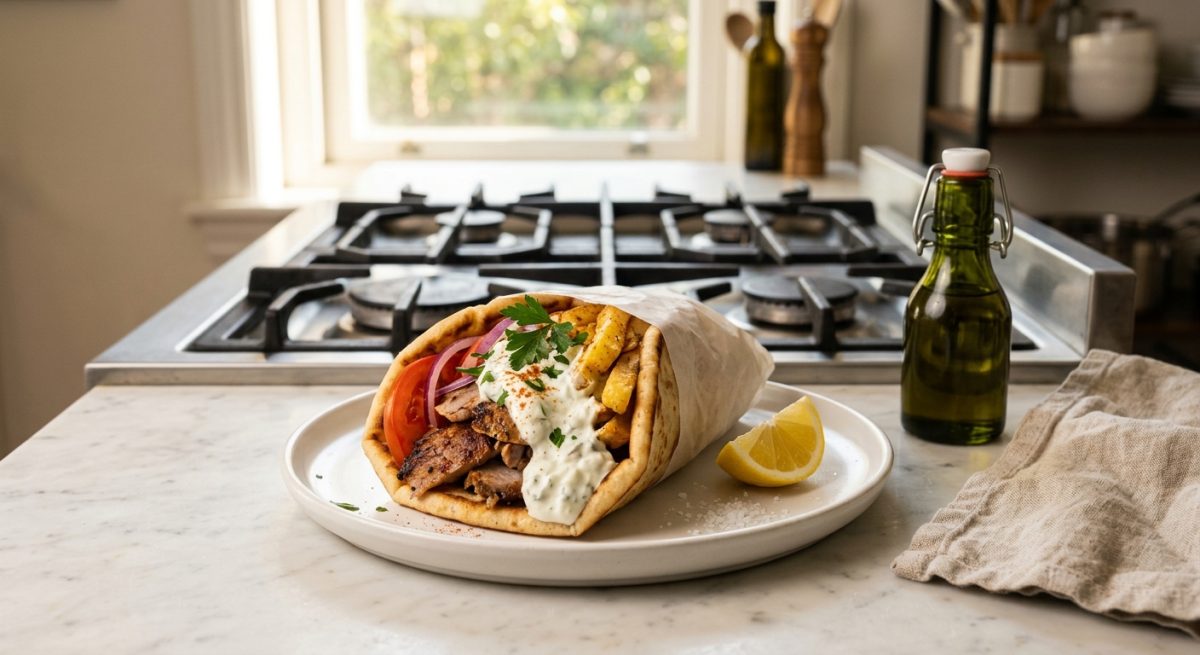
On Kos, the gyradiko — the little gyros shop — is part of the landscape. There is one near the harbor, one by the market, one that opens at midnight for the crowd coming out of the waterfront bars. As a boy, I did not think of gyros as a recipe. It was just the thing you ate standing up, with a paper napkin pressed against the dripping pita, the smell of pork fat and oregano hanging in the air.
It took me years of cooking professionally to understand what was actually happening on that vertical rotisserie. The pork shoulder is stacked and compressed, so as the outer layers cook and caramelize against the heat, fat from the inner layers bastes them constantly. You are eating something that has been self-basting for hours. No home oven can replicate that exactly — and I will not pretend otherwise.
What a home kitchen can do is capture the flavors: the spice blend of oregano, paprika, cumin, and allspice that defines Greek gyros pork; the caramelized, slightly crispy edges of thinly sliced pork; the cool contrast of tzatziki; the warmth of thick Greek pita. Two methods follow: a hot oven method and a cast-iron pan method.
Why This Recipe Works
- Thin slicing is non-negotiable. Slicing the shoulder no more than 3–4mm thick maximizes the surface area that crisps up. Thick chunks will steam, not caramelize.
- The spice blend does the heavy lifting. Oregano, smoked paprika, cumin, allspice, garlic — these are not interchangeable. The allspice is what separates Greek-style gyros from generic pork kebab.
- High heat is essential. Whether oven or pan, you need real heat — 230°C/450°F in the oven, screaming-hot cast iron on the stove. The goal is quick caramelization, not slow cooking.
- Rest and wrap immediately. Gyros pork should rest two minutes after cooking, then go straight into warm pita. The contrast between hot pork and cold tzatziki is part of what makes the wrap work.
The Authentic Version vs. The Home Version
The authentic Greek gyros is built on a vertical rotisserie — a large spit on which layers of marinated pork shoulder are stacked, compressed, and cooked slowly beside a gas flame. Gyros means “to turn” or “to rotate” — the dish is named for the motion. You can read more at Wikipedia’s gyros article.
The home version cannot replicate the self-basting rotisserie effect. What it can replicate: the spice profile, the caramelized exterior with high heat, the thinness of the sliced meat, and the final assembly with pita, tzatziki, tomato, and onion.
Ingredients
For the Pork
- 1 kg (2.2 lbs) pork shoulder, boneless
- 3 tablespoons olive oil
- 4 garlic cloves, minced or grated
- 1½ teaspoons dried Greek oregano
- 1 teaspoon smoked paprika
- ½ teaspoon sweet paprika
- ½ teaspoon ground cumin
- ¼ teaspoon ground allspice
- 1 teaspoon fine salt
- ½ teaspoon black pepper
- Juice of ½ lemon
For the Assembly
- 4–6 thick Greek pitas (full disc style, not pocket pitas)
- 1 batch tzatziki (see my Authentic Tzatziki recipe)
- 2 medium tomatoes, diced small
- 1 small red onion, halved and thinly sliced
- Paprika, for dusting (optional)
- Thin-cut fries cooked inside the wrap (optional but traditional)
Step-by-Step Instructions
Prepare the Pork
Step 1 — Slice thin. Place the pork shoulder in the freezer for 30–45 minutes. Slice across the grain into slices no thicker than 3–4mm (about ⅛ inch). If you have a slicing machine, use it.
Step 2 — Make the marinade. In a large bowl, combine olive oil, minced garlic, oregano, both paprikas, cumin, allspice, salt, pepper, and lemon juice. Stir to combine.
Step 3 — Marinate. Add the pork slices to the marinade and toss until every slice is coated. Cover and refrigerate for at least 2 hours, ideally overnight.
Method 1: Oven
Step 4 — Preheat oven to 230°C (450°F). Place a wire rack on a baking sheet lined with foil.
Step 5 — Arrange the pork. Lay the marinated slices in a single layer on the rack. Do not overlap — work in batches if needed.
Step 6 — Roast on the top rack for 12–15 minutes, until the edges are caramelized and dark.
Step 7 — Rest 2 minutes, then transfer to a board and chop loosely.
Method 2: Cast-Iron Pan
Step 4 (Pan) — Heat a cast-iron skillet over high heat until smoking. Add ½ tablespoon of olive oil and swirl to coat.
Step 5 (Pan) — Cook in batches. Add pork slices in a single layer — do not crowd the pan. Cook undisturbed 1½–2 minutes until caramelized. Flip and cook 1 more minute.
Step 6 (Pan) — Transfer to a plate and rest while you cook the remaining batches.
Assemble the Gyros
Step 8 — Warm the pitas. Heat each pita directly over a gas flame for 30 seconds per side, or in a dry hot pan until pliable with light char marks.
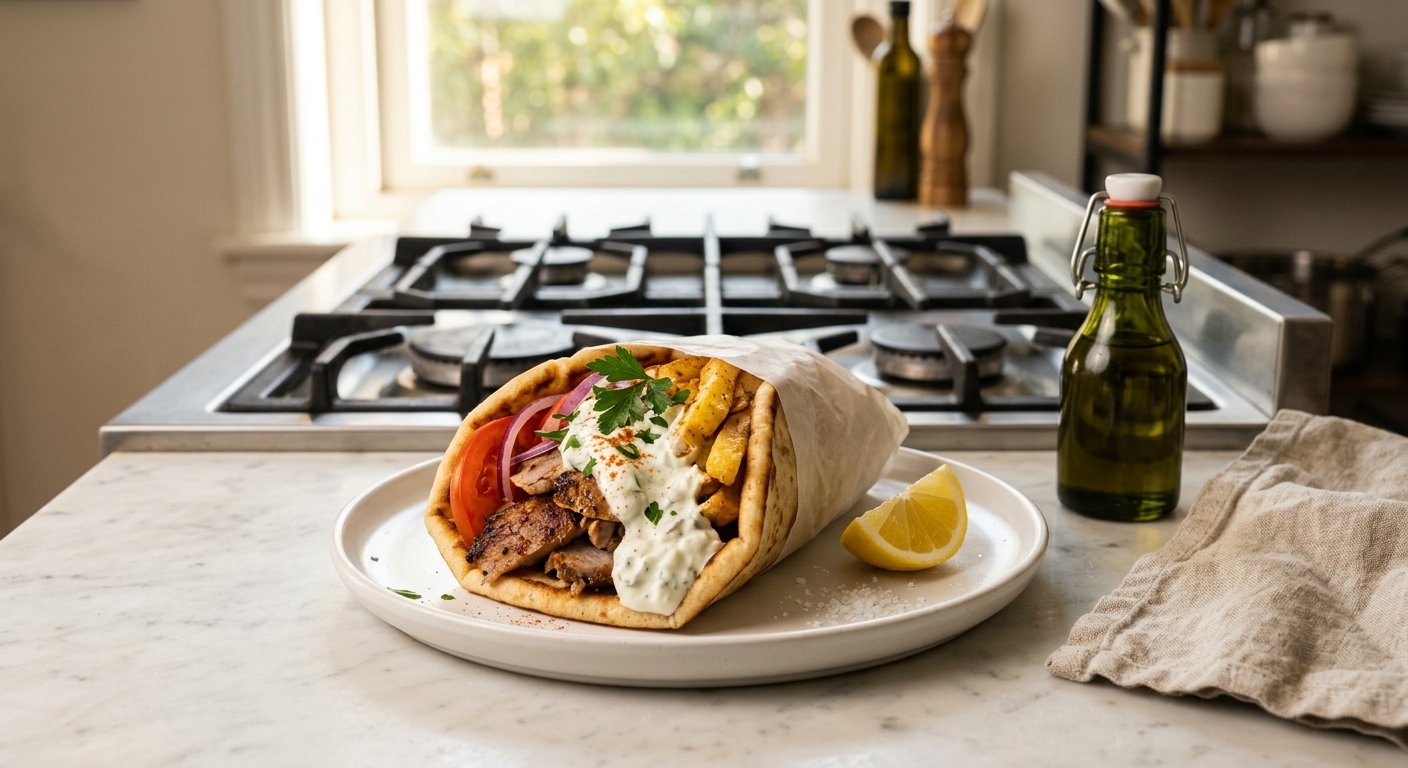
Step 9 — Build the wrap. Lay the warm pita flat. Spread a generous spoonful of tzatziki down the center. Add pork pieces, diced tomato, red onion rings, and a light dusting of paprika. Add thin fries if using.
Step 10 — Wrap tightly. Fold one side of the pita over the filling, then roll into a cylinder. Wrap the bottom half in parchment or foil. Serve immediately.
Greek Pork Gyros (Home Version)
Ingredients
For the Pork
- 1 kg boneless pork shoulder
- 3 tablespoons olive oil
- 4 garlic cloves, minced
- 1½ teaspoons dried Greek oregano
- 1 teaspoon smoked paprika
- ½ teaspoon sweet paprika
- ½ teaspoon ground cumin
- ¼ teaspoon ground allspice
- 1 teaspoon fine salt
- ½ teaspoon black pepper
- juice of ½ lemon
For Assembly
- 4-6 thick Greek pitas (full disc style) not pocket pitas
- 1 cup tzatziki
- 2 medium tomatoes, diced
- 1 small red onion, thinly sliced
- paprika for dusting
- thin-cut fries optional, traditional
Instructions
Prepare the Pork
- Place pork shoulder in freezer 30–45 minutes. Slice across the grain no thicker than 3–4mm (about ⅛ inch).
- Combine olive oil, garlic, oregano, paprikas, cumin, allspice, salt, pepper, and lemon juice.
- Add pork slices, toss until coated. Refrigerate 2 hours minimum, overnight preferred.
Oven Method
- Preheat oven to 230°C (450°F). Place wire rack on foil-lined baking sheet.
- Lay marinated slices in single layer on rack. Do not overlap — work in batches if needed.
- Roast on top rack 12–15 minutes until edges are caramelized and dark.
- Rest 2 minutes, then chop loosely.
Cast-Iron Pan Method
- Heat cast-iron skillet over high heat until smoking. Add ½ tablespoon olive oil.
- Add pork in single layer. Cook undisturbed 1½–2 minutes until caramelized. Flip, cook 1 minute more. Work in batches.
- Transfer to plate and rest while cooking remaining batches.
Assemble
- Heat each pita over gas flame 30 seconds per side or in dry hot pan.
- Lay pita flat. Spread tzatziki down center. Add pork, tomato, onion, paprika. Add fries if using.
- Fold one side over filling, roll into cylinder. Wrap bottom in parchment. Serve immediately.
Notes
Nutrition
Chef’s Notes
On the pork cut: Shoulder is correct. It has enough fat to stay moist and crisp at the edges under high heat. Loin is too lean — it will dry out and turn tough. If your butcher sells collar (neck) pork, that is also excellent.
On the spice blend: Do not skip the allspice. It is a small quantity but it is the note that makes Greek gyros taste distinctively Greek rather than generically spiced.
Gyros vs. souvlaki: These are two different things, though both involve pork and pita. Souvlaki is cubed meat, skewered and grilled. Gyros is thinly shaved from a rotating spit. For the souvlaki version, see my Souvlaki recipe.
Storage: Cooked pork keeps refrigerated for 3 days. Reheat in a hot dry pan to restore some of the caramelization. Do not assemble the wraps in advance.
Make it a plate: Instead of a wrap, serve the pork over rice or alongside Greek roasted potatoes with a side of tzatziki and a tomato-onion salad.
FAQ
What is gyros?
Gyros (pronounced YEE-ros in Greek) is a Greek street food made from meat — most commonly pork in Greece — cooked on a vertical rotisserie and shaved thin. It is served in pita with tomato, red onion, and tzatziki. The word comes from the Greek for “to turn,” referring to the spinning spit.
What is the difference between gyros and souvlaki?
Both are Greek pork dishes served in pita, but the preparation is entirely different. Souvlaki uses cubed meat skewered and grilled over coals. Gyros uses meat stacked on a vertical spit, compressed, and slowly cooked, then shaved thin. The texture, eating experience, and spice profile are different.
Can I make gyros at home without a rotisserie?
Yes — with the caveat that the result is not identical to a rotisserie gyros, but it is very good. The key is slicing the pork thin (semi-freezing the meat makes this easier), using the right spice marinade, and cooking at very high heat to get caramelization at the edges.
What spices go into Greek gyros?
The core gyros spice blend is: dried Greek oregano, smoked paprika, sweet paprika, ground cumin, and ground allspice, combined with garlic, olive oil, salt, pepper, and lemon. The allspice is the most distinctive element — it gives Greek gyros its characteristic warm, rounded flavor.
How do you wrap a gyros pita properly?
Use a thick, full-disc Greek pita (not the pocket pita style). Warm it first over a flame or in a dry pan until pliable. Lay it flat, spread tzatziki down the center, add pork, tomato, onion, and other fillings. Fold one side over the filling, then roll into a cylinder. Wrap the lower half tightly in parchment paper or foil. Serve and eat immediately.