
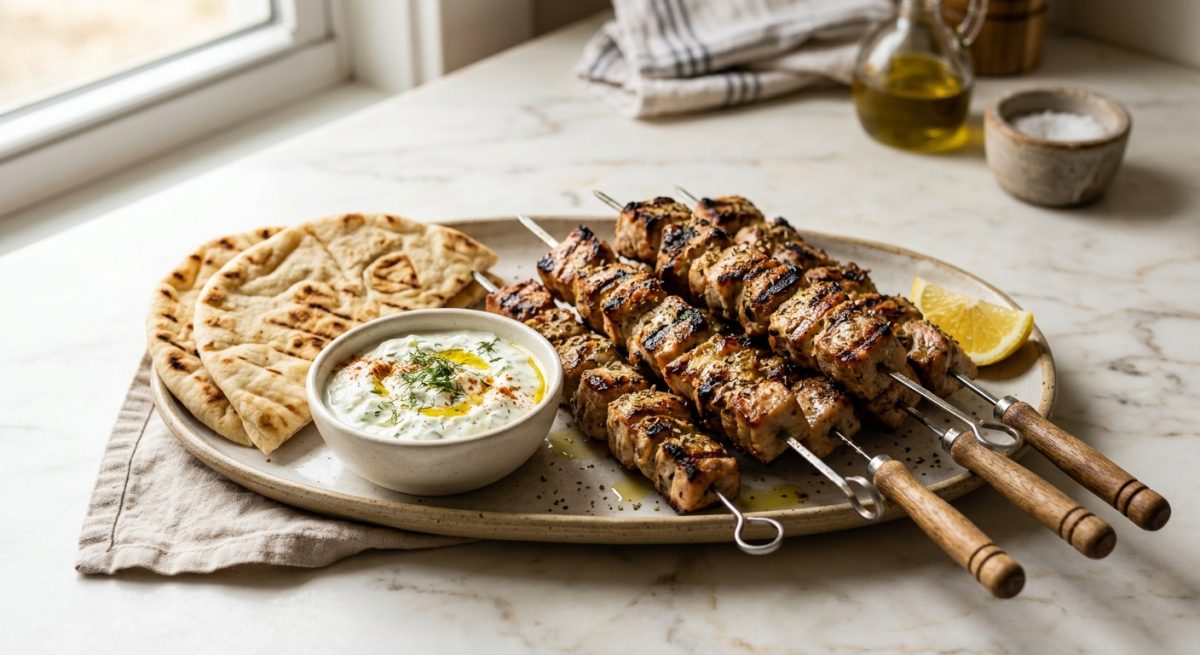
On Kos, there was a souvlaki stand on the main road heading toward the harbor. I cannot tell you the owner’s name — I was a child — but I can still tell you exactly what it smelled like: charcoal smoke, dried oregano, and the particular sweetness of pork fat hitting a very hot grill. My father would stop on the way back from the docks, and we would eat standing up, the skewers pulled from the grill and folded into warm pita, tomato, red onion, a generous smear of tzatziki. Paper-wrapped, eaten fast. No table, no utensils.
That is souvlaki Greek pork skewers done correctly. It is not a complex dish. But it is one of those recipes where every small decision — the cut of meat, the length of the marinade, the temperature of the grill — determines whether you get something extraordinary or something merely adequate. The technique has barely changed in decades, and there is a reason for that.
This recipe is as close as I can bring you to that souvlaki stand on Kos. Three ingredients in the marinade. The right cut of pork. High heat. Warm pita. Everything else is detail.
Table of Contents
Why This Recipe Works
- Pork shoulder, not loin. Shoulder has the fat content to stay juicy over high, direct heat. Loin is lean — it dries out fast and turns tough on the grill. This single choice accounts for more failed souvlaki than any other variable.
- The marinade is a tenderizer and a flavor base. Lemon acid begins to break down the protein; olive oil carries the oregano’s aromatic compounds into the meat. Marinating overnight versus 2 hours produces a meaningfully different result — deeper flavor and slightly more tender texture.
- High heat, short time. Souvlaki is not a low-and-slow dish. The goal is char on the outside, juice inside. That requires a very hot grill surface and minimal turning. Fussing with the skewers kills the crust.
- Cube size matters. 2.5 to 3 cm (1 inch) cubes cook through in 3–4 minutes per side without drying out. Smaller pieces overcook. Larger pieces risk exterior char before the inside reaches temperature.
Ingredients
For the Pork and Marinade
- 900g (2 lbs) pork shoulder, cut into 2.5–3 cm (1-inch) cubes
- 60ml (¼ cup) extra-virgin olive oil
- 3 tablespoons fresh lemon juice (about 1 large lemon)
- 2 teaspoons dried Greek oregano (rigani)
- 1 teaspoon fine sea salt
- ½ teaspoon freshly ground black pepper
- 2 garlic cloves, minced (optional — traditional souvlaki uses only the three main ingredients)
For Serving
- 4–6 Greek pita breads (thick, round style)
- 1 portion tzatziki (see my Homemade Tzatziki)
- 2 ripe tomatoes, sliced thin
- 1 small red onion, sliced thin
- Paprika, for dusting (optional)
- Lemon wedges
Step-by-Step Instructions
Step 1 — Cut the pork
Trim the pork shoulder of any very large, tough fat caps, but leave some fat — this is what keeps the meat moist. Cut into uniform 2.5–3 cm (1-inch) cubes. Uniformity is important: uneven pieces cook at different rates.
Step 2 — Make the marinade
In a large bowl, whisk together the olive oil, lemon juice, dried oregano, salt, pepper, and garlic (if using). The mixture should be well combined. Taste it — it should be bright and intensely oregano-forward.
Step 3 — Marinate
Add the pork cubes to the bowl and toss until every piece is evenly coated. Cover and refrigerate. Minimum: 2 hours. Preferred: overnight (8–12 hours). Do not marinate longer than 24 hours — the lemon acid will begin to break down the meat texture adversely.
Step 4 — Thread the skewers
If using wooden skewers, soak them in cold water for at least 30 minutes before use to prevent burning. Thread 4–5 pork cubes per skewer, pressing them together slightly but not so tightly they cannot cook through. Leave a small gap between pieces.
Step 5 — Prepare the grill
For charcoal: build a two-zone fire. You want the coals white-hot with a thin ash coating — this is the moment for souvlaki. For gas: preheat on high for at least 10 minutes. For a cast-iron grill pan: heat over high heat until a drop of water evaporates instantly on contact. Lightly oil the grate.
The grill must be very hot before the skewers go on. A lukewarm surface means the pork will steam rather than char, and you lose everything that makes souvlaki worth eating.
Step 6 — Grill the skewers
Place the skewers directly over the high heat. Do not move them for 3 minutes. A good char requires contact time. After 3–4 minutes, check the underside — you want deep golden-brown color with visible grill marks. Turn and repeat on the other side. Total grill time: 7–9 minutes, depending on the heat of your grill. Internal temperature should reach 70°C (160°F).
Chef’s tip: Resist the urge to turn constantly. Char is flavor. Moving the skewers repeatedly prevents the crust from forming.
Step 7 — Rest briefly and warm the pita
Let the skewers rest for 2 minutes off the heat. While they rest, place the pita directly on the grill for 30–45 seconds per side — you want it warm, slightly charred at the edges, and pliable. A soft, untoasted pita is the wrong vehicle for souvlaki.
Step 8 — Assemble and serve
Lay a warm pita flat. Spread a tablespoon of tzatziki down the center. Add tomato and red onion slices. Slide the pork off the skewer directly onto the pita (use the pita itself or a fork to hold the meat while you pull). Fold and eat immediately.
Souvlaki is a dish of immediacy. It does not improve with waiting.
Recipe Card
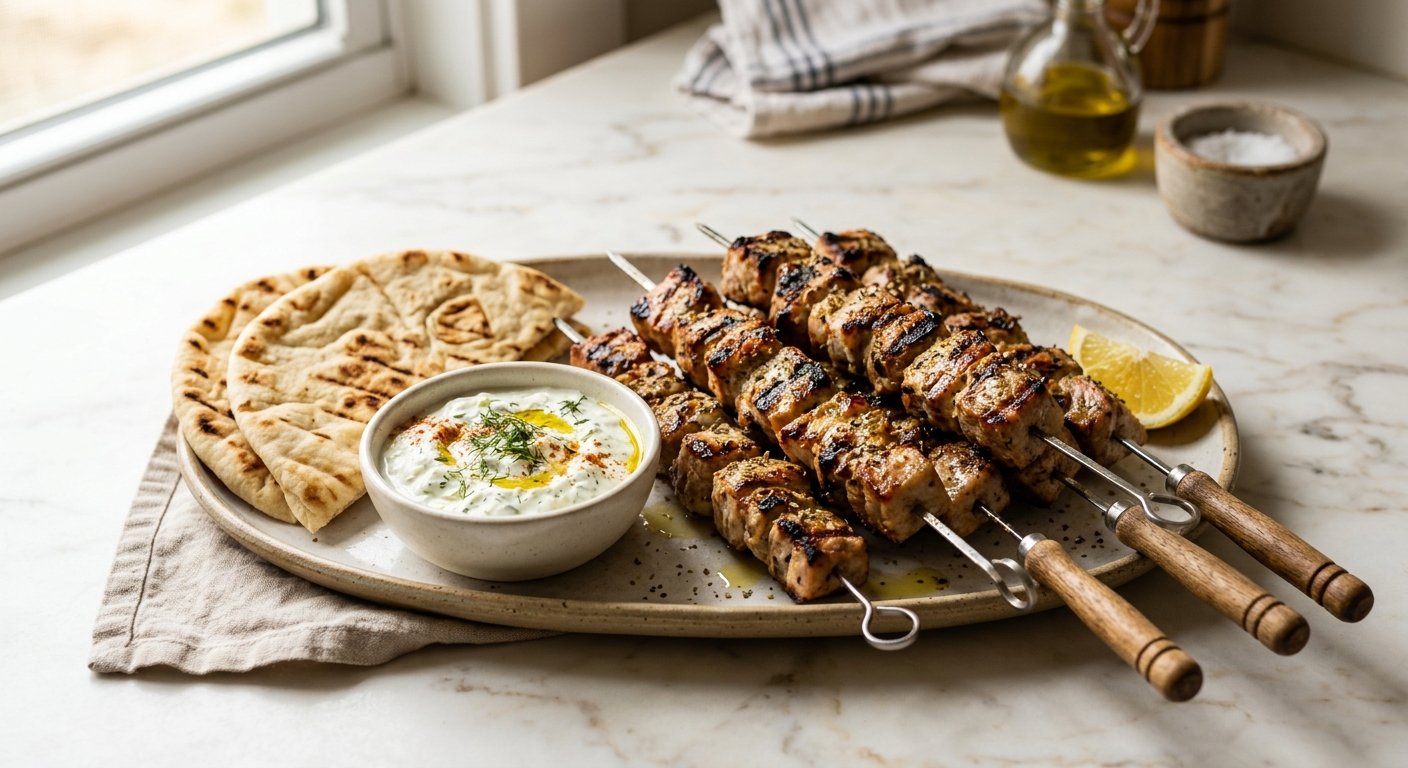
Souvlaki (Greek Pork Skewers)
Ingredients
For the Pork and Marinade
- 900 g pork shoulder cut into 2.5-3 cm (1-inch) cubes
- 60 ml extra-virgin olive oil
- 3 tablespoons fresh lemon juice about 1 large lemon
- 2 teaspoons dried Greek oregano (rigani)
- 1 teaspoon fine sea salt
- 1/2 teaspoon freshly ground black pepper
- 2 garlic cloves minced, optional
For Serving
- 4-6 Greek-style pita breads
- tzatziki homemade or store-bought
- 2 ripe tomatoes sliced thin
- 1 small red onion sliced thin
- lemon wedges
Instructions
- Cut pork shoulder into uniform 2.5-3 cm (1-inch) cubes, trimming large fat caps but leaving some fat for moisture.
- Whisk olive oil, lemon juice, dried oregano, salt, pepper, and garlic (if using) in a large bowl until well combined.
- Add pork cubes and toss to coat evenly. Cover and refrigerate for at least 2 hours, preferably overnight (8-12 hours). Do not exceed 24 hours.
- If using wooden skewers, soak in cold water for at least 30 minutes before grilling to prevent burning.
- Thread 4-5 pork cubes onto each skewer, pressing together slightly but leaving a small gap between pieces.
- Preheat grill or cast-iron grill pan to very high heat. Lightly oil the grate. The grill must be very hot before the skewers go on.
- Grill skewers over direct high heat, 3-4 minutes per side without moving, until deep golden-brown with char marks. Internal temperature should reach 70°C (160°F).
- Rest skewers 2 minutes. Meanwhile, grill pita 30-45 seconds per side until warm and lightly charred at the edges.
- Spread tzatziki on warm pita, add tomato and red onion slices, slide pork off skewer onto pita, fold and serve immediately.
Notes
A charcoal grill produces the most authentic result; a hot cast-iron grill pan is a good indoor substitute.
Souvlaki can also be made with chicken thighs or lamb shoulder using the same marinade and technique.
Nutrition
Chef’s Notes
On choosing the pork
Pork shoulder (also sold as pork butt in North America) is the correct choice. It has enough intramuscular fat to remain juicy over the intense heat souvlaki requires. Pork loin is commonly substituted but should not be — it produces a drier, tougher skewer that bears little resemblance to what you get from a good Greek souvlaki stand.
On the oregano
Greek dried oregano (rigani) has a different character than Italian dried oregano — more peppery, more aromatic, less sweet. If you can source Greek oregano, it is worth doing for this recipe. It is available in Greek grocery stores and online.
On the marinade timing
Two hours is the floor — you will get flavor penetration but not the full tenderizing effect of a longer soak. Overnight marinating changes the dish: the pork absorbs the olive oil and lemon more deeply, the oregano becomes integral rather than superficial. If you have time, plan ahead.
On indoor cooking
A heavy cast-iron grill pan, preheated until very hot, produces excellent souvlaki without an outdoor grill. The smoke will be significant — open windows. The char is real. The result is genuine. Do not use a non-stick pan: it cannot reach the temperatures required.
Storage
Grilled souvlaki keeps in the refrigerator for up to 3 days. Reheat in a dry hot pan or under a hot broiler — not the microwave. The marinade itself can be made ahead and the pork can marinate for up to 24 hours (no longer).
Other dishes in this tradition
If you enjoy the Greek grill tradition, my Greek Grilled Octopus uses similar principles — high heat, simplicity, olive oil — but with a completely different set of textures. And for another classic from the Greek street food canon, try my Keftedes (Greek Meatballs), which share the same oregano-forward flavor profile but are made in a pan rather than on the grill.
FAQ
What is souvlaki?
Souvlaki is one of the most popular street foods in Greece — small cubes of meat, typically pork, marinated and grilled on skewers. It is served either on the skewer with bread on the side, or wrapped in pita with tomato, onion, and tzatziki. The word comes from the Greek souvla, meaning skewer or spit.
What cut of pork is best for souvlaki Greek pork skewers?
Pork shoulder (also called pork butt) is the traditional and correct choice. It has enough fat to stay moist over high heat. Pork loin — which is commonly used as a substitute — is too lean for this cooking method and produces a dry, tough result.
Can I make souvlaki with chicken instead of pork?
Yes — chicken thighs work well with the same marinade. They have enough fat to remain moist on the grill. Avoid chicken breast as it dries out quickly. Lamb shoulder is another excellent option, particularly if you prefer a richer, more traditional Aegean flavor.
Can I make souvlaki in the oven?
You can, but the result is meaningfully different. The oven cannot replicate the char and smoke of direct high heat. If you must cook indoors and do not have a cast-iron grill pan, place the skewers on a rack over a baking sheet and broil on high, turning once, until charred in spots — roughly 10–12 minutes total.
How long should I marinate the pork?
At minimum, 2 hours. Overnight (8–12 hours) produces a noticeably better result: deeper flavor penetration and slightly more tender meat. Do not exceed 24 hours — the lemon acid will begin to break down the texture of the meat in an undesirable way, making it mushy.