
There is a Saturday night ritual on the island of Sifnos that has been going on for longer than anyone can remember. Before bed, the women of each household carry their covered clay pots — their skepastaria — down to the village bread oven. The baker keeps the fire low overnight. In the morning, after church, the pots come home. Inside: revithada. Greek baked chickpeas so soft they barely hold their shape, swimming in a broth so silky it coats the back of a spoon like cream.
I grew up on Kos, and we had our own way with chickpeas — revithia soupa, a straightforward broth with lemon and olive oil. It was good, honest food. But the first time I tasted proper revithada Greek baked chickpeas on Sifnos, I understood that what I had been eating was merely an introduction. Sifnian revithada is something else entirely. The overnight baking in a sealed clay pot does not just cook the chickpeas — it transforms them. The starches bloom. The broth becomes cloudy and unctuous. The olive oil, added generously at the table, turns the whole bowl into something you want to eat slowly, with bread, with good company, without any hurry.
This dish belongs to the category the Greeks call ladera — oil-based dishes in which vegetables or legumes are cooked in olive oil without meat. Five ingredients, at most: dried chickpeas, water, onion, olive oil, salt. Nothing hidden, nothing clever. Just patience, a proper vessel, and respect for the process.
In this post I will walk you through exactly how to make revithada the way it should be made: soaked overnight, sealed tight, baked low and slow for four to six hours. I will explain the five techniques that separate a genuine revithada from a pot of boiled chickpeas that happens to have olive oil on top. And I will give you a complete recipe card with every measurement and timing you need.
Why This Revithada Greek Baked Chickpeas Recipe Works
The reason most homemade chickpea dishes disappoint is not the chickpeas — it is the method. Here is what makes this revithada Greek baked chickpeas recipe different from the standard stovetop approach:
- Baking, not boiling. When chickpeas are simmered on the stovetop, the constant agitation breaks some of them down unevenly and pushes the starch into the water in a way that makes the broth gritty. In the oven, at a steady 150°C / 300°F, the heat surrounds the pot and the chickpeas cook in their own steam under the lid. The result is a uniform creaminess throughout, with every chickpea intact but yielding.
- Salt added late. This is not a myth or a superstition — it is chemistry. Salt added at the start of cooking toughens the skins and prevents the interior from becoming fully soft, no matter how long you cook. Add it in the last hour only, once the chickpeas are already tender, and it will season them from within without interfering with their texture.
- A sealed vessel matters. Whether you use a traditional Sifnian clay skepastaria, a tagine, or a good cast-iron Dutch oven with a tight-fitting lid, the seal is critical. The chickpeas need to cook in a closed, humid environment. A pot that lets too much steam escape will leave you with dry, mealy chickpeas and a thin broth.
- Olive oil at the table, not in the pot. Many recipes call for the olive oil to be added before baking. On Sifnos, they add it after. The oil goes in raw, directly onto the hot chickpeas when the pot is opened at the table. It emulsifies slightly with the broth and coats every chickpea with grassy, peppery flavor. If you bake the oil, you lose much of that fragrance. Use a good extra-virgin olive oil — this is the moment when its quality actually matters.
Ingredients
Serves 4–6
For the revithada:
- 500g (1 lb 2 oz / about 2½ cups) dried chickpeas
- 1.5 litres (6 cups) water, plus more if needed
- 2 medium yellow onions, roughly chopped
- 1½ tsp fine sea salt (added in the last hour only)
- Freshly ground black pepper
To serve:
- 80–100ml (⅓ cup) high-quality extra-virgin olive oil
- 1 small raw red onion, thinly sliced
- Crusty bread (my Homemade Pita Bread works beautifully here)
- Lemon wedges, optional
No broth, no stock, no herbs, no spices. The simplicity is intentional. If this is your first time making revithada, resist the urge to add anything else.
Step-by-Step Instructions
Step 1 — Soak the chickpeas (12 hours minimum)
Place the dried chickpeas in a large bowl and cover with cold water by at least 8cm (3 inches). Leave to soak overnight — twelve hours is the minimum, sixteen is better. The chickpeas will roughly double in volume. Drain and rinse them well before using.
Do not use canned chickpeas for this recipe. This is not a dish about convenience — it is about a long, slow transformation. Canned chickpeas are already cooked and will turn to mush at these temperatures over this time.
Step 2 — Prepare your vessel
If you have a clay pot or a ceramic casserole with a tight-fitting lid, use it. If not, a heavy cast-iron Dutch oven works very well. Whatever you use, make sure the lid fits snugly — you need to trap the steam.
Preheat your oven to 150°C / 300°F (fan-assisted: 140°C / 285°F).
Step 3 — Assemble the pot
Place the drained chickpeas in your pot. Add the roughly chopped onions. Pour in 1.5 litres of cold water — the water should come about 2–3cm above the chickpeas. Do not add salt yet. Do not add oil yet.
Cover the pot tightly. If you are using a clay pot without a great seal, you can press a piece of damp parchment paper under the lid to help retain moisture.
Step 4 — Bake low and slow (4–6 hours)
Place the covered pot in the oven and leave it alone. This is not a dish that benefits from checking and stirring. The minimum time is four hours; the ideal is five to six hours, which is closer to the overnight tradition of Sifnos.
After 3.5 to 4 hours: Carefully open the pot and check the chickpeas. They should be very soft but still holding their shape. The broth should be cloudy and slightly thickened. If the pot looks dry, add a small amount of hot water (no more than ½ cup) and return to the oven.
Step 5 — Salt in the final hour
When the chickpeas are tender all the way through, add the salt and a few grinds of black pepper. Stir gently once to distribute. Replace the lid and return the pot to the oven for the final 45 minutes to one hour. The salt will season the chickpeas from within and deepen the flavor of the broth without toughening the skins.
Step 6 — Serve at the table
Remove the pot from the oven and bring it directly to the table. Uncover it there, in front of whoever is eating with you. Pour the extra-virgin olive oil generously over the top — do not hold back. Serve with sliced raw red onion, crusty bread, and a glass of something cold.
According to tradition on Sifnos, this dish is served in its cooking pot at the table. There is no plating, no garnish beyond the olive oil. The bowl you scoop it into will be deep, the bread will be thick, and the conversation will be slow. That is the point.
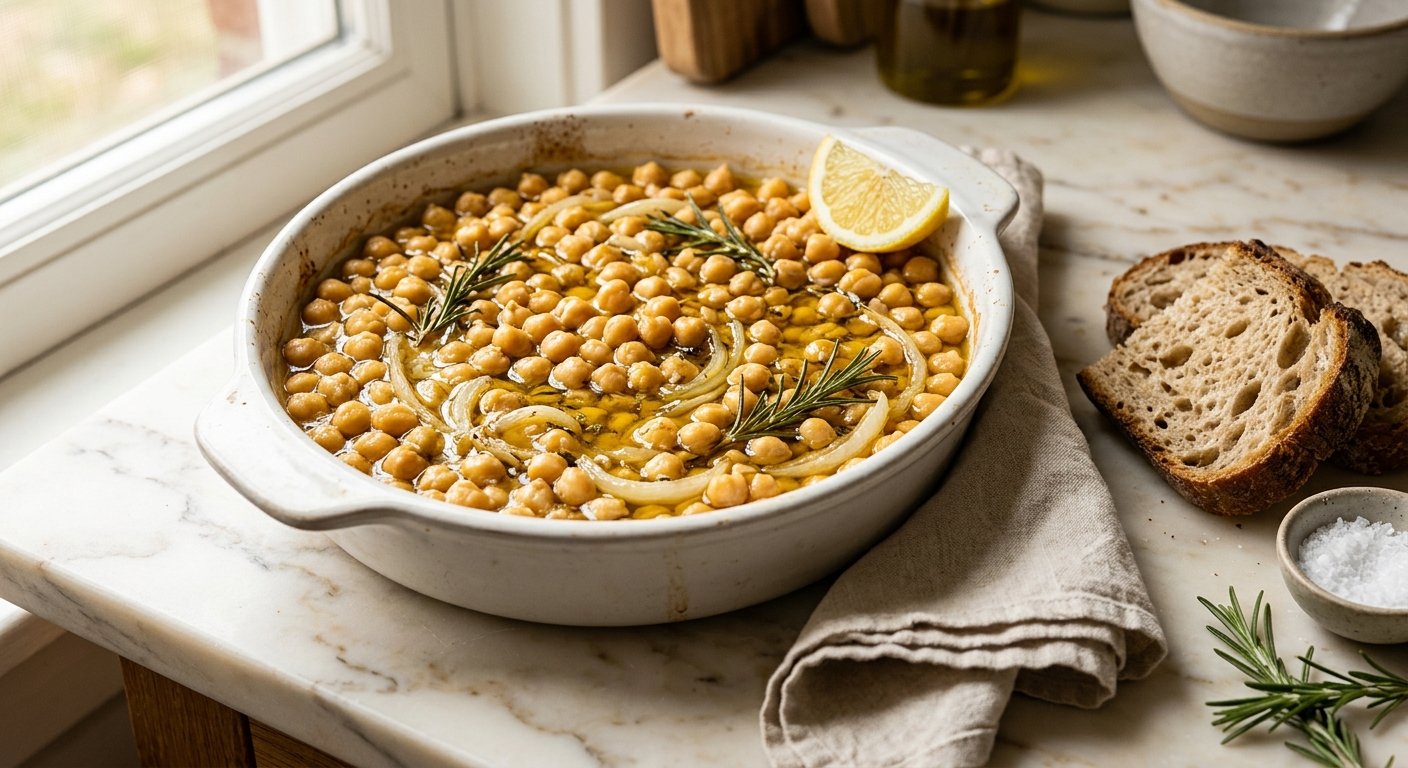
Revithada Greek Baked Chickpeas (Sifnos Style)
Ingredients
For the revithada
- 500 g dried chickpeas soaked overnight, about 2.5 cups
- 1.5 litres cold water 6 cups
- 2 medium yellow onions roughly chopped
- 1.5 tsp fine sea salt add in final hour only
- freshly ground black pepper
To serve
- 80-100 ml extra-virgin olive oil about 1/3 cup; use your best quality
- 1 small raw red onion thinly sliced
- crusty bread
- lemon wedges optional
Instructions
- Soak the dried chickpeas in a large bowl of cold water for at least 12 hours, or overnight. The chickpeas should be submerged by at least 8cm (3 inches). They will roughly double in volume. Drain and rinse thoroughly before using. Do not use canned chickpeas for this recipe.
- Preheat the oven to 150°C / 300°F (fan-assisted: 140°C / 285°F). If you have a clay pot or ceramic casserole with a tight-fitting lid, use it. A heavy cast-iron Dutch oven also works very well.
- Place the drained chickpeas and roughly chopped onions in your pot. Pour in the 1.5 litres (6 cups) of cold water. The water should come about 2-3cm above the chickpeas. Do NOT add salt or olive oil at this stage. Cover the pot tightly.
- Place the covered pot in the oven and bake for 4-6 hours without disturbing. After 3.5-4 hours, carefully open and check: chickpeas should be very soft and the broth cloudy. If the pot looks dry, add no more than half a cup of hot water, replace the lid, and return to the oven.
- When the chickpeas are fully tender, add the salt and a few grinds of black pepper. Stir gently once to distribute. Replace the lid and return to the oven for the final 45 minutes to 1 hour. The salt will season the chickpeas from within without toughening the skins.
- Remove the pot from the oven and bring it directly to the table. Uncover at the table. Pour the extra-virgin olive oil generously over the top. Serve immediately with sliced raw red onion, crusty bread, and optional lemon wedges.
Notes
Nutrition
Chef’s Notes
On the vessel
If you can find a Sifnian skepastaria or any unglazed clay pot from a Greek or Turkish kitchen supply shop, it is worth using. Clay conducts heat gently and evenly in a way that no metal pot quite replicates, and it absorbs and releases moisture slowly, helping regulate the humidity inside. That said, I have made excellent revithada in a good Le Creuset Dutch oven many times. Do not let the absence of a clay pot stop you.
On olive oil quality
This is a dish with five ingredients. There is nowhere to hide. Use the best extra-virgin olive oil you own — ideally a Greek one, ideally from Crete or the Peloponnese where the flavors tend toward grassy, peppery, and bitter in the right way. One of the pleasures of revithada is pouring that oil at the table and watching it pool in the creamy broth. It should smell green and alive.
Variations
- Rosemary: Some Sifnian households add a single sprig of fresh rosemary to the pot. It complements the chickpeas without overpowering them.
- Lemon: A squeeze of fresh lemon at the table brightens the dish considerably. In my mother’s kitchen on Kos we always served chickpea dishes with lemon on the side.
- Leftover broth: The cooking liquid from revithada is excellent. Save it — it works as a base for a light chickpea soup the next day, or as a braising liquid for vegetables.
Storage
Revithada keeps well. Store leftovers in a covered container in the refrigerator for up to 4 days. Reheat gently on the stovetop with a splash of water, and add a fresh pour of olive oil when serving again. The flavors deepen on the second and third day.
What to serve alongside
This is a complete meal in itself with bread, but if you want to build a Sunday table around it, a Traditional Greek Village Salad (Horiatiki) alongside is ideal — the acidity of the tomatoes and the brine of the olives contrast well with the soft, rich chickpeas. If you are feeding a larger crowd and want a meat dish on the same table, my Paidakia (Greek Grilled Lamb Chops) pairs naturally.
FAQ
What does revithada taste like?
Revithada tastes of chickpeas and olive oil in the most concentrated, honest way possible. The chickpeas become creamy almost to the point of dissolving, and the broth develops a silky body from the released starch. There is no tomato, no spice, no stock. The flavor comes from the long, slow cooking itself, and from the quality of the olive oil poured at the table.
Can I make revithada in a slow cooker?
You can approximate it in a slow cooker on the low setting for 8–10 hours, but the result is not quite the same. The dry, gentle heat of the oven produces a different texture in the broth than the wet heat of a slow cooker. If the oven is not an option, a slow cooker is a reasonable substitute — still add salt only in the final hour, and still finish with raw olive oil at the table.
Why do I have to soak the chickpeas overnight? Can I skip it?
No. For this specific recipe, the overnight soak is not optional. Quick-soaked chickpeas may work in other preparations, but they will not become fully tender through a low-temperature bake. Plan ahead — soak the night before.
Is revithada the same as hummus?
No, they are completely different preparations. Hummus is a purée made from cooked chickpeas, tahini, lemon, and garlic — smooth, spreadable, served cold. Revithada Greek baked chickpeas are whole, baked slowly in water with onion and olive oil, and served warm in their broth. They share the same main ingredient and nothing else.
What is a skepastaria?
A skepastaria is the traditional covered clay pot used on Sifnos specifically for baking revithada. The word comes from the Greek skepazo, meaning “to cover.” These pots are designed to retain moisture and distribute heat very evenly. A heavy Dutch oven with a tight lid is a very workable substitute.
Can I freeze revithada?
Yes. Cool completely, then transfer to freezer-safe containers with some of the broth. Freeze for up to 3 months. Thaw overnight in the refrigerator and reheat gently. Add a fresh drizzle of olive oil before serving — do not skip this step after freezing.
Revithada is the kind of dish that reminds you why simplicity in cooking is not the same thing as poverty of flavor. When you open that pot after six hours and the smell of chickpeas and olive oil fills the kitchen, you will understand what Sifnos has known for centuries.