
Spring on Kos arrives almost overnight. One morning the hills are winter-grey; the next, the wildflowers push through and the agora overflows with the season’s first peas — fat and green, still in their pods, the vendors pressing handfuls into your hand to taste. My mother needed no convincing. She would buy a kilogram without a word, then swing by the butcher for a shoulder of lamb, and by noon the whole neighbourhood knew she was making arnaki me araka.
Greek lamb and peas is not a dish you often find in restaurants. It belongs to home kitchens — to mothers and grandmothers who understand that the best cooking is frequently the simplest. What you need is patience, good olive oil, and the kind of fresh dill that smells like spring itself. Everything else — lemon, onion, a little water — exists to support those two lead ingredients.
I have cooked Greek lamb and peas in professional kitchens and in the tiny apartment I shared as a culinary student in Rhodes. I have made arnaki me araka with frozen peas in December when nostalgia got the better of me, and with just-shelled peas in early May when the timing was exactly right. The recipe I am giving you is the one I settled on after years of testing — my mother’s method with one or two small refinements I picked up along the way.
It is a one-pot dish. It is not complicated. And it is, without question, worth making. This recipe serves 6.
Table of Contents
- What Is Arnaki me Araka?
- Why This Recipe Works
- Ingredients
- Step-by-Step Instructions
- Recipe Card
- Chef’s Notes
- FAQ
What Is Arnaki me Araka?
Arnaki me araka is a traditional Greek spring stew of braised lamb and green peas, cooked together with olive oil, onion, dill, and lemon juice. The name translates directly: arnaki means “little lamb” — an endearment for young or tender lamb in Greek — and araka means “peas.” Together, arnaki me araka describes one of the most beloved seasonal dishes in the Greek home-cooking repertoire.
Arnaki me araka belongs to the ladera family of Greek cooking. Ladera dishes — from the Greek word for oil — are vegetables, legumes, or meats braised or simmered in generous amounts of extra-virgin olive oil, usually with minimal added liquid. The cooking method dates back centuries and reflects the Mediterranean philosophy of allowing quality ingredients to define a dish. In ladera cooking, olive oil is not just a cooking fat; it is the sauce.
You will find versions of Greek lamb and peas across the mainland and the islands, with regional variation in herbs and technique. Some families add a pinch of tomato; others add a grating of nutmeg. In the Dodecanese, where I grew up, the version is typically clean and bright — lamb, peas, dill, lemon, olive oil — with nothing to distract from the quality of the spring ingredients. If you enjoy this style of cooking, my Fasolakia (Greek Green Beans braised in olive oil) follows the same ladera principles and is equally satisfying.
Why This Recipe Works
- Browning the lamb first is the single most important step in Greek lamb and peas. The Maillard reaction builds layered flavour into the meat and leaves behind caramelised bits in the pot that enrich the braising liquid. Do not rush this step, and do not crowd the pot — steam is the enemy of a good crust.
- Using bone-in lamb shoulder adds body and richness to the sauce. As the collagen in the connective tissue breaks down during braising, it creates a silky, glossy liquid that coats every pea. Boneless cuts simply do not produce the same result.
- Adding the peas late preserves their sweetness and colour. Peas cooked for an hour turn grey and starchy; peas added in the final 12–15 minutes of cooking stay bright, tender, and full of spring flavour. The timing matters.
- Finishing off the heat with dill and lemon makes a substantial difference to the final dish. Heat destroys the volatile oils in fresh dill and the bright acidity of lemon juice. Adding both at the very end — after the pot has left the stove — keeps the flavour of the Greek lamb and peas dish fresh rather than flat.
Ingredients
For the Lamb Base
- 1.5 kg (3.3 lb) bone-in lamb shoulder or leg, cut into large pieces
- 4 tablespoons extra-virgin olive oil, plus a drizzle to finish
- 2 medium yellow onions, finely diced
- 3 garlic cloves, thinly sliced
- 120 ml (½ cup) dry white wine (optional but recommended)
- 240 ml (1 cup) warm water or light chicken stock
- 1 teaspoon dried oregano
- 1 teaspoon fine sea salt, plus more to taste
- ½ teaspoon freshly ground black pepper
For the Peas and Finish
- 500 g (1 lb) fresh or frozen peas (see note)
- 1 large bunch fresh dill, roughly chopped (about 30 g / 1 oz)
- Juice of 1 large lemon (approximately 4 tablespoons)
- Extra sea salt and freshly ground pepper to taste
On the peas: Fresh spring peas are the traditional choice for arnaki me araka. Outside of pea season, good-quality frozen peas are an honest substitute — I use them in winter and the result is nearly as good. Do not use canned peas; they will fall apart during cooking.
On the lamb: Look for pieces with some fat and bone attached. Shoulder is my preference for braising — it has more connective tissue than leg, which means a richer finished sauce. Ask your butcher to cut the shoulder into 5–6 cm pieces with the bone in.
Step-by-Step Instructions
1. Bring the lamb to room temperature. Remove the lamb from the refrigerator at least 30 minutes before cooking. Pat the pieces very dry with paper towels. Moisture prevents browning, and browning is where the flavour of this Greek lamb and peas dish is built.
2. Season the lamb. Season all sides with salt, black pepper, and dried oregano. Do this before searing — the seasoning bonds to the crust as the lamb browns and carries deep into the meat as it braises.
3. Heat the oil. Place a large, heavy-bottomed pot or Dutch oven over medium-high heat. Add the olive oil and let it heat until it shimmers — about 90 seconds. The pot should be wide enough to hold the lamb in a single layer, or you will need to work in two batches.
4. Brown the lamb. Add the lamb pieces without crowding. Do not move them for 3–4 minutes, until a deep golden crust has formed on the bottom. Turn and brown on all remaining sides. This step takes 10–12 minutes in total. The colour you build here is the colour of the finished arnaki me araka sauce. Transfer the browned pieces to a plate and set aside.
5. Soften the onions. Reduce the heat to medium. Add the diced onions to the same pot. Stir to coat them in the fat, scraping up the caramelised bits from the bottom as you go — do not discard those bits; they are flavour. Cook for 6–8 minutes until the onions are soft, golden, and fully translucent.
6. Add the garlic. Add the sliced garlic and cook for 1 minute, stirring frequently. The garlic should smell fragrant and turn pale gold, not brown.
7. Deglaze with wine. Pour in the white wine if using and stir well, scraping the bottom of the pot completely clean. Let the wine reduce by half, about 2 minutes. If you are not using wine, add a splash of warm water instead and scrape up the fond.
8. Return the lamb and add liquid. Nestle the browned lamb back into the pot. Pour in the warm water or stock. The liquid should come roughly one-third of the way up the lamb — enough to create a braising environment without fully submerging the meat.
9. Braise low and slow. Bring to a gentle simmer, then reduce the heat to low. Cover the pot with a tight-fitting lid and braise for 60–75 minutes, until the lamb is very tender and beginning to pull from the bone. Check every 20–25 minutes and add a small splash of warm water if the pot looks dry.
10. Add the peas. Remove the lid and add the peas directly into the pot. Stir gently to distribute them among the lamb pieces. Replace the lid and cook for a further 12–15 minutes, until the peas are tender. Fresh peas need the full 15 minutes; small frozen peas may be done in 8–10. A good test: taste one. It should be sweet and fully cooked through, with no raw starchiness.
11. Finish with dill and lemon. Pull the pot off the heat entirely. Add the chopped fresh dill and squeeze in the lemon juice. Stir gently to distribute both through the stew. Taste and adjust salt, pepper, and lemon to your preference. This finishing step is what separates a memorable Greek lamb and peas from one that is merely good.
12. Rest and serve. Cover the pot and let the arnaki me araka rest for 5 minutes before serving. This brief rest allows the sauce to settle and thicken slightly. Serve directly from the pot with thick slices of crusty bread, or transfer to a warm serving bowl. A drizzle of your best olive oil just before the table does not go amiss.
Recipe Card
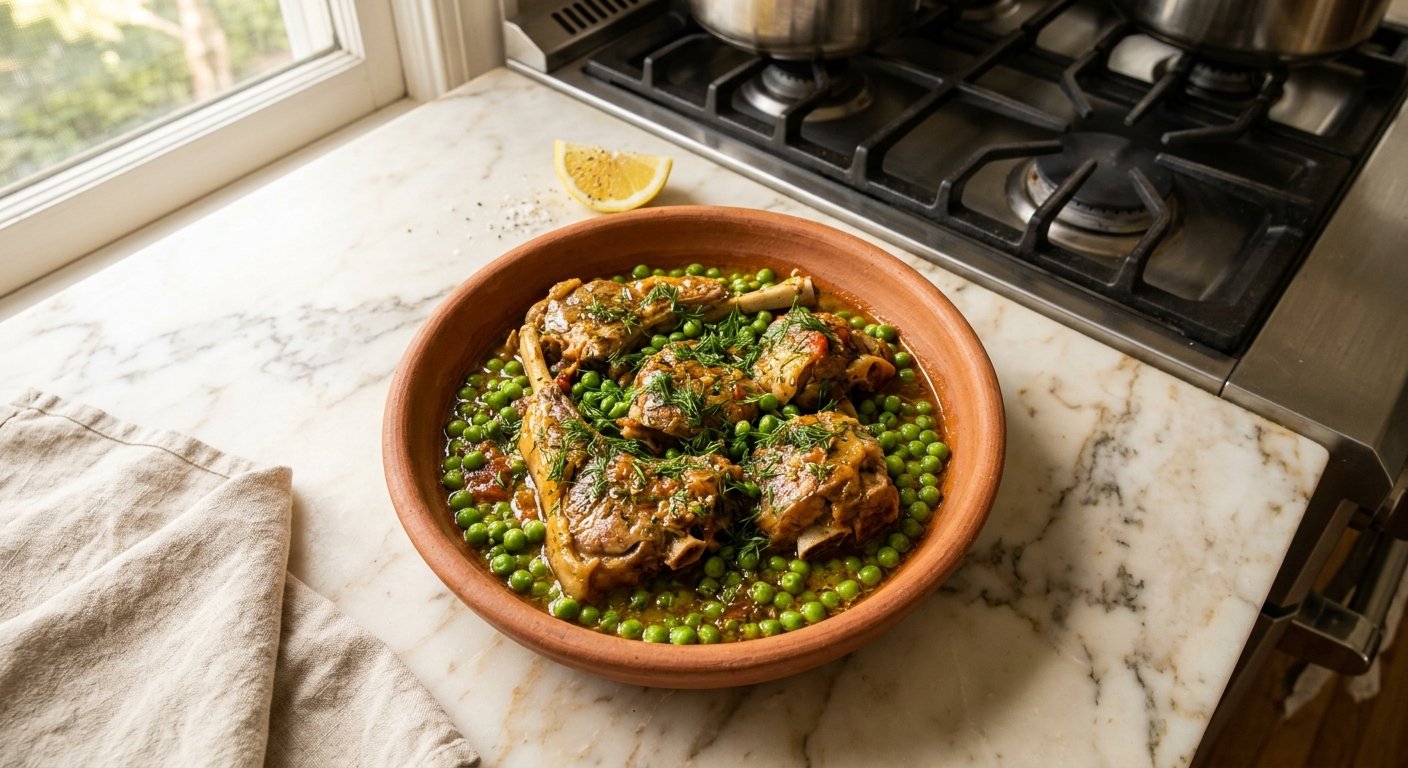
Arnaki me Araka (Greek Lamb and Peas)
Ingredients
For the Lamb Base
- 1.5 kg bone-in lamb shoulder or leg cut into large pieces
- 4 tablespoons extra-virgin olive oil plus a drizzle to finish
- 2 medium yellow onions finely diced
- 3 garlic cloves thinly sliced
- 120 ml dry white wine optional but recommended
- 240 ml warm water or light chicken stock
- 1 teaspoon dried oregano
- 1 teaspoon fine sea salt plus more to taste
- 0.5 teaspoon freshly ground black pepper
For the Peas and Finish
- 500 g fresh or frozen peas do not use canned
- 30 g fresh dill roughly chopped
- 4 tablespoons fresh lemon juice about 1 large lemon
- sea salt and black pepper to taste
Instructions
- Bring lamb to room temperature for at least 30 minutes. Pat very dry with paper towels.
- Season lamb on all sides with salt, pepper, and oregano.
- Heat olive oil in a large heavy pot over medium-high heat until shimmering.
- Brown lamb in batches, 3-4 minutes per side, until deeply golden. Transfer to a plate.
- Reduce heat to medium. Add onions, scraping up browned bits. Cook 6-8 minutes until soft and golden.
- Add garlic. Cook 1 minute, stirring, until fragrant.
- Add white wine; stir and reduce by half, about 2 minutes. (Or add a splash of warm water if skipping wine.)
- Return lamb to the pot. Add water or stock – liquid should come one-third up the lamb.
- Bring to a gentle simmer, cover, and braise over low heat for 60-75 minutes until lamb is very tender.
- Add peas, cover, and cook a further 12-15 minutes until tender. (Frozen peas: 8-10 minutes.)
- Remove from heat. Add fresh dill and lemon juice. Stir gently. Adjust seasoning.
- Rest 5 minutes covered. Serve with crusty bread and a drizzle of olive oil.
Notes
Nutrition
Chef’s Notes
Can I use boneless lamb? Yes. Boneless lamb shoulder works well and makes serving easier at the table. Reduce the braising time by about 15 minutes, since boneless pieces become tender more quickly. The sauce will be slightly less rich without the collagen from the bone, but arnaki me araka made with boneless lamb is still a very fine dish.
Make-ahead strategy. Arnaki me araka improves overnight. The lamb absorbs more of the braising liquid and the flavours deepen. My approach: cook the lamb base fully, but hold back the peas, dill, and lemon. Refrigerate the lamb in its sauce. The next day, skim any solidified fat from the surface, bring the lamb back to a simmer, add the peas, cook until tender, and finish with the dill and lemon off the heat. The peas stay much more vibrant this way.
Storage. Refrigerate leftovers in a sealed container for up to 3 days. Reheat gently over low heat with a small splash of water to loosen the sauce. I do not recommend freezing Greek lamb and peas — cooked peas become watery and lose their texture after freezing.
What to serve alongside. In my mother’s kitchen on Kos, this Greek lamb and peas dish always came with a thick slice of village bread — nothing else was needed. You can also pair it with a wedge of feta, a bowl of thick Greek yoghurt, or a simple cucumber salad. For a more substantial spread, this dish pairs naturally with my Greek Lemon Roasted Potatoes (Patates Lemonates), which roast in the oven while the arnaki me araka braises on the stove. If you enjoy ladera cooking, my Giouvetsi (Greek Baked Lamb with Orzo) is another spring table favourite.
On the white wine. The wine is optional, but I recommend it. It adds a gentle, round acidity to the braising liquid that balances the richness of the lamb. Use a dry white — an assyrtiko from the Aegean, a simple Greek white, or any dry European white wine you would drink yourself. If you prefer to cook without alcohol, use additional warm water or stock in its place.
Seasonal variation. When fresh or frozen peas are not available, try fresh or frozen broad beans (fava beans). The flavour profile shifts — earthier and denser — but the dish holds together well. In late summer on Kos, I have made Greek lamb and peas with fresh shelled borlotti beans, which create an even more substantial one-pot meal.
FAQ
What is the best cut of lamb for Greek lamb and peas?
Bone-in lamb shoulder is the best choice for arnaki me araka. The shoulder has more connective tissue than leg or loin, which breaks down during braising to create a rich, silky sauce. If shoulder is unavailable, bone-in leg pieces also work well. Avoid lean cuts like rack of lamb — they will dry out during the long braise.
Can I use frozen peas for arnaki me araka?
Yes. Good-quality frozen peas are an excellent substitute for fresh peas when they are out of season. Add them directly from frozen — do not thaw first. Frozen peas need about 8–10 minutes of cooking time in the Greek lamb and peas stew, compared to 12–15 for fresh. The flavour and colour are close to fresh, and the texture holds well.
How do I know when the lamb is properly done?
The lamb in your arnaki me araka should be very tender — it should offer almost no resistance when pressed gently with a spoon, and the meat should be visibly starting to pull away from the bone. If in doubt, taste a piece. The braising time is 60–75 minutes at a low simmer, but larger or older lamb pieces may need an extra 10–15 minutes. Do not rush this step.
What should I serve with Greek lamb and peas?
Crusty bread is the traditional accompaniment — essential for mopping up the olive oil–rich sauce. A wedge of feta, a bowl of Greek yoghurt, or a simple green salad all make good additions. For a full ladera meal, serve the arnaki me araka alongside my Fasolakia (Greek Green Beans braised in olive oil), which follows the same cooking philosophy and comes together in about 45 minutes.
Can I make arnaki me araka in the oven?
Yes. After returning the lamb to the pot with liquid (Step 8), transfer the covered pot to a 160°C (320°F) oven. Braise for 75–90 minutes. Add the peas, return the pot to the oven uncovered for 15 minutes, then finish off the heat with dill and lemon. The oven method provides very even, hands-off heat and is a good choice if you are cooking other dishes on the stove at the same time.