
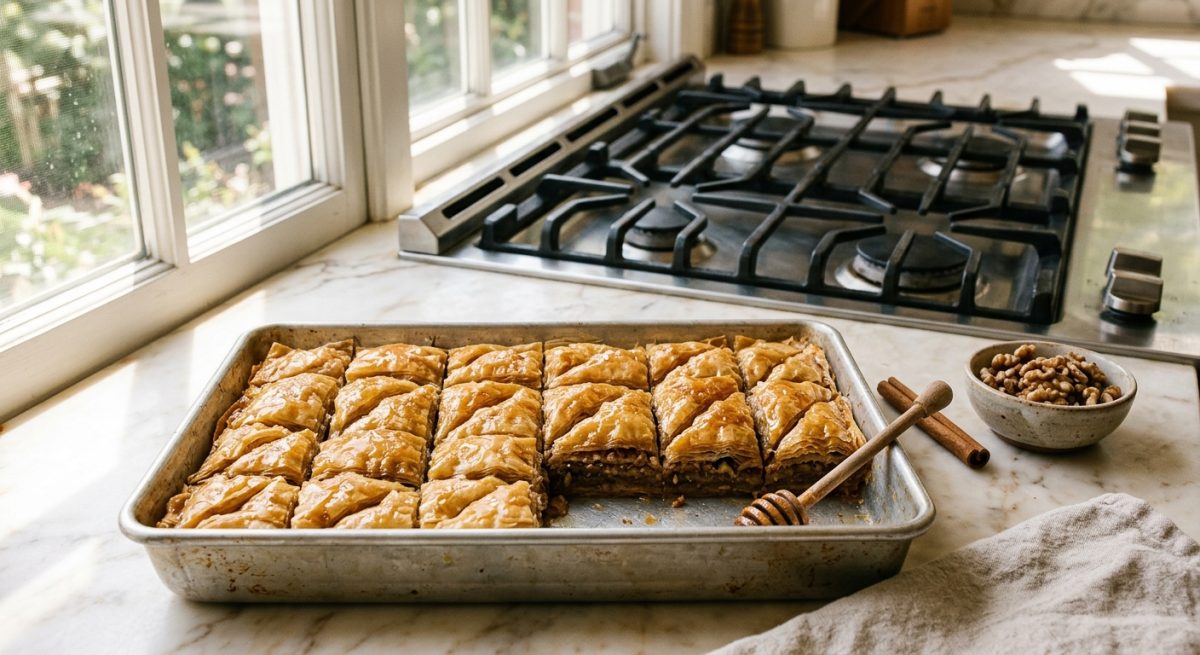
Every December on Kos, my mother would clear the kitchen table completely — not for any ordinary cooking, but for baklava. It was an event. The phyllo sheets came out of their paper wrapping slowly, carefully, like documents that mattered. My job as a boy was to stand at her elbow holding the damp cloth that kept those sheets from drying and cracking. I was not allowed to touch anything else.
She made baklava once a year, at Christmas, because it deserved that weight. Not because it was difficult — she could do it with her eyes half-closed by the end — but because she believed some things should remain special. A baklava recipe made every week loses something. Made at the holidays, it carries the whole year in it.
The version I am giving you here is built on what I learned at that table, refined over decades in professional kitchens where I had to understand not just the steps, but the reasons behind them. Why the syrup must be cool when it meets the hot pan. Why you cut the baklava before it goes in the oven, not after. Why clarified butter matters when you have forty sheets of phyllo to brush.
This is a Greek baklava recipe — walnuts, honey, cinnamon, cloves — the Dodecanese style I grew up with.
Why This Recipe Works
- Cold syrup on hot baklava. This is the technique most home bakers get backwards. Pour room-temperature or cool syrup over the baklava the moment it comes out of the oven. The thermal contrast drives the syrup deep into the layers while keeping the top crisp rather than soft and sticky.
- Cut before baking, not after. Baked phyllo shatters when you cut it cold. Cutting before baking lets the layers fuse cleanly along the cut lines, giving you perfect diamond pieces that hold together when you lift them.
- Clarified butter only. The milk solids in whole butter burn at oven temperatures and can make the phyllo taste slightly bitter. Clarifying — or using ghee — gives you pure fat that brushes smoothly and browns evenly without any off-flavors.
- The walnut layer is seasoned, not just chopped. Sugar, cinnamon, and a pinch of cloves mixed into the walnuts before layering means the flavor is built into the filling, not just carried by the syrup. Every bite tastes complete.
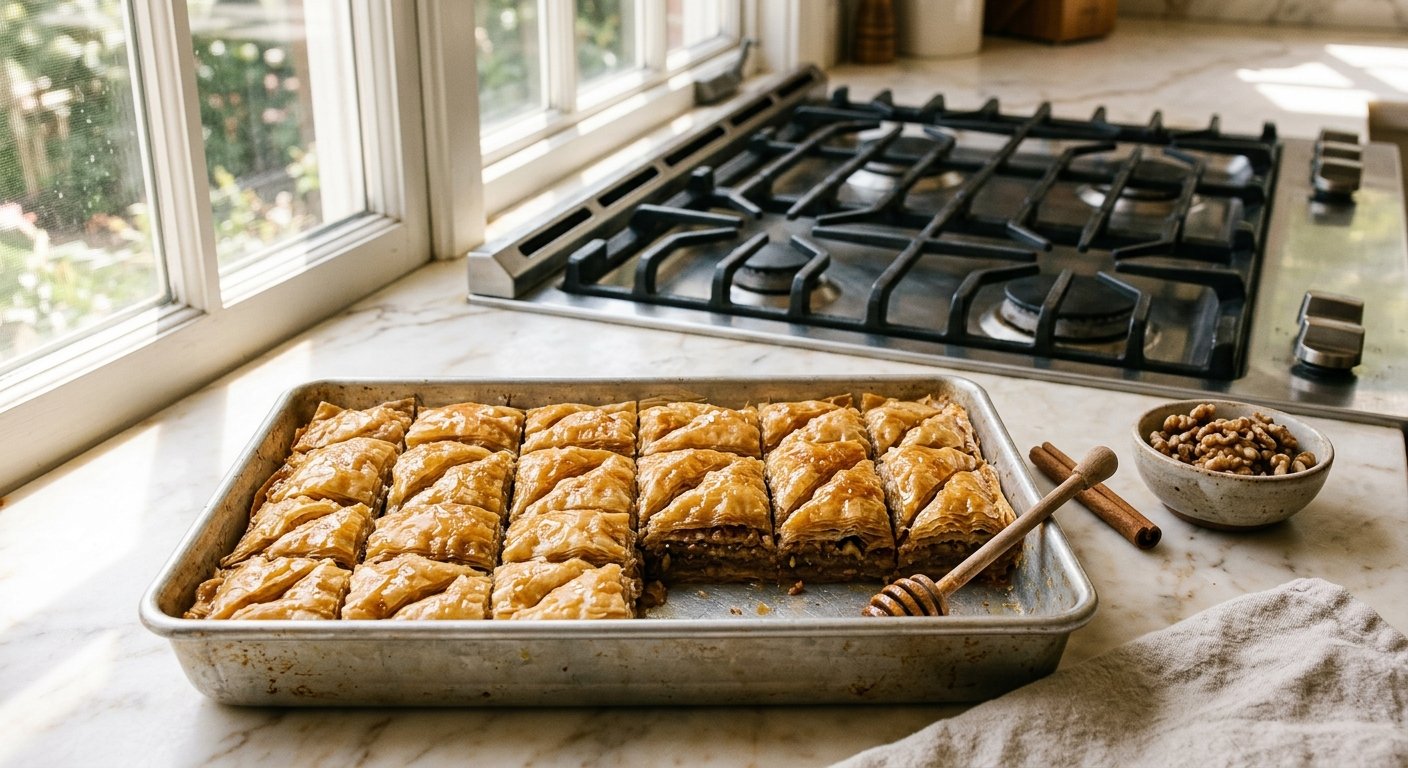
Classic Greek Baklava
Ingredients
Nut Filling
- 3 cup walnut halves roughly chopped
- 3 tablespoons granulated sugar
- 1 teaspoon ground cinnamon
- 1/4 teaspoon ground cloves
Pastry
- 1 lb phyllo dough thawed overnight in refrigerator
- 1 1/2 cup unsalted butter clarified, or good-quality ghee
Honey Syrup
- 1 cup granulated sugar
- 1 cup Greek honey thyme honey preferred
- 3/4 cup water
- 1 strip lemon peel
- 1 cinnamon stick
- 3 whole cloves
Instructions
- Combine walnuts, sugar, cinnamon, and cloves in a bowl. Set aside.
- Make the syrup: combine sugar, honey, water, lemon peel, cinnamon stick, and cloves in a saucepan. Bring to a boil, reduce heat, and simmer 10 minutes. Remove aromatics and set aside to cool completely. The syrup must be cool when it meets the hot pastry.
- Clarify the butter: melt over low heat, skim foam, pour off clear fat, discard milk solids.
- Preheat oven to 325°F (160°C). Butter the baking pan generously.
- Layer 8–10 phyllo sheets in the pan, brushing each with butter. Keep unused phyllo covered with a damp cloth.
- Spread half the walnut mixture evenly over the base. Press down lightly.
- Add 4–6 more buttered phyllo sheets on top.
- Spread remaining walnut mixture evenly.
- Layer remaining phyllo sheets, buttering each generously. Finish with a generous final butter brushing on top.
- Cut all the way through to the bottom of the pan into diamond shapes before baking. Use a sharp knife with a light sawing motion.
- Bake at 325°F for 45–55 minutes until deep golden brown. Cover loosely with foil if top browns too fast in the last 15 minutes.
- Remove from oven. Pour the cooled syrup slowly and evenly over the entire surface of the hot baklava. You will hear it sizzle and absorb.
- Cool at room temperature for at least 4 hours before serving. Do not refrigerate.
Notes
Nutrition
Chef’s Notes
On phyllo
The biggest mistake people make is letting the phyllo dry out. Keep it covered from the moment you open the package. If a sheet tears, just layer it over the next one and brush with butter. No one will see the inside anyway.
On walnuts vs. pistachios
Many regions use pistachios, and I love them — but on Kos we used walnuts. My mother’s preference, and I haven’t found a reason to change it. If you want to use pistachios (unsalted, roughly chopped), reduce the cinnamon slightly. The flavor profile is more delicate.
On the syrup
Some Greek recipes call for more sugar and less honey. I prefer this ratio — honey-forward, with real depth. If you can source Greek thyme honey, use it. It has a slight bitterness that cuts the richness beautifully. If not, any good wildflower honey works.
Make-ahead
Baklava is better the next day. You can make it up to 3 days before you need it. Store covered at room temperature.
Frequently Asked Questions
Can I use store-bought phyllo dough for baklava?
Yes — and you should. Fresh handmade phyllo is beautiful, but it is a skill that takes years to develop. Commercially available phyllo from the freezer section works very well. The key is to thaw it properly (overnight in the refrigerator, not on the counter) and to work with it while it is still slightly cool.
Why is my baklava soggy instead of crispy?
Almost always, this comes down to syrup temperature. If you pour warm or hot syrup onto hot baklava, the pastry absorbs too much liquid and loses its crispness. Use cool or room-temperature syrup poured over freshly-baked hot baklava. The temperature contrast drives absorption without waterlogging the phyllo.
Can I make Greek baklava with pistachios instead of walnuts?
Absolutely. Pistachios are traditional in many parts of Greece and across the wider region. Use unsalted pistachios, roughly chopped. Reduce the cinnamon to ½ teaspoon — pistachio baklava is more delicate in flavor and doesn’t need as much spice.
How long does homemade baklava keep?
Stored loosely covered at room temperature (not in an airtight container, which traps moisture), baklava keeps well for 4–5 days. It actually tastes better on day 2 and 3 as the syrup settles. Do not refrigerate — cold temperatures make the phyllo soft.
Is Greek baklava the same as Turkish baklava?
The pastry is related — baklava has been made across the eastern Mediterranean and Middle East for centuries, and many cultures have their own beloved versions. Greek baklava tends to use walnuts, honey, and warm spices like cinnamon and cloves. Turkish baklava often uses pistachios and a lighter sugar syrup. Both are delicious, and both deserve respect. What I can speak to is the version I grew up with on Kos — and this is that recipe.