
There is a particular kind of Tuesday evening I remember clearly from growing up on Kos. The sun had already dropped behind the hills, the harbor was settling into its evening quiet, and my mother would appear in the kitchen with a tray of chicken she had been marinating since morning. She never announced what was for dinner. She didn’t have to. The moment that lemon and oregano hit the hot oven, the whole house knew.
Kotopoulo lemonato — Greek lemon chicken — is not a recipe that announces itself with complexity. It is built on five things: good bone-in chicken, fresh lemon, raw garlic, dried Greek oregano, and olive oil. What it asks of you is patience before you cook it (the marinade needs time) and heat when you do (a proper hot oven, not a cautious one). In return it gives you skin that crisps and blisters at the edges, meat that pulls clean from the bone, and pan juices that smell, frankly, like someone’s grandmother loves you.
I have eaten kotopoulo lemonato in tavernas by the water in Kos, in London restaurants trying hard to be Greek, and from my own oven more times than I can count. The version I am giving you here is the pan-roasted method — not a braised casserole, not a slow-cooked one-pot. High heat, a wide roasting pan, bone-in thighs and drumsticks. The skin crisps properly. The garlic caramelizes at the edges. And when you deglaze that pan with a splash of cold water and reduce it briefly, you get a concentrated pan sauce that my mother used to pour directly over the platter while she told you to sit down and eat.
This is that recipe.
Table of Contents
Why This Recipe Works
- Bone-in, skin-on pieces hold up. Thighs and drumsticks have enough fat to baste themselves throughout a long, hot roast. Boneless cuts dry out. The bone conducts heat from the inside; the skin protects the meat and crisps into something worth eating.
- Marinating time is not optional. Lemon juice begins to denature the surface proteins within an hour, but the garlic and oregano need longer to penetrate. Two hours gives you a reasonable result. Overnight gives you the dish you remember.
- High heat creates the crust. 220°C / 425°F is not a typo. Lower temperatures steam the chicken rather than roast it. You want the skin to blister slightly at the edges and the lemon slices to caramelize in the pan — that happens only with genuine heat.
- The pan sauce earns its place. Deglazing the roasting pan with cold water and reducing it for two minutes recovers all the browned lemon and garlic fond. This is where the dish’s concentrated flavor lives. Pouring it over the platter at the table is not optional.
Ingredients
For the chicken and marinade
- 1.2–1.4 kg (about 2.5–3 lb) bone-in, skin-on chicken pieces (thighs and drumsticks)
- 3 tablespoons fresh lemon juice (from about 2 lemons)
- 1 tablespoon finely grated lemon zest
- 4 garlic cloves, finely grated or minced
- 4 tablespoons extra-virgin olive oil
- 2 teaspoons dried Greek oregano (see Chef’s Notes on sourcing)
- 1½ teaspoons fine sea salt
- ½ teaspoon freshly ground black pepper
For roasting and the pan sauce
- 1 lemon, sliced into thin rounds
- 2 tablespoons water (for deglazing)
- 1 teaspoon dried Greek oregano (additional, for finishing)
- Flaky salt, to finish
Step-by-Step Instructions
1. Make the marinade.
In a large bowl or zip-lock bag, combine the lemon juice, lemon zest, grated garlic, olive oil, dried oregano, salt, and pepper. Whisk briefly to combine. Add the chicken pieces and turn to coat thoroughly. Cover and refrigerate for a minimum of 2 hours — overnight is strongly preferred. If marinating overnight, let the chicken come to room temperature for 30 minutes before roasting.
2. Preheat the oven.
Set your oven to 220°C / 425°F (200°C fan / 400°F fan). Place a shelf in the upper third of the oven. A hot oven from the start is essential — do not rush this step.
3. Arrange the pan.
Transfer the chicken pieces to a wide roasting pan, skin-side up, in a single layer with a little space between each piece. Pour any remaining marinade over the top. Tuck the lemon slices under and around the chicken. Do not crowd the pan — crowded pieces steam rather than roast.
4. Roast.
Place the pan in the upper third of the oven and roast for 25 minutes. Baste the chicken with the pan juices using a spoon or brush. Return to the oven for another 20–25 minutes, until the skin is deep golden and blistered at the edges and the internal temperature reads 74°C / 165°F at the thickest point.
Chef’s tip: If the skin is not crisping by the 40-minute mark, switch on the grill/broiler for the final 3–4 minutes. Watch it closely.
5. Rest the chicken.
Transfer the chicken pieces to a warm platter. Cover loosely with foil and rest for 5 minutes.
6. Make the pan sauce.
Place the roasting pan directly over medium heat on the stovetop (use two burners if necessary). Add the cold water to the pan and use a wooden spoon to scrape up all the browned bits from the base. Let it bubble and reduce for 1–2 minutes until slightly syrupy. Taste and adjust salt.
7. Finish and serve.
Pour the pan sauce over the chicken on the platter. Scatter a pinch of additional dried oregano and a little flaky salt over the top. Serve immediately.
Recipe Card
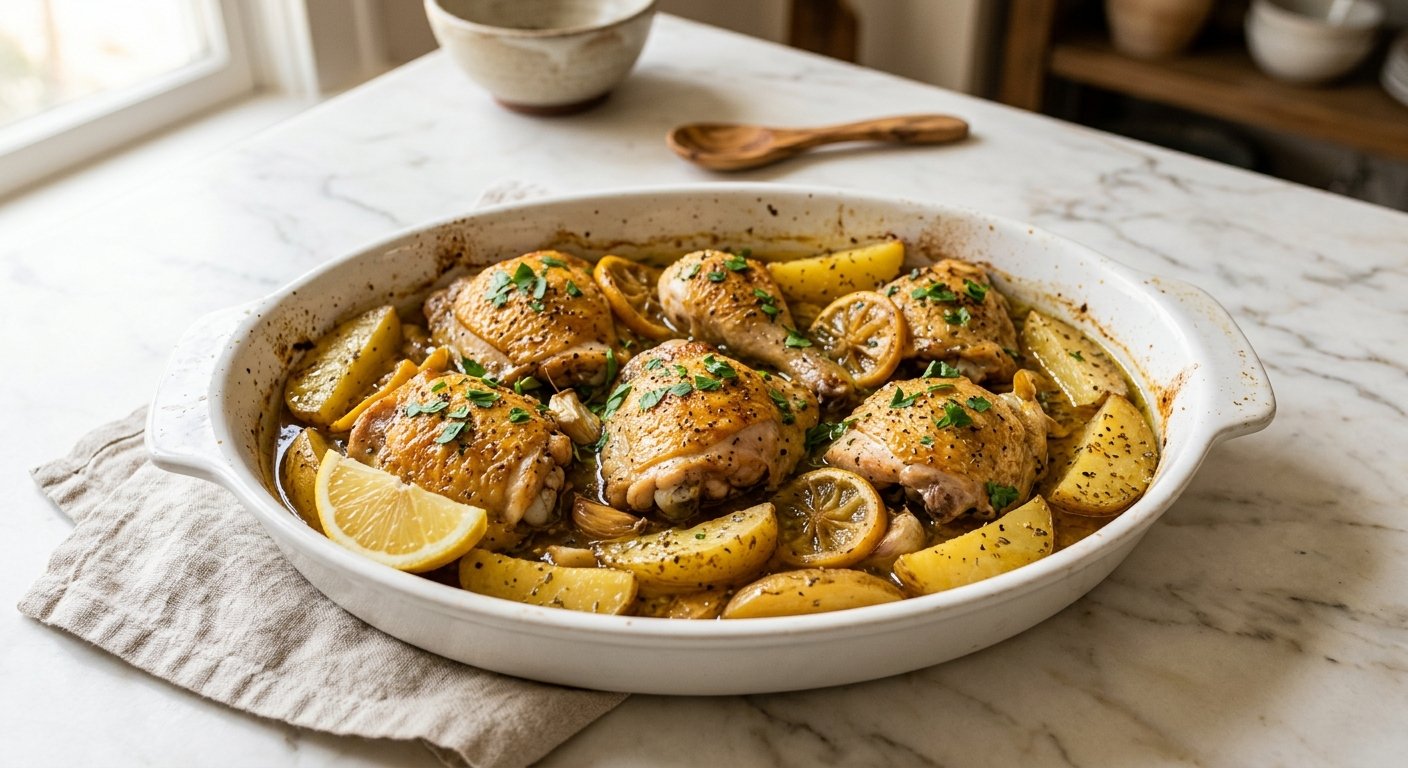
Kotopoulo Lemonato (Greek Lemon Chicken)
Ingredients
For the marinade
- 1.4 kg bone-in, skin-on chicken thighs and drumsticks about 2.5-3 lb
- 3 tablespoons fresh lemon juice from about 2 lemons
- 1 tablespoon lemon zest finely grated
- 4 garlic cloves finely grated or minced
- 4 tablespoons extra-virgin olive oil
- 2 teaspoons dried Greek oregano rigani
- 1.5 teaspoons fine sea salt
- 0.5 teaspoon freshly ground black pepper
For roasting and the pan sauce
- 1 lemon sliced into thin rounds
- 2 tablespoons cold water for deglazing
- 1 teaspoon dried Greek oregano for finishing
- flaky salt to finish
Instructions
- In a large bowl or zip-lock bag, combine the lemon juice, lemon zest, grated garlic, olive oil, dried oregano, salt, and pepper. Whisk briefly to combine. Add the chicken pieces and turn to coat thoroughly. Cover and refrigerate for a minimum of 2 hours. Overnight is strongly preferred. If marinating overnight, let the chicken come to room temperature for 30 minutes before roasting.
- Set your oven to 220°C / 425°F (200°C fan / 400°F fan). Place a shelf in the upper third of the oven.
- Transfer the chicken pieces to a wide roasting pan, skin-side up, in a single layer with a little space between each piece. Pour any remaining marinade over the top. Tuck the lemon slices under and around the chicken. Do not crowd the pan.
- Place the pan in the upper third of the oven and roast for 25 minutes. Baste the chicken with the pan juices. Return to the oven for another 20-25 minutes, until the skin is deep golden and blistered at the edges and the internal temperature reads 74°C / 165°F at the thickest point. If the skin is not crisping by the 40-minute mark, switch on the grill/broiler for the final 3-4 minutes.
- Transfer the chicken pieces to a warm platter. Cover loosely with foil and rest for 5 minutes.
- Place the roasting pan directly over medium heat on the stovetop. Add the cold water and use a wooden spoon to scrape up all the browned bits from the base. Let it bubble and reduce for 1-2 minutes until slightly syrupy. Taste and adjust salt.
- Pour the pan sauce over the chicken on the platter. Scatter a pinch of additional dried oregano and a little flaky salt over the top. Serve immediately.
Notes
Chef’s Notes
On Greek oregano: There is a specific character to rigani — the dried Greek hill oregano — that differs from Italian dried oregano or the fresh herb. It is more resinous, more peppery, and it holds up to heat in a way fresh leaves do not. If you cannot find Greek oregano specifically, look for Origanum vulgare subsp. hirtum, which the Oxford Companion to Food identifies as the variety traditional to Greek and Turkish cooking. The difference in the finished dish is noticeable.
Can I spatchcock a whole chicken? Yes, and it works well. A 1.6 kg spatchcocked bird needs 45–50 minutes at the same temperature. Apply the marinade under the skin as well as over it.
Can I add potatoes to the pan? Technically yes, though the pan becomes crowded and the chicken skin will not crisp as well. My recommendation: roast the chicken in its own pan and serve alongside my Patates Lemonates (Greek Lemon Potatoes), which cook at the same temperature and finish at roughly the same time. They are made for each other.
Make-ahead: The chicken can be marinated up to 18 hours in advance and kept covered in the refrigerator. The roasted chicken reheats reasonably well — cover with foil at 160°C / 320°F for 15 minutes, though the skin will not recover its original crispness.
Storage: Leftovers keep refrigerated for 3 days. The cold chicken, shredded, is excellent in a pita with tzatziki.
What to serve with it: This dish belongs alongside Horiatiki (Greek Village Salad) and good bread to soak up the pan sauce. For a more substantial table, add a platter of Souvlaki and let people choose.
FAQ
Can I use boneless, skinless chicken for kotopoulo lemonato?
You can, but the result is a different dish. Without the skin, there is no fat to protect the meat at high heat, and the chicken dries out before the marinade caramelizes properly. If you prefer boneless, reduce the oven temperature to 200°C / 400°F and cut the roasting time to 25–30 minutes. The pan sauce will be thinner.
How long should I marinate the Greek lemon chicken?
Two hours is the minimum for the garlic and oregano to begin penetrating the meat. Overnight (8–12 hours) produces noticeably better flavor. Beyond 18 hours, the acid in the lemon juice begins to affect the texture of the surface meat — it can become slightly chalky. If you marinate overnight, keep the lemon juice measurement to 3 tablespoons; do not be tempted to add more.
Can I use fresh oregano instead of dried?
Dried Greek oregano is the traditional and correct choice for this dish. The essential oils in fresh oregano are too volatile — much of their flavor burns off at high roasting temperatures. Use dried for cooking and, if you have access to fresh, a small amount as a garnish after the chicken comes out of the oven. The two serve different purposes.
Can I make kotopoulo lemonato ahead of time?
The chicken is best eaten immediately from the oven when the skin is still crisp. If you need to prepare ahead, marinate the chicken the night before (the marinade improves with time). The cooked chicken can be reheated covered at 160°C for 15 minutes, though you will sacrifice some of the skin texture. The pan sauce can be made, cooled, and reheated separately.
What are the best side dishes for Greek lemon chicken?
The natural pairing is Patates Lemonates — the pan juices of both dishes share the same lemon-oregano character and the combination is a complete Greek Sunday meal. A crisp Horiatiki alongside cuts the richness of the chicken. Good bread is essential to deal with the pan sauce. Rice or orzo cooked in chicken stock also works well for the same reason.
Recipe by Chef Niko | mypreptable.com