
There is a dish I have eaten at every significant table on Kos — at Easter, at name-day celebrations, at the kafeneion after church, packed cold in a cloth and carried to the beach for a midday meal that had nothing to apologize for. That dish is spanakopita. Spanakopita Greek spinach and feta pie is so deeply woven into the fabric of Greek home cooking that it sometimes gets taken for granted — and that, I think, is how it gets made badly.
I have had spanakopita that was soggy. I have had it bland, its filling tasting of nothing, the filo soft and yielding where it should be shattering. I have had it made with ricotta instead of feta — well-meaning, perhaps, but fundamentally wrong. And I have had it made with butter on the filo, which I understand from a technical standpoint but which is not how my mother made it on Kos, and not how most of Greece makes it. In the Aegean tradition, olive oil is what you brush on the filo. Butter is a Western substitution that changes the flavor profile noticeably.
The good news is that none of the mistakes are hard to avoid. Once you understand what the recipe is actually asking — and why each step matters — spanakopita becomes a reliable, deeply satisfying dish that you will return to again and again. It stores well, travels well, and feeds a crowd. After years of making this in professional kitchens and in my own home, here is what I have found to be essential.
Table of Contents
Why This Recipe Works
Making a spanakopita Greek spinach and feta pie that is actually good comes down to five decisions. Every other detail follows from these:
- The spinach must be bone dry. Moisture is the enemy of filo. Fresh spinach releases a remarkable amount of water when it wilts — far more than it looks like it contains raw. If you do not squeeze that water out thoroughly — and I mean aggressively, in handfuls, until you can barely extract another drop — the moisture migrates upward through the filo during baking and gives you a soft, pale base with none of the crunch the dish requires. The same applies to frozen spinach: defrost it fully and then squeeze it with both hands, repeatedly, until it is nearly dry.
- Feta — real feta — and enough of it. The filling should taste salty and rich. Under-feta’d spanakopita is flat and disappointing. According to Wikipedia’s entry on feta, authentic feta must be made from sheep’s milk or a blend with up to 30% goat’s milk, and must come from specific regions of Greece — it has Protected Designation of Origin status. That mineral, tangy sharpness is exactly what the spinach filling needs. Do not substitute with fresh mozzarella, ricotta, or any neutral white cheese. They do not taste the same.
- Olive oil on the filo, not butter. In Dodecanese kitchens — and in most of mainland Greece — filo for savory pies is brushed with olive oil, not melted butter. Butter produces a richer, heavier result and is common in some Northern Greek and Turkish preparations, but it changes the character of the pie. Olive oil gives you a crisper, more delicate filo with a faint fruity note that complements the filling. Use a good quality extra-virgin olive oil and do not be stingy — each sheet needs to be properly coated.
- Three sheets minimum per layer, scored before baking. One thin layer of filo provides no structural protection. The top layers should be at least three sheets thick, each one brushed. Before the pan goes in the oven, score through the top filo layers with a sharp knife — marking out your squares or diamonds without cutting all the way through the filling. This scoring is structural: it allows steam to escape during baking (which keeps the filo dry and crisp), and it means your pieces come out clean and intact rather than shattering unevenly when you cut into a baked, brittle surface.
- Rest before cutting. Like pastitsio and lahanodolmades, spanakopita needs 10-15 minutes off the heat before you cut and serve it. The filling firms up, the filo sets, and the pieces hold together. Cut it too soon and you get a greasy, sliding mess.
Ingredients
For the Filling
- 700g (1.5 lbs) fresh spinach, stems removed — or 500g (1 lb) frozen spinach, fully defrosted
- 300g (10.5 oz) Greek feta, crumbled (do not use pre-crumbled; buy a block)
- 4 large eggs
- 1 bunch scallions or spring onions (about 6-8), finely sliced
- 1/4 cup fresh dill, finely chopped
- 1/4 teaspoon freshly ground black pepper
- 1/4 teaspoon ground nutmeg
- 2 tablespoons olive oil (for sauteing the scallions)
For the Filo and Pan
- 12-14 sheets filo pastry (store-bought, thawed overnight in the fridge if frozen)
- 120ml (1/2 cup) extra-virgin olive oil, for brushing
- A 33x23cm (13×9 inch) baking pan, lightly oiled
Step-by-Step Instructions
1. Prepare the spinach — this is the most important step.
If using fresh spinach: wash and dry the leaves. In a large skillet over medium-high heat, wilt the spinach in batches with just the water clinging to the leaves. It will cook down dramatically. Transfer to a colander and let it cool. Once cool enough to handle, take handfuls of spinach and squeeze firmly over the sink. Keep squeezing until almost no water comes out. Then squeeze again. Roughly chop the squeezed spinach.
If using frozen: defrost completely, spread on a clean kitchen towel, roll up the towel, and squeeze out as much water as possible. Transfer to a cutting board and chop finely.
2. Saute the scallions.
In the same skillet, heat 2 tablespoons of olive oil over medium heat. Add the sliced scallions and cook gently for 4-5 minutes until soft and translucent. Remove from heat and allow to cool slightly.
3. Make the filling.
In a large bowl, combine the squeezed spinach, sauteed scallions, crumbled feta, eggs, fresh dill, black pepper, and nutmeg. Mix well with a fork until the eggs are fully incorporated. Taste — if the feta is mild, you may want to add a small pinch of salt, but most feta provides enough. The filling should taste assertively of cheese and herb.
4. Prepare your workspace.
Unroll the filo sheets onto a clean surface. Place a slightly damp kitchen towel over the stack to keep them from drying out. Have your olive oil and a pastry brush ready. Work quickly once you start — filo dries and tears easily.
5. Layer the base.
Preheat your oven to 190C / 375F (fan-assisted) or 200C / 400F (conventional). Brush the base of your pan lightly with olive oil. Lay one sheet of filo in the pan, allowing it to drape over the edges. Brush with olive oil. Repeat with 5-6 sheets total for the base, each one brushed. Alternate the direction you lay them slightly if they are longer than the pan — this creates a stronger base.
6. Add the filling.
Pour the spinach and feta filling over the base filo layers. Spread evenly with a spatula, pressing gently into the corners. The filling should be about 2-3cm (around 1 inch) thick.
7. Layer the top.
Add 6-8 more sheets of filo over the filling, brushing each one with olive oil. For the final top sheet, brush generously. Fold the overhanging edges from the base sheets up and over the top, tucking them in — this creates a neat sealed edge and a slightly thicker border that crisps up well.
8. Score the top and bake.
Using a sharp knife, score through only the top filo layers (not through the filling) in your desired portions — squares or diamonds. Score deep enough to cut through 3-4 top layers, which allows steam to escape. Brush the entire top surface once more with olive oil. Bake for 40-45 minutes until deeply golden and crisp across the entire surface. If the edges brown faster than the center, tent loosely with foil for the last 10 minutes.
9. Rest before serving.
Remove from the oven and allow to rest for 10-15 minutes before cutting through the score lines and serving. The filo will remain crisp.
Recipe Card
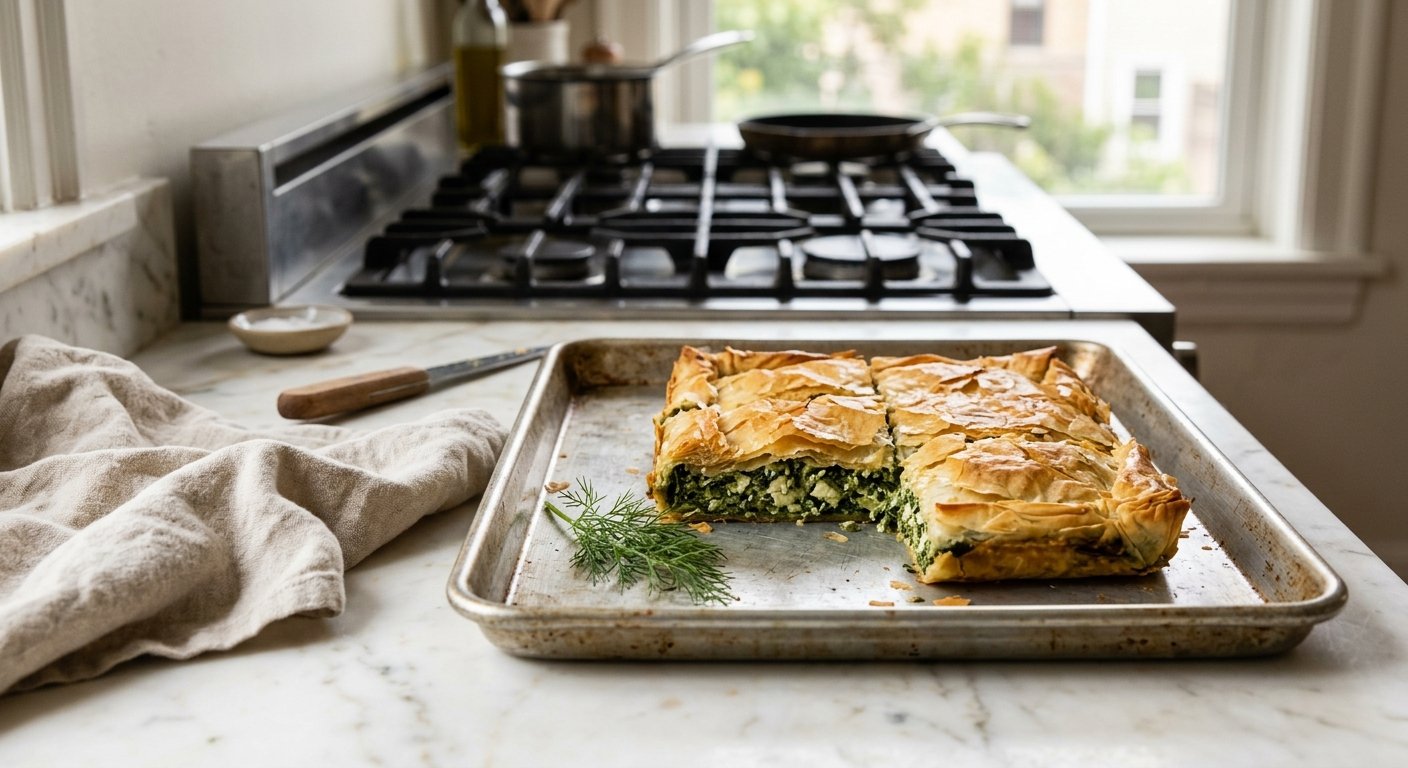
Spanakopita (Greek Spinach and Feta Pie)
Ingredients
For the Filling
- 700 g fresh spinach, stems removed (or 500g frozen spinach, fully defrosted)
- 300 g Greek feta, crumbled from a block
- 4 large eggs
- 6-8 scallions (spring onions), finely sliced
- 1/4 cup fresh dill, finely chopped
- 1/4 tsp freshly ground black pepper
- 1/4 tsp ground nutmeg
- 2 tbsp olive oil, for cooking the scallions
For the Filo and Pan
- 12-14 sheets filo pastry thawed overnight in fridge if frozen
- 120 ml extra-virgin olive oil, for brushing
- olive oil for greasing the pan
Instructions
- Wilt fresh spinach in a skillet in batches, cool, then squeeze out all moisture firmly by hand. Chop. (For frozen: defrost fully and squeeze aggressively in a towel until nearly dry, then chop.)
- In the same skillet, heat 2 tbsp olive oil over medium heat. Saute scallions 4-5 minutes until soft. Cool.
- In a large bowl, combine spinach, scallions, feta, eggs, dill, pepper, and nutmeg. Mix until eggs are fully incorporated. Taste and adjust salt if needed.
- Preheat oven to 190C / 375F (fan) or 200C / 400F (conventional). Lightly oil the baking pan.
- Layer 5-6 filo sheets in the pan for the base, brushing each one with olive oil as you go. Let sheets overhang the edges.
- Spread spinach and feta filling evenly over the base filo.
- Layer 6-8 more filo sheets over the filling, brushing each with olive oil. Fold the overhanging base sheets up over the top edges to seal.
- Using a sharp knife, score through the top filo layers (not the filling) into squares or diamonds. Brush the surface generously with olive oil.
- Bake 40-45 minutes until deeply golden and crisp all over.
- Rest 10-15 minutes before cutting through the score lines and serving.
Nutrition
Chef’s Notes
On filo thickness: Store-bought filo ranges in thickness depending on brand. The thinner the sheets, the more you should use per layer. For very thin phyllo, go up to 8 sheets on the base. You want structure.
On the tray format vs. triangles: On Kos, and across most of the Aegean, spanakopita is made in a large tray and cut into portions after baking. The triangular individual spanakopita you often find at bakeries or cocktail parties — known as spanakopitakia — are a different format. Both are valid, but the tray version is the family-table dish. If you want to make the triangular format for a party, cut filo sheets into long strips, place a tablespoon of filling at one end, and fold flag-style into triangles. Brush with olive oil and bake at the same temperature for 20-25 minutes.
On the filo technique: If you want to explore the same filo method applied to a sweet context, my galaktoboureko uses a similar olive oil-brushed layering with a semolina custard filling — a good next step once you are comfortable with the technique.
For a related savory filo pie using only cheese (no spinach), see my tiropita Greek cheese pie — the filo handling is identical, which makes it an easier starting point if this is your first time working with filo pastry.
Storage: Spanakopita keeps well. Covered at room temperature it holds for 24 hours without losing much crispness. Refrigerated and covered, up to 4 days — reheat in a 180C / 350F oven for 10-12 minutes to restore the filo’s texture. Do not reheat in the microwave; it steams the filo soft.
Freezing: Freeze baked spanakopita in individual portions, well-wrapped, for up to 2 months. Reheat from frozen in a 180C oven for 18-20 minutes.
Variations:
- Hortopita: Substitute half the spinach with wild greens — dandelion, chard, or a mix. The flavor is more earthy and complex. If you can find them fresh, leeks are also excellent here.
- Adding herbs: Some families add fresh flat-leaf parsley alongside or instead of dill. I prefer dill, which is the more distinctly Greek flavor profile.
- Dried vs. fresh dill: Use fresh. Dried dill has a fundamentally different character — more hay-like, less bright — and is not a substitute in this dish.
FAQ
Can I use frozen spinach for spanakopita?
Yes — frozen spinach works well and is actually the preferred option for many Greek home cooks because it skips the wilting step. The critical requirement is that you defrost it completely and then squeeze out every drop of water you possibly can. Spread it on a clean towel, roll the towel up, and press firmly. Repeat with a fresh section of towel if needed. Under-squeezed frozen spinach will make the filo soggy from the bottom up.
Why does my spanakopita filo go soggy?
Almost always: excess moisture in the spinach, not enough oil on the filo, or cutting it too soon after baking. These three issues cover roughly 90% of soggy spanakopita cases. The spinach must be bone dry before it goes into the filling. The filo must be generously brushed with oil, not just swiped lightly. And the pie must rest 10-15 minutes before cutting so the structure sets.
Can I use butter instead of olive oil on the filo?
You can, technically. The filo will still bake and turn golden. But in the Greek tradition — certainly in Dodecanese cooking — olive oil is the correct fat for savory filo pies. Butter produces a heavier, richer result and changes the flavor profile. If you find a recipe calling for butter in spanakopita, it is likely influenced by Turkish or Northern Greek adaptations, or by Western interpretations of the dish. Use olive oil.
What can I substitute for feta cheese?
Nothing works as a true substitute. Feta has a Protected Designation of Origin status for good reason — its flavor, saltiness, and crumbly texture are specific to its milk source and aging process. Ricotta, fresh mozzarella, and cream cheese are all fundamentally different products that produce a blander, less Greek result. If you cannot find authentic Greek feta, a Bulgarian-style feta (also sheep’s milk based) comes closest. Do not use the pre-crumbled variety sold in plastic tubs — buy a block stored in brine.
How do I keep the filo from drying out while I work?
Once you unroll the filo stack, keep the sheets you are not actively using covered with a slightly damp (not wet) kitchen towel. Work quickly and deliberately — lay a sheet, brush it, add the next. If a sheet tears, do not discard it; just layer it in anyway. In a multi-layer structure, small tears are invisible in the finished pie. Filo becomes brittle when dry, but as long as you keep the stack covered between uses you will have very few problems.