
There are pastries that exist in a category beyond everyday cooking. Galaktoboureko is one of them.
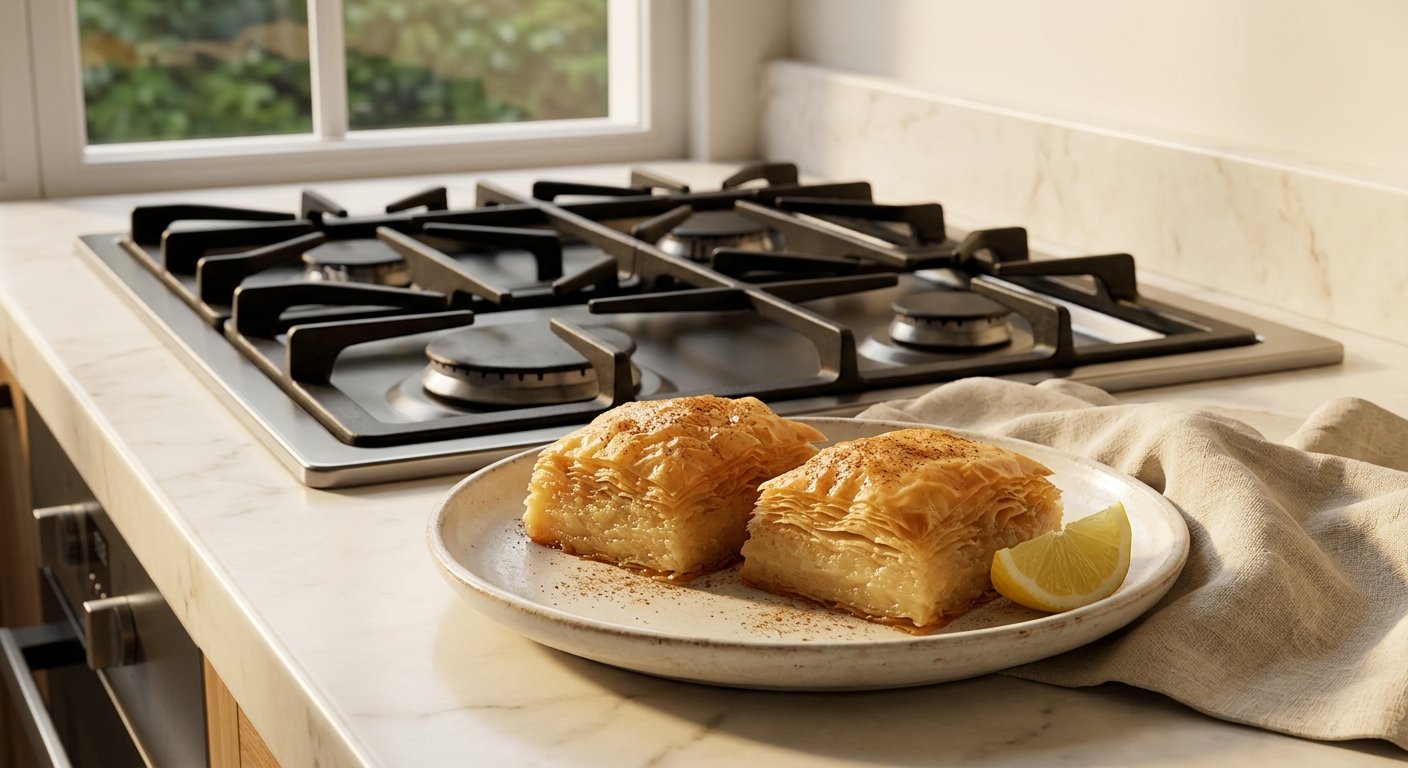
On Kos, the zaharoplasteia was a serious institution. Every town had at least one good one, and the galaktoboureko behind the glass counter had a particular way of sitting: the filo layers pressed together under their own weight, the custard visible from the side where someone had cut a piece and the golden edge revealed the pale yellow interior. When you ordered a piece, it came on a small plate, and the syrup that had been poured over it when it came out of the oven had had time to settle into the filo properly. Cold syrup on hot pastry. That rule matters more than almost anything else in this recipe.
Galaktoboureko Greek custard pie is, at its core, a semolina custard layered between sheets of buttered filo, then soaked in a light citrus syrup. It is one of the great Greek pastries, and it has a simplicity that conceals how precise the technique needs to be.
Why This Recipe Works
- Fine semolina gives the right texture. The semolina custard should be thick, silky, and sliceable once it cools. Fine semolina cooks into a smooth, lightly grainy custard that holds together cleanly when cut. Coarse semolina produces a gritty result that is unpleasant in a pastry context.
- Tempering the eggs is not optional. You are adding eggs to hot milk. If you pour hot milk directly into eggs without tempering, you get scrambled eggs in milk. Adding the hot milk slowly to the egg mixture while whisking raises the temperature gradually and safely. Do not skip this step.
- The custard must be thick before it leaves the heat. It will thicken further as it cools, but if it is thin in the pan, it will seep under the filo and give you a soggy base. Cook it until it is visibly thick and pull-away-from-the-sides thick. It takes patience and constant stirring.
- The syrup rule. Cold syrup on hot pastry, or hot syrup on cold pastry. Never both hot or both cold. The temperature differential drives absorption: the pastry absorbs the syrup without becoming saturated. This is the rule that separates a properly made galaktoboureko from a soggy one.
- Score before baking, not after. Filo that has set in the oven cannot be cut cleanly. Score the top layers before the pan goes in, and your pieces will come out intact.
Step-by-Step Instructions
1. Make the syrup first
Combine sugar, water, lemon juice, cinnamon stick, and lemon zest in a saucepan. Bring to a boil, stir until sugar dissolves, simmer 5 minutes. Cool completely before use. Make this ahead and refrigerate it if possible.
2. Make the semolina custard
Heat milk until steaming but not boiling. In a large bowl, whisk together eggs, sugar, semolina, and lemon zest. Slowly ladle half the hot milk into the egg mixture, whisking constantly. Return this mixture to the saucepan with the remaining milk. Cook over medium heat, stirring constantly with a wooden spoon or spatula, for 8 to 12 minutes until the custard is thick. Remove from heat, stir in butter and vanilla. Lay plastic wrap directly on the surface to prevent a skin forming. Let cool slightly.
3. Assemble the base filo
Preheat oven to 180 degrees C (350 degrees F). Butter a 9×13 inch baking pan. Layer 6 to 7 filo sheets in the pan, brushing each generously with melted butter. Allow the sheets to overhang the sides by several centimetres.
4. Add the custard and top filo
Pour the custard evenly over the filo base. Fold the overhanging edges up over the custard. Layer the remaining filo sheets on top, brushing each with butter. Tuck the top layer edges down inside the pan edges.
5. Score and bake
Using a sharp knife, score through the top filo layers (not into the custard) in the pattern you want to cut later: squares or diamonds. Bake 45 to 50 minutes until deep golden brown all over. The custard should not jiggle. Rest 15 to 20 minutes.
6. Pour the cold syrup
Pour the cold syrup slowly and evenly over the warm pastry. Do this gradually. Let absorb 30 to 45 minutes at room temperature before cutting along the score lines and serving.
Recipe Card
Galaktoboureko (Greek Custard Pie)
Ingredients
Semolina Custard
- 1 litre whole milk
- 150 g fine semolina
- 200 g granulated sugar
- 4 large eggs
- 60 g unsalted butter
- 1 tsp vanilla extract
- 1 lemon zest only
Filo Assembly
- 450 g filo dough about 12-14 sheets, thawed overnight
- 150 g unsalted butter melted, for brushing
Syrup
- 300 g granulated sugar
- 240 ml water
- 1 tbsp fresh lemon juice
- 1 cinnamon stick
- 1 strip lemon zest
Instructions
- Make the syrup: Combine sugar, water, lemon juice, cinnamon stick, and lemon zest in a saucepan. Bring to a boil, stir until sugar dissolves, simmer 5 minutes. Cool completely. Remove cinnamon and zest. The syrup must be cold before use.
- Make the custard: Heat milk until steaming. Whisk eggs, sugar, semolina, and lemon zest in a large bowl. Slowly pour half the hot milk into the egg mixture while whisking constantly (tempering). Return to saucepan with remaining milk. Cook over medium heat, stirring constantly, 8-12 minutes until thick. Remove from heat; stir in butter and vanilla. Cover surface with plastic wrap to prevent a skin forming.
- Preheat oven to 180 degrees C (350 degrees F). Butter a 9x13 inch (23x33 cm) baking pan.
- Layer bottom filo: Place 6-7 filo sheets in the pan, brushing each layer generously with melted butter. Allow edges to overhang the sides of the pan.
- Add custard: Pour the custard evenly over the filo base.
- Layer top filo: Fold overhanging edges over the custard. Add remaining filo sheets, brushing each with butter. Tuck edges down inside the pan.
- Score: Cut through the top filo layers (not into the custard) in serving portions - squares or diamonds.
- Bake 45-50 minutes until deep golden brown all over. Rest 15-20 minutes out of the oven.
- Add syrup: Pour the cold syrup slowly and evenly over the warm pastry. Let absorb 30-45 minutes at room temperature before serving.
Notes
Serve at room temperature or slightly warm.
Keeps covered at room temperature up to 2 days, refrigerated up to 5 days (filo softens over time).
Nutrition
Chef Notes
On filo: The dough must be fully thawed overnight in the refrigerator. Never microwave-thaw filo. Once you open the package, keep unused sheets covered with a damp towel to prevent drying.
On custard consistency: If your custard seems thin after cooking, give it another 2 to 3 minutes. It thickens further as it cools, but should already be clearly thick in the pan before you pull it from the heat.
On the syrup rule: Cold syrup on hot pastry. This is not a guideline. If you pour hot syrup on hot pastry, the fat in the filo repels the syrup and you get a greasy, saturated mess. Temperature differential is the mechanism that makes the absorption work correctly.
Serving and storage: Galaktoboureko is best served at room temperature, 45 minutes to several hours after the syrup is added. Keeps covered at room temperature up to 2 days, refrigerated up to 5 days (the filo gradually softens).
On filo pies of the Greek kitchen: If you enjoy working with filo, consider exploring Tiropita (Greek Cheese Pie) as a savory companion, or Spanakopita (Greek Spinach and Feta Pie) for the quintessential savory filo pie of the Greek kitchen.
FAQ
What is galaktoboureko?
Galaktoboureko is a traditional Greek dessert pastry made with a semolina custard filling (galaktos = milk, boureko = filled pastry) layered between sheets of buttered filo dough, baked until golden, and soaked in a light lemon-citrus syrup. According to Wikipedia on galaktoboureko, it is found across Greek and broader Eastern Mediterranean cuisines with regional variations in the syrup flavoring and custard density.
Can I make galaktoboureko the day before?
Yes. It actually improves after a few hours as the syrup fully absorbs. Bake it the evening before, add the syrup, let it rest overnight at room temperature or in the refrigerator. The filo will be slightly softer the next day, but the flavor will be deeper.
Why is my custard filling runny?
The custard was not cooked long enough before assembly. It must be noticeably thick in the saucepan, not pourable. If it is thin when you pour it, it will seep under the filo and produce a soggy base. Return it to heat and cook longer, stirring constantly.
Can I use olive oil instead of butter on the filo?
For this dessert, butter is the traditional choice and gives a richer, more appropriate result. Olive oil is the tradition for savory Greek filo pies. For galaktoboureko, use butter.
What is the hot/cold syrup rule?
Cold syrup on hot pastry, or hot syrup on cold pastry. The temperature differential drives absorption: when the syrup contacts the pastry at a different temperature, it is absorbed evenly into the filo layers without making them greasy or oversaturated. If both are the same temperature (both hot or both cold), the absorption is uneven and often produces a soggy result.