
There is a specific stillness to Sunday mornings on Kos that I have never been able to fully explain to someone who did not grow up there. The kafeneion fills slowly, the sea is flat, and from somewhere near the middle of the village, if the wind is right, you catch the smell of wood smoke and warm clay. That was the fourno — the communal village oven — and what was cooking inside it was almost certainly revithia.
Every family had their clay pot. You brought it on Sunday afternoon, the baker slid it into the cooling oven after the bread came out, and by Monday noon the chickpeas had done exactly what chickpeas do when left alone with a little heat and time: they turned into something silky, golden, and deeply satisfying. No stock. No fuss. No cheating. My mother was very clear on all three points.
This revithia recipe follows that same logic. Dried chickpeas, soaked overnight, cooked low and slow in nothing but water with onion, olive oil, and bay leaves, finished with an unreasonable amount of lemon. The chickpea starch does all the work of building the broth. By the time the pot is done, you have a soup that tastes as though it simmered for days on a professional stock, and it cost almost nothing to make.
If you have been cooking other dishes from the Greek ladera tradition — the olive-oil-braised vegetables that define island cooking — you will recognize the spirit here immediately. Revithia is that same philosophy applied to legumes: good ingredients, proper time, no shortcuts.
Why This Recipe Works
- Overnight soaking is not optional. Dried chickpeas that go straight into the pot never fully soften the way they should, and the broth stays thin. Soaking for at least 12 hours, preferably 24, allows the chickpea to hydrate evenly and release its starch slowly during cooking — that starch is what turns plain water into a creamy, unctuous broth.
- Water only — no stock. Using plain water forces the chickpeas to become the flavor. The starch, the chickpea oil, and the slow cooking produce a broth with more depth than most people expect. Adding chicken or vegetable stock muddies this with competing notes. Trust the chickpea.
- Olive oil in volume, twice. A generous pour at the start of cooking (not a drizzle — half a cup or more) emulsifies into the broth as the soup simmers. A second pour at the end, when the soup comes off the heat, adds freshness and that glossy finish you see pooling in a proper bowl of revithia.
- Low heat and a lid ajar. Boiling hard makes the chickpeas fall apart unevenly and turns the broth cloudy. A gentle, barely-bubbling simmer with the lid slightly open allows steam to escape, concentrates the broth slowly, and keeps the chickpeas intact but completely tender.
Ingredients
For the soup
- 500g (1 lb 2 oz) dried chickpeas
- 1.5 litres (6 cups) cold water, plus more as needed
- 1 large yellow onion, finely diced
- 4 garlic cloves, lightly crushed
- 2 bay leaves
- 125ml (1/2 cup) good extra-virgin olive oil, plus extra to finish
- 1 1/2 teaspoons fine sea salt (added toward the end — see notes)
- Freshly ground black pepper
For finishing and serving
- Juice of 1–2 lemons (start with one, taste, add more — you will add more)
- Extra-virgin olive oil for drizzling
- Crusty sourdough or village bread
- Black olives
- Raw white onion, thinly sliced
- Lemon wedges
Optional aromatics (any one, not all)
- 1 sprig fresh rosemary
- 1/2 teaspoon dried oregano
Step-by-Step Instructions
1. Soak the chickpeas.
Place the dried chickpeas in a large bowl and cover with at least double their volume of cold water. Leave at room temperature for a minimum of 12 hours, or up to 24. The chickpeas will roughly double in size. Drain and rinse well before using.
2. Build the base.
In a large heavy-bottomed pot or Dutch oven, warm 2 tablespoons of the olive oil over medium heat. Add the diced onion and cook gently for 8–10 minutes until soft and translucent — not browned. Add the crushed garlic and cook for another 2 minutes.
3. Add chickpeas, water, and oil.
Add the soaked, drained chickpeas to the pot along with the 1.5 litres of cold water, the bay leaves, and the remaining olive oil (the full half-cup, poured in directly). If using rosemary or oregano, add it now. Bring to a gentle boil over medium-high heat, skimming any foam that rises to the surface in the first 10 minutes.
4. Simmer low and slow.
Reduce the heat to the lowest setting where the soup still shows a few lazy bubbles. Leave the lid slightly ajar — resting it on a wooden spoon across the rim works well. Cook for 2 to 3 hours, checking every 45 minutes. Add a splash of water if the level drops too low; the chickpeas should always be covered. You are looking for chickpeas that are completely soft throughout — no chalky centre — and a broth that has thickened and turned a pale, creamy gold.
5. Season and finish.
When the chickpeas are fully tender, remove the bay leaves (and rosemary sprig if using). Add the salt and several grinds of black pepper. Stir and taste. Squeeze in the juice of one lemon, stir again, and taste — then almost certainly add more lemon. Remove from the heat and pour over another generous drizzle of raw olive oil. Stir once, gently.
6. Rest before serving.
Give the soup 10 minutes off the heat before ladling. It thickens slightly as it rests, and the flavors settle.
7. Serve.
Ladle into deep bowls. Finish each bowl with another pour of olive oil (do not skip this), a few cracks of black pepper, and a lemon wedge on the side. Bring the bread, the olives, and the raw onion to the table.
Recipe Card
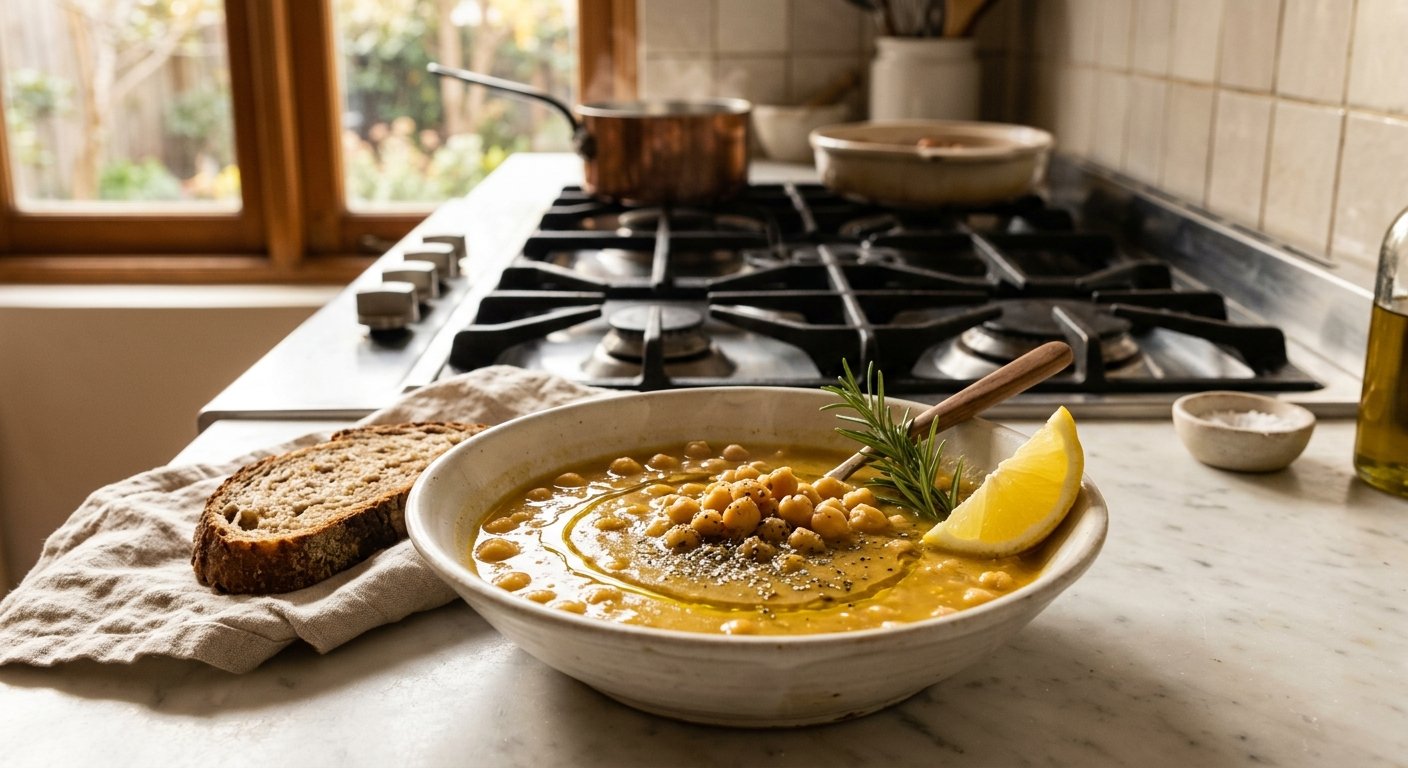
Revithia — Greek Chickpea Soup
Ingredients
For the soup
- 500 g dried chickpeas soaked overnight and drained
- 1.5 litres cold water plus more as needed
- 1 large yellow onion finely diced
- 4 garlic cloves lightly crushed
- 2 bay leaves
- 125 ml extra-virgin olive oil plus more to finish
- 1½ tsp fine sea salt added in last 20 minutes
- black pepper to taste
- lemon juice from 1–2 lemons
Optional aromatics (use one, not both)
- 1 sprig fresh rosemary
- ½ tsp dried oregano
To serve
- extra-virgin olive oil for drizzling
- crusty bread
- black olives
- raw white onion thinly sliced
- lemon wedges
Instructions
- Soak dried chickpeas in a large bowl of cold water for at least 12 hours (up to 24). Drain and rinse well before using.
- Warm 2 tablespoons of the olive oil in a large heavy-bottomed pot over medium heat. Add the diced onion and cook gently for 8–10 minutes until soft and translucent — not browned. Add the crushed garlic and cook for another 2 minutes.
- Add the soaked, drained chickpeas to the pot along with the water, bay leaves, and remaining olive oil. If using rosemary or oregano, add it now. Bring to a gentle boil, skimming any foam that rises in the first 10 minutes.
- Reduce heat to the lowest setting where the soup still shows a few lazy bubbles. Prop the lid slightly ajar. Cook for 2½–3 hours, checking every 45 minutes. Add water if level drops below the chickpeas. You are looking for completely tender chickpeas and a broth that has thickened and turned a pale, creamy gold.
- Remove the bay leaves (and rosemary if using). Add salt and several grinds of black pepper. Squeeze in the juice of one lemon, stir, and taste — then almost certainly add more. Remove from heat and drizzle over another generous pour of raw olive oil. Stir once, gently.
- Rest the soup 10 minutes off the heat before ladling. It thickens slightly as it rests and the flavors settle.
- Ladle into deep bowls. Finish each bowl with another pour of olive oil, cracked black pepper, and a lemon wedge on the side. Serve with crusty bread, olives, and raw onion at the table.
Notes
Nutrition
Chef’s Notes
On the salt timing: Salt added at the beginning of long-simmered legume dishes has long been debated. In practice, I add mine toward the end — in the last 20 minutes — to avoid any toughening of the skins during the long cook. The chickpeas are already done by then and absorb the seasoning well.
The clay pot alternative: If you have a proper clay pot (chytra), use it. Soak it in cold water for 20 minutes first, then fill it as you would the Dutch oven and cook in a 150°C / 300°F oven with the lid ajar. The gentler, even heat of the oven produces an even better broth than stovetop. This is exactly how it was done in the village fourno on Kos.
Leftovers and storage: Revithia keeps well in the refrigerator for up to 5 days — in fact it is better the next day, once the chickpeas have had time to fully absorb the broth. Reheat gently on the stovetop with a splash of water, as it will have thickened. Always add a fresh drizzle of olive oil and a squeeze of lemon after reheating. It also freezes well for up to 3 months.
Variations:
- Revithia with spinach: Add 200g fresh spinach in the last 10 minutes of cooking for a more substantial pot.
- Spiced version: A pinch of cumin and smoked paprika works well if you prefer a slightly warmer profile, though it is not traditional.
Pairing with other ladera dishes: Revithia belongs to the same family of olive-oil-braised dishes as my Fasolakia — Greek Green Bean Stew and Gigantes Plaki, the baked giant beans in tomato sauce. All three share the same philosophy: let the main ingredient and good olive oil do the work. If you want to explore more of this style of Greek legume cooking, my Fava Santorinis — yellow split pea puree from the Aegean islands — is another dish that rewards patience.
According to the Harvard T.H. Chan School of Public Health’s nutrition source on legumes, chickpeas are one of the most nutrient-dense legumes available, with notable fiber, plant protein, and micronutrient content. That is why dishes like revithia have been a dietary cornerstone of Greek island life for centuries — not just because they taste good, but because they sustain.
FAQ
What is revithia?
Revithia (ρεβίθια) is the Greek word for chickpeas, and by extension it refers to the traditional Greek soup made from them. It is one of the oldest dishes in the Greek culinary repertoire, historically associated with island communities and the ladera (olive-oil) cooking tradition. On many Greek islands, including Kos, Ikaria, and Sifnos, revithia is the quintessential Monday dish: the pot went into the wood oven or low heat on Sunday and was ready by midday Monday.
Can I use canned chickpeas instead of dried?
You can, but the result will be meaningfully different. Canned chickpeas are already fully cooked and lack the starch content that slow-cooked dried chickpeas release into the broth. The soup will be thinner, the chickpeas softer in a less pleasant way, and the overall flavor more muted. If you use canned, reduce the cooking time to 30–40 minutes, skip the overnight soak obviously, and expect a lighter, less creamy result. For the dish to taste as it should, dried chickpeas are the right choice.
Can I make revithia in an Instant Pot or pressure cooker?
Yes, with caveats. After soaking overnight, pressure cook the chickpeas with the onion, garlic, bay leaves, and olive oil on high pressure for 45–50 minutes, then natural release for 20 minutes. The chickpeas will be tender and the broth reasonably thick, though it will not have quite the same silky depth as the long stovetop version. Finish with salt, pepper, and lemon exactly as you would the slow-cooked version.
What is ladera cooking?
Ladera (λαδερά) literally means “of the oil” in Greek — it refers to a category of Greek dishes cooked primarily in olive oil, usually with vegetables, legumes, or a combination of both, without meat or stock. The olive oil is not a finishing agent in ladera cooking; it is one of the primary flavor components. Revithia, fasolakia, gigantes plaki, and briam are all ladera dishes. They are characteristic of the Greek Orthodox fasting tradition, since they contain no animal products, and are central to the everyday cooking of the Aegean islands.
How do I store and reheat revithia?
Store cooled soup in an airtight container in the refrigerator for up to 5 days. Revithia thickens considerably as it cools — add a few tablespoons of water when reheating on the stovetop over gentle heat, stirring occasionally. Always re-season after reheating: a fresh squeeze of lemon and a drizzle of raw olive oil restore what the refrigerator muted. The soup also freezes well; portion into containers and freeze for up to 3 months. Defrost overnight in the refrigerator before reheating.