
There is a particular sound that takes me back to the waterfront of Kos every time I hear it — the crack of a thin slab of pasteli against a marble counter, shattering into rough golden pieces that glitter with toasted sesame. My grandmother made a fresh batch every few days in her small kitchen on the island, laying the hot honey and sesame mixture onto an oiled marble slab near the window and smoothing it thin with a parchment-wrapped rolling pin. Within minutes, the whole kitchen smelled of warm thyme and toasted grain — a scent I spent decades trying to recreate in every professional kitchen I worked in since.
This pasteli recipe traces directly back to that marble slab. Two ingredients. One pan. Twenty minutes from start to finish, plus a short rest while the Greek sesame honey bars cool and set. The honey we used on Kos was something exceptional: thyme honey harvested from hillside apiaries above Kos Town, amber-coloured and intensely aromatic in a way that most supermarket honey simply cannot match. If you can source Greek thyme honey for this recipe, it will reward you. If not, any raw, unprocessed honey with good flavour will work well.
Pasteli is one of the oldest confections in the world, and for good reason. It is naturally gluten-free, packed with calcium, iron, and healthy fats from the sesame seeds, and it keeps beautifully at room temperature for up to four weeks. The ancient Greeks knew what they were doing. Once you make this pasteli recipe, you will understand why it has survived essentially unchanged for three thousand years.
Table of Contents
What Is Pasteli?
Pasteli (παστέλι) is a traditional Greek sesame honey bar — one of the most ancient confections in the world. References to a sesame-and-honey sweet appear in Greek texts going back at least two millennia, and food historians consider pasteli among the earliest documented Greek sweets, made long before refined sugar reached the Mediterranean. Ancient athletes consumed it as an energy food, and small offerings of sesame-honey preparations were left at temple shrines throughout the Greek world.
At its core, pasteli is nothing more than toasted sesame seeds bound with honey that has been cooked to the hard-crack stage. The result is a brittle-style candy bar: deeply crunchy, intensely nutty, satisfying in the uncomplicated way that only very simple, very good food can be. Unlike more elaborate Greek sweets such as Greek Baklava — which layers filo, nuts, and honey syrup with considerable technique — pasteli asks almost nothing of the cook beyond patience and a watchful eye on the thermometer.
Regional variations exist across Greece. Some mainland versions incorporate walnuts or almonds. Cretan pasteli sometimes uses carob alongside sesame. On Kos and across the Dodecanese, the traditional version stays pure: just sesame seeds and local thyme honey, pressed thin and left to harden into Greek sesame honey bars that snap cleanly when broken. That simplicity is the point.
Why This Pasteli Recipe Works
- Toasting sesame seeds before adding honey is essential. Raw sesame stirred into hot honey produces flat, slightly bitter pasteli. Toasting first drives off moisture, unlocks the nutty oils in each seed, and creates the deep golden flavour that proper Greek sesame honey bars are known for. It takes five minutes and makes an enormous difference.
- Cooking honey to the hard-crack stage gives pasteli its characteristic snap. At 145–155°C (295–310°F), the sugars in the honey form rigid, glassy structures rather than sticky, pliable ones. Under-cooked honey yields soft, tacky pasteli that bends rather than breaks. A candy thermometer removes the guesswork entirely.
- Speed on the pour matters. Once the sesame meets the hot honey and you pour the mixture, you have perhaps four minutes before it becomes unworkable. Have your parchment surface oiled and ready before you begin cooking. The first time you make this pasteli recipe you will learn the rhythm quickly.
- Scoring while warm prevents shattering. Fully set pasteli is brittle and can shatter unpredictably when cut. Score into bars at the three-to-four-minute mark, when the surface is firm but the mixture still retains a little warmth. When fully cold, it snaps cleanly along those lines.
Ingredients
Makes 20 bars.
- 300g (2 cups) unhulled sesame seeds
- 150g (approximately ½ cup) raw honey — thyme honey preferred
- ¼ teaspoon fine sea salt (optional but recommended)
- Neutral oil (sunflower or light olive oil) for greasing the surface
A note on sesame seeds: Use unhulled (natural, brown) sesame seeds rather than hulled white sesame seeds. The thin bran layer on unhulled seeds adds a slightly earthy, complex flavour and gives the finished Greek sesame honey bars better texture and structure.
A note on honey: The honey you use shapes this pasteli recipe more than any other variable. A mild acacia honey will give sweet, gentle bars. A robust thyme or wildflower honey will give bars with real depth — faintly herbal, intensely aromatic, the kind that makes you understand immediately why honey has been prized in Greek cooking for thousands of years.
How to Make Pasteli: Step-by-Step Instructions
Step 1 — Toast the sesame seeds. Place the sesame seeds in a wide, dry skillet over medium heat. Stir or shake the pan constantly for 4–5 minutes until the seeds turn a light golden colour and the nutty aroma becomes noticeable. Transfer immediately to a heatproof bowl or plate. Do not leave them in the hot pan — they will continue to cook and can burn.
Chef tip: Even colour is the goal. Medium heat, constant movement, and full attention for five minutes. Sesame seeds go from golden to burnt faster than you expect once they start to darken.
Step 2 — Prepare your work surface. Line a baking sheet or a wooden cutting board with a sheet of parchment paper. Brush the parchment lightly with neutral oil. Have a second piece of oiled parchment ready to place on top, as well as an oiled rolling pin and a sharp knife or pastry scraper for scoring.
Step 3 — Cook the honey to the hard-crack stage. Pour the honey into a small, heavy-bottomed saucepan. Clip a candy thermometer to the side. Cook over medium heat without stirring until the honey reaches 150°C (300°F). This takes approximately 8–10 minutes, but watch carefully — the temperature climbs slowly at first and then accelerates sharply once it passes 130°C.
Chef tip: No candy thermometer? Use the cold-water test. Drop a small amount of the cooking honey into a cup of ice-cold water. At the hard-crack stage, the honey immediately forms brittle, glassy threads that shatter when you try to bend them. If the honey is still soft or pliable in the water, keep cooking.
Step 4 — Add sesame seeds and salt. Remove the saucepan from the heat. Quickly add all the toasted sesame seeds and the salt. Stir vigorously with a wooden spoon or silicone spatula until every seed is fully coated. The mixture will be very thick and sticky. Work with purpose — you have about 60–90 seconds before it becomes difficult to move.
Step 5 — Pour and roll thin. Immediately pour the pasteli mixture onto the centre of your prepared parchment. Place the second sheet of oiled parchment directly on top. Use the rolling pin to press and roll the mixture into an even layer approximately 5–7mm thick. Remove the top sheet of parchment.
Chef tip: Thinner pasteli (5mm) is crispier and more delicate. Thicker pasteli (7–8mm) has a slightly chewier bite. Both are good.
Step 6 — Score while warm. After 3–4 minutes, when the pasteli has firmed up but still retains a little warmth, use a sharp knife or pastry scraper to score the slab into rectangles — approximately 4cm x 8cm is traditional. Press firmly to create clean break lines without cutting all the way through. Work quickly and decisively.
Step 7 — Cool completely and break. Leave the pasteli undisturbed at room temperature for at least 30 minutes, until it is completely cold and hard throughout. Snap or cut along the scored lines. If some pieces are sticking together, place the slab in the refrigerator for 10 minutes to firm them up before separating.
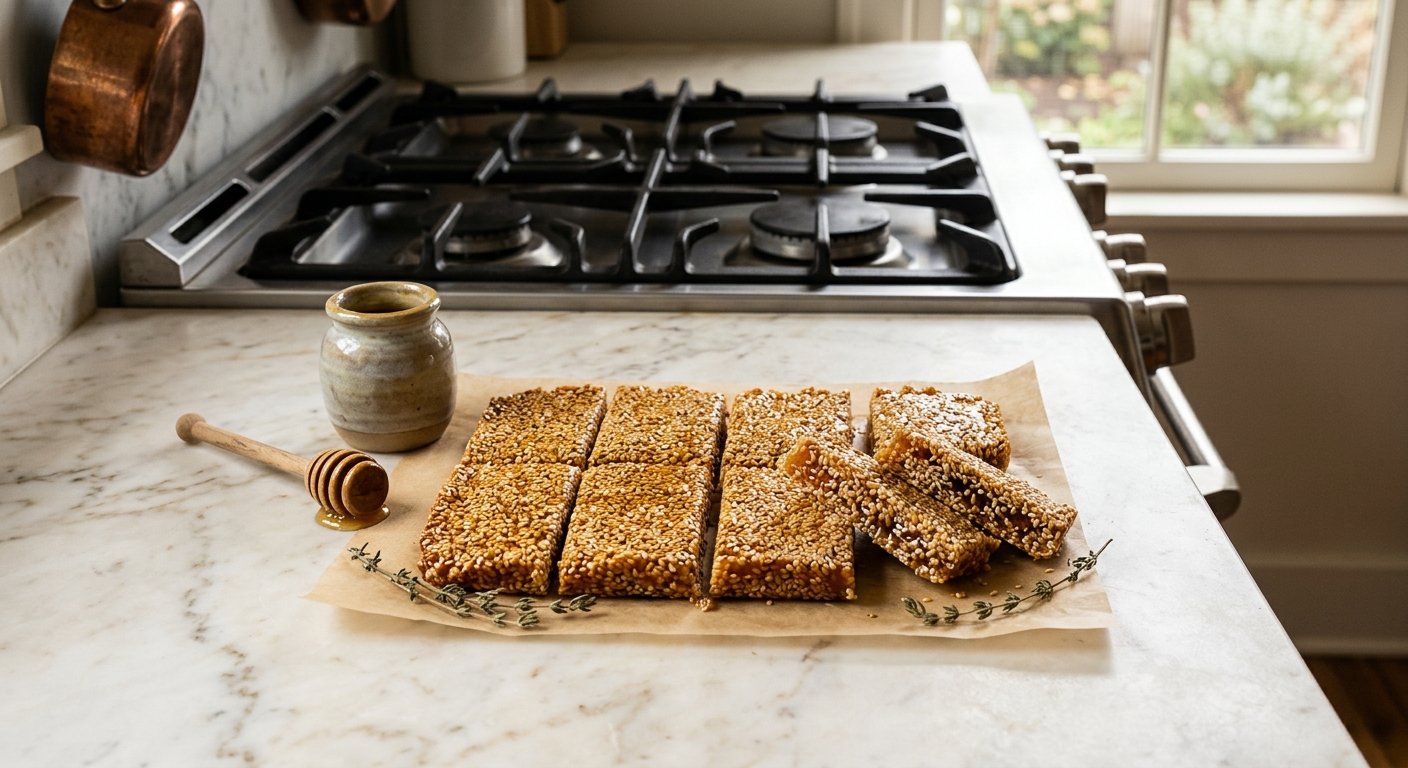
Pasteli (Greek Sesame Honey Bars)
Ingredients
- 300 g unhulled sesame seeds
- 150 g raw honey Greek thyme honey preferred
- 0.25 teaspoon fine sea salt optional
- neutral oil for greasing parchment
Instructions
- Toast sesame seeds in a dry skillet over medium heat, stirring constantly, for 4-5 minutes until golden and fragrant. Transfer to a bowl.
- Line a baking sheet with oiled parchment paper. Prepare a second sheet of oiled parchment and an oiled rolling pin.
- Pour honey into a small heavy-bottomed saucepan over medium heat. Cook without stirring to 150 degrees C (300 degrees F), about 8-10 minutes.
- Remove from heat. Add toasted sesame seeds and salt. Stir quickly until all seeds are coated.
- Pour onto prepared parchment. Cover with second oiled parchment and roll to 5-7mm thickness. Remove top parchment.
- After 3-4 minutes, score into bars with a sharp knife or pastry scraper.
- Cool completely at room temperature for 30+ minutes until hard. Snap along scored lines.
Notes
Nutrition
Chef’s Notes
Getting the honey temperature right. The hard-crack stage is the one technical variable in this pasteli recipe that has no workaround. Under 145°C, the honey retains enough moisture that the finished bars will be sticky and soft — your Greek sesame honey bars will bend rather than snap. Above 160°C, the honey begins to caramelise and can develop a bitter undertone. Aim for 148–152°C as your ideal window.
Storage and shelf life. Store finished pasteli in an airtight tin or container at room temperature, with layers of parchment paper between the bars to prevent sticking. Properly cooked pasteli — honey taken to the hard-crack stage, fully cooled before cutting — keeps for 3–4 weeks without any loss of quality. Do not refrigerate routinely, as the moisture differential between a cold refrigerator and a warm kitchen will cause the surface to become tacky.
Variations. A small handful of roughly chopped walnuts or almonds added with the sesame seeds adds texture and richness. Keep the total volume roughly the same as the recipe calls for — the ratio of solid ingredients to honey is important for structural integrity. Pistachios work beautifully for a more festive presentation and make these Greek sesame honey bars a particularly striking holiday gift.
Gifting pasteli. Pasteli has been given as a gift in Greek culture for centuries. Wrapped in parchment and tied with string, a stack of these bars travels well and keeps for weeks without refrigeration. If you enjoy making traditional Greek confections, my Greek Semolina Halva is another stovetop sweet that comes together in under 30 minutes and uses pantry staples. For the holidays, a platter combining pasteli and Loukoumades — crisp Greek honey donuts dusted with cinnamon — makes the kind of spread that disappears quickly at any table.
Frequently Asked Questions
Can I make pasteli without a candy thermometer?
Yes. Use the cold-water test: drop a small amount of the cooking honey into a cup of ice-cold water and try to shape it with your fingers. At the hard-crack stage (150°C), the honey immediately forms brittle, glassy threads that shatter when you try to bend them. You want that last stage for crisp pasteli.
Why is my pasteli sticky instead of crispy?
Sticky pasteli is almost always a cooking temperature issue — the honey did not reach the hard-crack stage before you added the sesame. If your bars are tacky, the mixture was under-cooked. Humidity in the kitchen can also cause surface stickiness even in properly cooked bars; keep finished Greek sesame honey bars in an airtight container and they should firm up within a few hours.
Can I use white (hulled) sesame seeds?
Yes, though the flavour will be noticeably milder and the bars slightly more delicate in texture. Hulled sesame seeds lack the outer bran layer, which reduces the earthy, slightly complex notes that distinguish traditional pasteli. The technique and temperature guidance are identical either way.
Is pasteli vegan?
The traditional pasteli recipe uses honey, which many vegans choose not to consume. For a vegan alternative, brown rice syrup can be cooked to the hard-crack stage and substituted in equal weight, though the resulting bars will have a different flavour profile.
How should I store homemade pasteli?
In an airtight container at room temperature, with layers of parchment or wax paper between bars to prevent sticking. Pasteli made with honey cooked to the hard-crack stage keeps for 3–4 weeks without losing quality. Avoid refrigerating regularly — moisture in the refrigerator makes the surface tacky.
Can I add other nuts to this pasteli recipe?
Absolutely. Walnuts, almonds, and pistachios all work well. Roughly chop any larger nuts before adding. Keep the total solid volume (sesame plus nuts) similar to what the recipe specifies — if you add 50g of walnuts, reduce the sesame seeds to 250g to maintain the right ratio of solids to honey.