
Caption: Arni sto fourno — lamb from the oven — is the dish I wait for all year.
There are dishes I cook any week of the year, and then there is arni sto fourno — the Greek roasted leg of lamb that belongs to a different category entirely. It is a dish for occasions. For Easter Sunday above all others, but also for name days, for family gatherings when the table is crowded and the wine is already open before the food is ready.
Growing up on Kos, Holy Week had a rhythm as fixed as the tides. The midnight liturgy, the cracking of red eggs, the slow unwinding of Easter Sunday around a table that seemed to grow longer every year. At the center of that table, without exception, was lamb. My mother would prepare the leg the evening before — studding the flesh with whole garlic cloves she cut from the papery heads hanging in her kitchen, rubbing it down with dried oregano she had gathered from the hillsides above our village, the strong-smelling rigani of the Dodecanese. The lamb went into the oven while we were still at church, or just after we returned, and by the time the last relatives had arrived and found their seats, the house had taken on that smell: meat roasting slowly with lemon and white wine, fat rendering down into the pan, everything concentrated into something that announces, without ambiguity, that something important is happening today.
Arni sto fourno is not a complicated dish. But it rewards patience and a respect for the ingredients, and there are specific things that separate a good version from a truly memorable one. These are the five things I have come to believe matter most.
According to the Wikipedia overview of Greek Easter traditions, Easter is the most important religious and social celebration in the Greek calendar — and lamb, whether spit-roasted or cooked in the oven, is always at its center.
Table of Contents
Why This Recipe Works
- Bone-in leg, always. The bone conducts heat evenly into the thickest part of the meat and releases collagen into the pan juices, giving you a richer sauce than you will ever get from a boneless roll. For arni sto fourno, bone-in is not a preference — it is the correct approach.
- Garlic studded deep, not rubbed on. Garlic pushed into deep cuts in the flesh slow-roasts from the inside out, sweetening as it cooks and perfuming every bite. Surface rubs simply burn during the high-heat phase and contribute little to the interior of a large joint.
- Two-stage roasting temperature. High heat first (220C / 430F) to develop color and a crust, then low and slow (160C / 320F) to bring the internal temperature up gradually. This produces meat that is falling from the bone — the Greek standard — while retaining its juices.
- Wine and lemon in the pan, used for basting. As the wine and lemon reduce with the drippings, they build a concentrated, bright jus. This is your sauce. Pour it over the carved lamb at the table. Nothing from a bottle competes with it.
- Rest before carving. Twenty to thirty minutes under foil is not optional. The fibers need time to relax and reabsorb the juices. Cut too early and they run onto the board instead of staying in the meat.
Ingredients
For the lamb:
- 1 whole bone-in leg of lamb, 2-2.5 kg (4.5-5.5 lbs)
- 6-8 garlic cloves, halved lengthwise
- 3 tablespoons extra virgin olive oil
- 2 teaspoons dried Greek oregano (rigani)
- 1 teaspoon fine sea salt
- 1/2 teaspoon freshly ground black pepper
- Juice of 1 lemon
For the roasting pan:
- 125 ml (1/2 cup) dry white wine
- 125 ml (1/2 cup) water
- Juice of 1 lemon (additional)
For the potatoes:
- 1 kg (2.2 lbs) Yukon Gold or waxy potatoes, cut into large wedges
- 2 tablespoons extra virgin olive oil
- 1 teaspoon dried oregano
- 1/2 teaspoon fine sea salt
- Juice of 1 lemon
Step-by-Step Instructions
1. Prepare the lamb (up to 24 hours ahead)
Remove the lamb from the refrigerator at least 1 hour before it goes in the oven. Cold meat hitting a hot oven seizes on the outside before the interior has time to respond — you end up with an unevenly cooked joint.
Pat the surface dry with paper towels. Using a small, sharp knife, cut 12-16 deep incisions all over the leg, each about 3-4 cm (1.5 inches) deep. Into each incision, push a halved garlic clove as far as it will go. The garlic should sit inside the flesh, not sit on the surface where it will simply char.
2. Season the lamb
In a small bowl, combine the olive oil, dried oregano, salt, black pepper, and lemon juice. Mix to a rough paste. Rub this all over the leg, working it into the gaps around the shank bone and over the thick topside. If you are doing this the night before, cover loosely with plastic wrap and refrigerate overnight. Bring back to room temperature before roasting.
The garlic goes deep — not on the surface. This is the detail most recipes miss.
3. Prepare the roasting pan and preheat
Preheat your oven to 220C (430F), or 200C fan. Choose a roasting pan large enough to hold the lamb and the potatoes with some room around them — you need space for the juices to reduce and concentrate without burning.
Toss the potato wedges with olive oil, oregano, lemon juice, salt, and a few grinds of pepper. Arrange them around the outside of the pan, leaving a clear space in the center for the lamb.
4. Initial high-heat roast
Place the lamb in the center of the roasting pan, fat side up. Pour the white wine, water, and additional lemon juice into the bottom of the pan — underneath the lamb, not poured over it. You want the surface to color and crust, not steam.
Roast at 220C (430F) for 20-25 minutes, until the surface has developed good color. Do not open the oven during this time.
5. Reduce heat and slow roast
Reduce the oven temperature to 160C (320F), or 140C fan. Cover the pan tightly with heavy-duty foil, or use a lid if your roasting pan has one. The foil traps steam from the wine and lemon in the pan and prevents the meat from drying out over the long, slow cook.
Continue roasting for 2 to 2.5 hours, basting with the pan juices every 45 minutes when you uncover briefly. If the pan is running dry at any point, add a splash more white wine or water. There should always be some liquid in the bottom.
For the Greek definition of done — meat that falls from the bone with the pressure of a fork, very well-cooked — aim for a total roasting time of 3 to 3.5 hours from when the lamb first entered the oven. If you prefer a pinkish interior, use an instant-read thermometer and pull the lamb when the thickest part (away from the bone) reads 60-63C (140-145F).
6. Rest the lamb
Transfer the lamb to a carving board. Tent loosely with foil and rest for 20-30 minutes. This is not optional. While the lamb rests, return the potatoes to the oven uncovered at 200C (390F) for 15-20 minutes to crisp if needed.
Baste every 45 minutes. The pan juices are your sauce — protect them.
7. Make the pan jus
Pour the pan drippings into a small saucepan. Skim most of the fat from the surface. Bring to a boil over medium-high heat and reduce for 3-5 minutes until slightly thickened and concentrated. Taste for salt. This is the sauce — nothing added, just the concentrated flavors of the lamb, lemon, wine, and oregano.
8. Carve and serve
Pull the meat from the bone in large pieces, or carve slices against the grain depending on your preference. Pour the pan jus over the carved meat immediately before serving. Arrange with the roasted potatoes and bring to the table.
Recipe Card
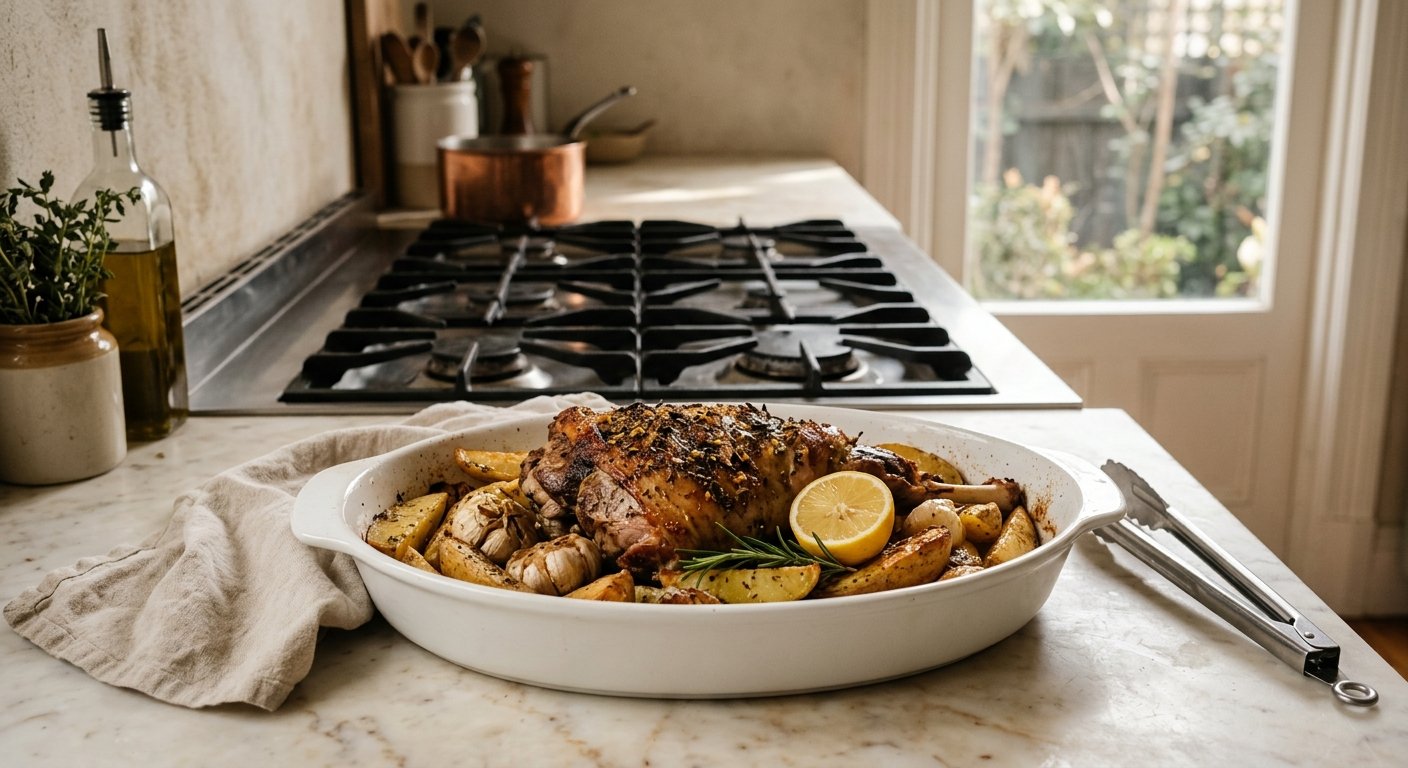
Arni sto Fourno (Greek Roasted Leg of Lamb)
Ingredients
For the lamb
- 1 whole bone-in leg of lamb, 2-2.5 kg (4.5-5.5 lbs)
- 6 garlic cloves, halved lengthwise up to 8
- 3 tablespoons extra virgin olive oil
- 2 teaspoons dried Greek oregano (rigani)
- 1 teaspoon fine sea salt
- 1/2 teaspoon freshly ground black pepper
- 1 lemon, juiced
For the roasting pan
- 125 ml dry white wine 1/2 cup
- 125 ml water 1/2 cup
- 1 additional lemon, juiced
For the potatoes
- 1 kg waxy potatoes, cut into large wedges 2.2 lbs, Yukon Gold work well
- 2 tablespoons extra virgin olive oil
- 1 teaspoon dried oregano
- 1/2 teaspoon fine sea salt
- 1 lemon, juiced
Instructions
- Remove lamb from refrigerator 1 hour before roasting. Pat dry with paper towels.
- Make 12-16 deep cuts all over the leg with a sharp knife. Push a halved garlic clove deep into each cut.
- Mix olive oil, oregano, salt, pepper, and lemon juice to a paste. Rub all over the lamb. Marinate overnight in the refrigerator if time allows.
- Preheat oven to 220C (430F). Toss potatoes with olive oil, oregano, lemon juice, salt, and pepper; arrange around the edges of the roasting pan.
- Place lamb fat-side up in center of pan. Pour wine, water, and additional lemon juice into the pan bottom.
- Roast uncovered at 220C for 20-25 minutes until browned on the surface.
- Reduce heat to 160C (320F). Cover pan tightly with foil.
- Roast for a further 2-2.5 hours (3-3.5 hours total for fall-off-the-bone), basting with pan juices every 45 minutes.
- Remove lamb from oven. Rest on a carving board, tented loosely with foil, for 20-30 minutes.
- Meanwhile, return potatoes to oven uncovered at 200C (390F) for 15 minutes to crisp.
- Skim excess fat from pan drippings and reduce over medium-high heat for 3-5 minutes to make the jus.
- Carve lamb, pour jus over, and serve with potatoes.
Notes
Greek tradition roasts to well-done (falling from the bone), approximately 3-3.5 hours total.
Lamb can be studded and rubbed up to 24 hours in advance; refrigerate until needed.
Nutrition
Chef Notes
On choosing the lamb. A whole bone-in leg (shank end included if possible) is what this recipe was built around. Ask your butcher for a leg from a young animal — the meat should be deep pink-red, not grayish. In Greece, Easter lamb typically comes from animals 3-6 months old, which gives especially mild, tender meat. What you find in most Western supermarkets is generally older and has a more pronounced flavor — still excellent, just different. The technique compensates.
On dried oregano. Greek oregano — rigani — is more pungent and aromatic than the Italian variety most supermarkets stock. If you have access to a Greek or Mediterranean grocery, the difference is worth seeking out. Dried is always correct here; fresh oregano does not have the same concentrated intensity and will cook off without contributing much.
Bone-in versus boneless. A boneless leg roll is easier to carve and cooks more evenly by temperature. But it loses the bone contribution to the pan sauce, and the texture is more uniform, less interesting. For weeknight cooking, boneless is convenient. For a table of eight on Easter Sunday, use bone-in.
Storage. Leftovers keep for 3-4 days refrigerated, covered. Reheat covered in foil with a small splash of water at 160C (320F) for 20-30 minutes. Shredded leftover lamb is excellent in sandwiches with a spoonful of quick tzatziki sauce — one of the better things about having made too much.
Building a larger Easter table. This lamb is the centerpiece, but it does not need to work alone. Begin the meal with a bowl of Avgolemono Soup — the egg-lemon broth has an affinity with lamb that makes it the natural first course at a Greek Easter table. If you are doing a mixed lamb spread, my Paidakia (Greek Grilled Lamb Chops) offers a different preparation — grilled quickly over high heat — that contrasts nicely with the slow-roasted oven lamb. The two techniques on the same table say something true about how Greeks actually cook.
FAQ
How long does it take to roast a leg of lamb in the oven?
For a bone-in leg of lamb weighing 2-2.5 kg (4.5-5.5 lbs), budget a total roasting time of 3 to 3.5 hours at the temperatures used in this recipe for the Greek standard: well-done, falling from the bone. If you prefer the meat slightly pink in the interior, you are looking at 2 to 2.5 hours, or until the thickest part reads 60-63C (140-145F) on an instant-read thermometer. Add 30 minutes resting time to either calculation.
Should I use a bone-in or boneless leg of lamb for arni sto fourno?
Bone-in produces the better result for arni sto fourno. The bone conducts heat into the thickest part of the joint and releases collagen and flavor into the pan drippings, making the jus richer and more gelatinous. Boneless leg roll is more convenient to carve and will cook slightly more quickly, but the flavor of the sauce and the texture of the meat around the bone are lost. For a special occasion, bone-in is always the choice.
How do I know when the lamb is done?
For the traditional Greek preparation — meat that pulls away from the bone with very little effort — there is no thermometer reading that tells you when you have arrived. You will know by feel when you insert a fork: it should meet almost no resistance. For a more precise method, use an instant-read thermometer: 60-63C (140-145F) for medium-pink, 70C (160F) for medium-well, and 75C+ (167F+) for the falling-from-the-bone texture the oven lamb should have.
Can I make arni sto fourno ahead of time?
Yes. The lamb can be studded with garlic and rubbed with the seasoning paste up to 24 hours before roasting — cover and refrigerate. Once roasted, the lamb reheats well: cover tightly with foil with a small amount of liquid and reheat at 160C (320F) for 20-30 minutes. The flavor often improves overnight as the juices redistribute through the meat.
What do I serve with Greek roasted leg of lamb?
The potatoes cooked in the same pan are the essential companion — they absorb the lamb fat and lemon and taste like nothing else. Beyond that, a simple Greek salad and a bowl of tzatziki to pass around the table complete the meal without competing with the lamb. For a larger Easter spread, start with Avgolemono Soup as the first course, and consider Paidakia (Greek Grilled Lamb Chops) alongside if you want to offer two lamb preparations — though on most Greek Easter tables, the oven lamb stands alone.