
On Kos, March 25th means two things: the national holiday for the Annunciation, and bakaliaros me skordalia — battered fried salt cod served alongside the most aggressively garlicky dip in the Greek kitchen. My mother made skordalia every year for this occasion, and the smell of raw garlic being pounded in the stone mortar — skorda mixing with salt until it turned to paste — is as specific a memory as I have from childhood.
The word skordalia comes from skorda, the Greek word for garlic, and the dish makes no effort to obscure what it is. This is a raw garlic dip, thickened with stale bread or walnuts, emulsified with olive oil, and brightened with lemon juice. It belongs to the same ancient family of emulsified Greek dips as taramosalata — starchy base, slow oil, acid — but skordalia carries the sharpest flavor of any of them.
There are regional variations across Greece, and the two most distinct are the bread-based version common throughout the islands and much of the mainland, and the walnut-based version found primarily in northern Greece — in Macedonia, Epirus, and parts of Thrace — where nuts are worked into the dip to add richness and a subtler heat. I will give you both, along with the technique that makes either version smooth and properly assertive. One note before we begin: the garlic quantity in this recipe is not a typo. Skordalia is a garlic dip. It should taste like one.
Table of Contents
Why This Recipe Works
- Fresh garlic only. The raw pungency of fresh, firm garlic cloves is the entire foundation of this dish. Pre-minced garlic from a jar, garlic powder, or roasted garlic will each produce something entirely different — and none of them is skordalia. Use garlic you could smell when you brought it home from the market.
- The starchy base is the emulsifier. Whether you use bread or walnuts, the starch (or fat, in the case of nuts) gives the oil something to bind to. This is exactly the same principle behind taramosalata: soak the bread thoroughly, then squeeze every drop of water out before using it. The bread must be as dry as possible or the emulsion will not hold.
- Slow oil and alternating acid. Add the olive oil in a thin, steady stream — not in one pour. Alternate every few tablespoons of oil with a splash of lemon juice. This is the same logic as making aioli, and it is the difference between a smooth, cohesive dip and a broken, greasy one.
- The garlic quantity is correct. Four to six large cloves for four servings is not excessive for this dish. That is what skordalia tastes like. If you want a milder result, start with four and taste before adding more. What you should not do is halve the garlic and call the result authentic — that is a different preparation.
Ingredients
For Bread-Based Skordalia (Serves 4–6)
- 150g (about 5 oz) stale white bread, crusts removed
- 4–6 large cloves fresh garlic, peeled
- 1 tsp fine sea salt, plus more to taste
- 120ml (½ cup) good-quality extra-virgin olive oil
- 3 tbsp fresh lemon juice (about 1 large lemon), plus more to taste
- 1 tbsp white wine vinegar (optional — for a sharper finish)
- Cold water, as needed to loosen
For Walnut-Based Skordalia (Serves 4–6)
- 120g (about 1 cup) shelled walnuts, lightly toasted and cooled
- 50g (about 1¾ oz) stale white bread, crusts removed
- 4–6 large cloves fresh garlic, peeled
- 1 tsp fine sea salt, plus more to taste
- 100ml (scant ½ cup) good-quality extra-virgin olive oil
- 3 tbsp fresh lemon juice
- 1 tbsp red wine vinegar
- Cold water, as needed
Step-by-Step Instructions
Bread-Based Skordalia
- Soak the bread. Tear the stale white bread into chunks and submerge in cold water for 10 minutes. It should absorb the water fully.
- Squeeze completely dry. Lift the soaked bread and squeeze with both hands until no more water can be extracted. This step is not optional — excess water prevents the emulsion from forming. The squeezed bread should feel dense and almost rubbery, not wet.
- Pound the garlic. In a mortar, combine the garlic cloves and salt. Pound steadily until you have a completely smooth paste. The salt acts as an abrasive and helps break down the cell structure. If you do not have a mortar, crush the garlic on a cutting board using the flat of a knife with salt underneath.
- Combine and emulsify. In a food processor (or continuing in the mortar), work the garlic paste into the squeezed bread until the mixture is uniform. With the machine running — or while stirring vigorously — add the olive oil in a slow, thin, steady stream. Alternate every 2–3 tablespoons of oil with a splash of lemon juice. Continue until all the oil is incorporated and the mixture is pale, thick, and smooth.
- Adjust consistency and season. If the skordalia is too thick, add cold water one tablespoon at a time. Taste and adjust with salt and lemon juice. The flavor should be intensely garlicky with a clean, bright finish.
Walnut-Based Skordalia (Northern Greek Style)
- Soak and squeeze the bread as above.
- Pound the garlic to a paste with salt in the mortar.
- Process the walnuts. In a food processor, pulse the toasted walnuts until they are finely ground — not a paste, but no large pieces remaining. Add the squeezed bread and garlic paste and process until combined.
- Emulsify with oil and acid. With the processor running, add the olive oil in a slow stream, alternating with lemon juice and red wine vinegar. The walnuts add enough fat that the emulsion comes together quickly. The finished dip will be slightly darker in color and noticeably richer in texture than the bread-only version.
- Adjust and season. Add cold water by the tablespoon to reach the consistency you want. Taste for salt and acid. The walnut version often benefits from an extra squeeze of lemon to cut through the nut richness.
Recipe Card
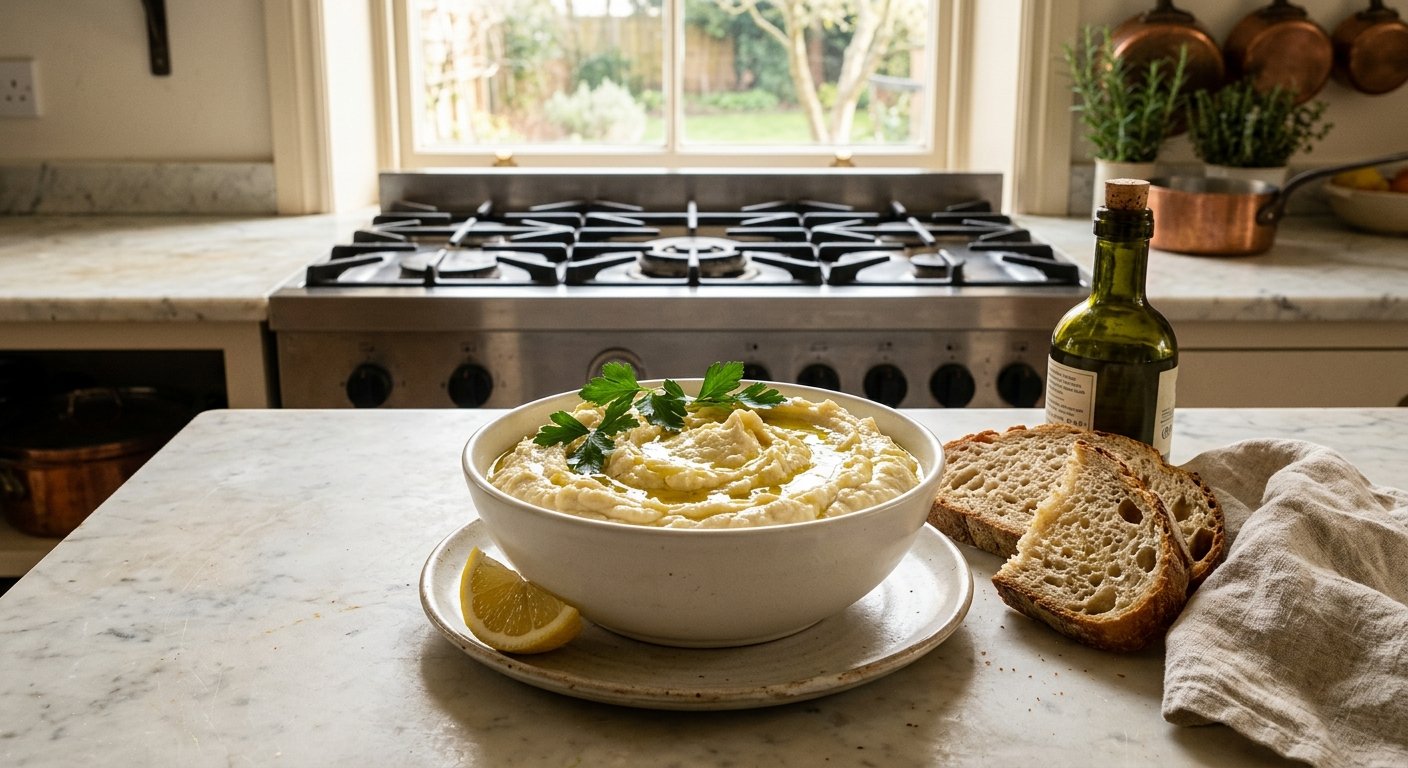
Classic Skordalia (Greek Garlic Dip)
Ingredients
Bread-Based Skordalia (Classic Island Version)
- 150 g stale white bread crusts removed
- 4-6 large cloves fresh garlic peeled
- 1 tsp fine sea salt plus more to taste
- 120 ml extra-virgin olive oil
- 3 tbsp fresh lemon juice about 1 large lemon
- 1 tbsp white wine vinegar optional
- cold water as needed
Walnut-Based Skordalia (Northern Greek Style)
- 120 g shelled walnuts lightly toasted and cooled
- 50 g stale white bread crusts removed
- 4-6 large cloves fresh garlic peeled
- 1 tsp fine sea salt plus more to taste
- 100 ml extra-virgin olive oil
- 3 tbsp fresh lemon juice
- 1 tbsp red wine vinegar
- cold water as needed
Instructions
Bread-Based Skordalia
- Soak the bread. Tear the stale white bread into chunks and submerge in cold water for 10 minutes. It should absorb the water fully.
- Squeeze completely dry. Lift the soaked bread and squeeze with both hands until no more water can be extracted. This step is not optional — excess water prevents the emulsion from forming. The squeezed bread should feel dense and almost rubbery, not wet.
- Pound the garlic. In a mortar, combine the garlic cloves and salt. Pound steadily until you have a completely smooth paste. The salt acts as an abrasive and helps break down the cell structure. If you do not have a mortar, crush the garlic on a cutting board using the flat of a knife with salt underneath.
- Combine and emulsify. In a food processor (or continuing in the mortar), work the garlic paste into the squeezed bread until the mixture is uniform. With the machine running — or while stirring vigorously — add the olive oil in a slow, thin, steady stream. Alternate every 2–3 tablespoons of oil with a splash of lemon juice. Continue until all the oil is incorporated and the mixture is pale, thick, and smooth.
- Adjust consistency and season. If the skordalia is too thick, add cold water one tablespoon at a time. Taste and adjust with salt and lemon juice. The flavor should be intensely garlicky with a clean, bright finish.
Walnut-Based Skordalia (Northern Greek Style)
- Soak and squeeze the bread as above.
- Pound the garlic to a paste with salt in the mortar.
- Process the walnuts. In a food processor, pulse the toasted walnuts until they are finely ground — not a paste, but no large pieces remaining. Add the squeezed bread and garlic paste and process until combined.
- Emulsify with oil and acid. With the processor running, add the olive oil in a slow stream, alternating with lemon juice and red wine vinegar. The walnuts add enough fat that the emulsion comes together quickly. The finished dip will be slightly darker in color and noticeably richer in texture than the bread-only version.
- Adjust and season. Add cold water by the tablespoon to reach the consistency you want. Taste for salt and acid. The walnut version often benefits from an extra squeeze of lemon to cut through the nut richness.
Notes
Nutrition
Chef’s Notes
The regional distinction. Bread-based skordalia is the form most associated with the Aegean islands, the Peloponnese, and much of central Greece. It is what my mother made on Kos, what you find at tavernas by the harbor, and what arrives alongside the Annunciation Day fried cod. The walnut version — sometimes called skordalia me karidia — is more common in northern Greece, particularly in Macedonia and Epirus, where walnuts have been part of the culinary tradition for centuries. Both are genuine. Neither is superior. They are different expressions of the same philosophy.
How much garlic is right? Chef Niko’s position: four cloves is the minimum for this recipe at four servings. Six is correct. Eight is acceptable if your garlic is small or if you have been eating this dish your whole life. What is not acceptable is two cloves and calling the result skordalia. The dish is named for the garlic. Honor that.
What to serve with skordalia.
- Battered fried salt cod (bakaliaros) — the Annunciation Day pairing, non-negotiable
- Roasted or steamed beets — the combination works because the sweetness of the beet and the rawness of the garlic do exactly what you want them to do
- As part of a meze spread alongside Kolokithokeftedes (Greek Zucchini Fritters) and a Greek Village Salad (Horiatiki)
- Grilled eggplant, zucchini, or cauliflower
- Crusty bread, for spreading
Storage. Skordalia keeps in the refrigerator for up to 4 days in a sealed container. The garlic flavor deepens overnight — this is not a problem, it is expected. Bring to room temperature before serving. Do not freeze: the emulsion breaks on thawing.
On the mortar vs. food processor. Traditional Greek cooks make skordalia entirely in a goudi (stone mortar), producing a slightly coarser, more textured result. A food processor is faster and gives a smoother finish. Both are valid.
According to The Oxford Companion to Food (Davidson, 3rd ed.), skordalia belongs to a Mediterranean family of garlic-based sauces — alongside Spanish alioli, Italian agliata, and Provençal aioli — all built on the same emulsification logic: raw garlic, fat, acid, and a starchy or protein-rich binder.
FAQ
What is skordalia?
Skordalia is a traditional Greek garlic dip and sauce made from raw garlic pounded to a paste and emulsified with olive oil and lemon juice, bound together by either soaked stale bread or walnuts (and sometimes potato). It is one of Greece’s oldest condiments, served as a meze, a sauce for fried fish, or an accompaniment to roasted vegetables and beets.
Is bread-based or walnut-based skordalia more traditional?
Both traditions are genuinely old and authentically Greek. The bread-based version has a longer documented history and is dominant across the islands and much of southern Greece. The walnut-based version is the regional tradition in Macedonia and northern Greece. Neither is more “correct” than the other — they reflect different geographies and different pantries.
How much garlic should I use?
Four to six large cloves per batch (serving 4–6) is the traditional range. Start with four if you are new to skordalia; use six if you know what you are getting into. Do not reduce the garlic below four cloves — you will produce something milder and more polite, but it will not be skordalia.
How do I make skordalia less intensely garlicky?
Blanch the garlic cloves in boiling water for 60 seconds before pounding — this softens the sharpness without eliminating the garlic flavor entirely. Adding extra lemon juice and a small amount of cold water also helps balance the heat. Using the walnut-based version naturally produces a milder result than bread-based, because the fat in the walnuts rounds the sharp edges of the raw garlic.
What do you serve with skordalia, and how long does it keep?
Skordalia is classically served with battered fried salt cod (bakaliaros) on Annunciation Day (March 25th), and with roasted beets year-round. It also works as a dip for bread, a sauce for grilled vegetables, or part of a wider meze spread. Kept in a sealed container in the refrigerator, it holds for up to 4 days. Bring to room temperature before serving.