
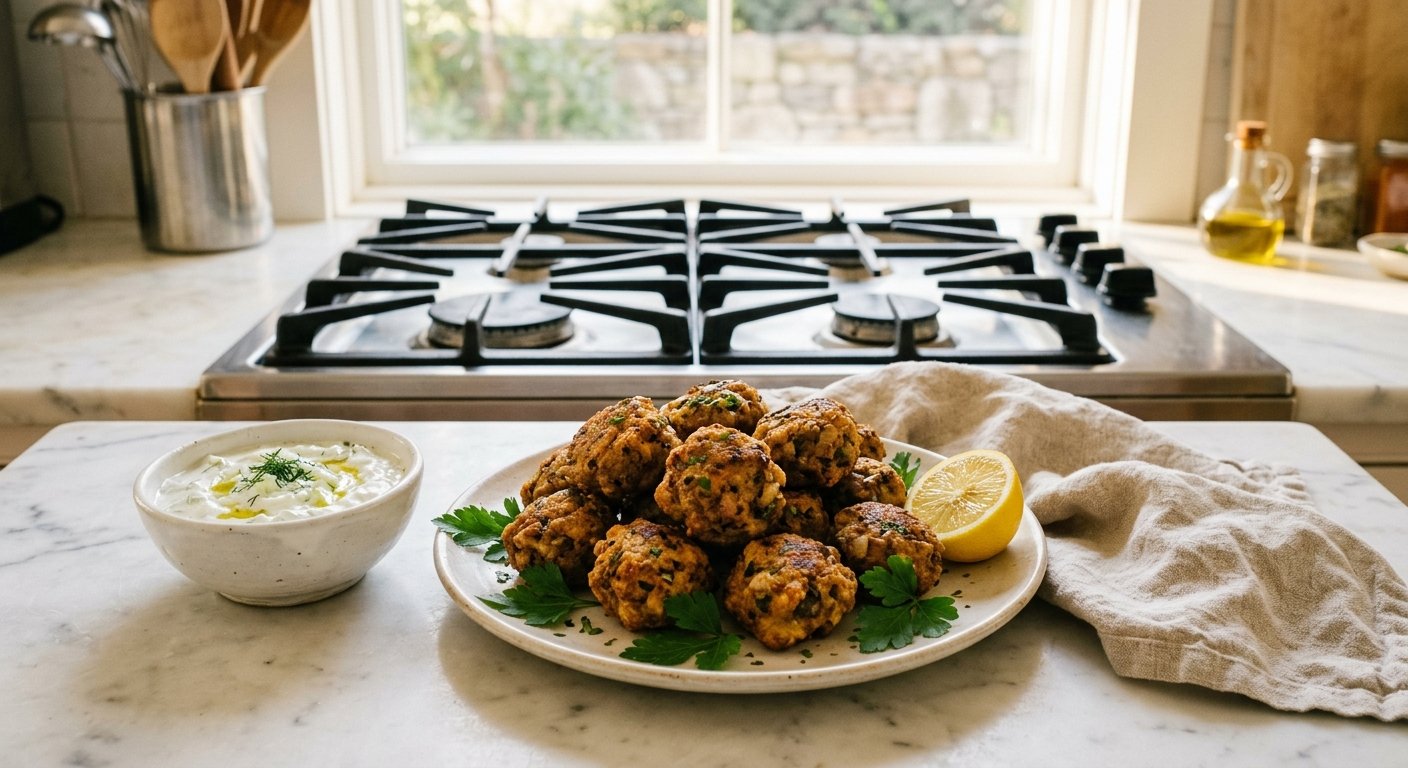
There is a sound I will always associate with Sunday afternoons on Kos. It is not the church bells, though those rang too. It is the crackle of keftedes Greek meatballs hitting a pan of hot olive oil — a sharp, immediate sizzle that spread through the kitchen and out into the courtyard, announcing to everyone within range that my mother was cooking.
She made them every week without fail. Not because the recipe was elaborate — it is not — but because keftedes are that kind of food. The kind that requires no occasion. You made them because you had meat and stale bread and mint growing in a pot by the back door, and because your family would eat them standing at the counter before they ever reached the table.
My mother’s version is what I still make today: a 50-50 mix of pork and beef, red onion grated on the box grater, three tablespoons of fresh mint, dried oregano, a splash of ouzo, and bread — never breadcrumbs — soaked in cold water and squeezed until barely a drop remained. That bread is the reason her keftedes Greek meatballs were tender inside while staying crispy outside. It is the detail most recipes get wrong.
Table of Contents
- What Are Keftedes?
- Why This Recipe Works
- Ingredients
- Step-by-Step Instructions
- How to Serve Keftedes
- Chef’s Notes
- FAQ
What Are Keftedes?
Keftedes (pronounced kef-TEH-thes; singular: keftedas) are the Greek answer to fried meatballs — and one of the most universally eaten dishes across the entire Greek culinary repertoire. The name derives from the Ottoman Turkish word köfte, itself borrowed from the Persian kufteh, meaning “beaten” or “pounded.” This etymology reflects the long exchange of flavors across the eastern Mediterranean. You can read more in the Wikipedia entry on köfte.
On Kos, keftedes appeared at every gathering: the first plate out at a meze table, a tray wrapped in foil at a beach picnic, a pot kept warm on the stove for anyone who walked through the door in the early evening. They are not refined food. They are essential food — and that is exactly why they have endured.
Unlike Italian-American meatballs, which are typically braised in sauce, keftedes are entirely defined by their crust. The exterior is non-negotiable. The mint is non-negotiable. Everything else is a matter of conversation.
Why This Recipe Works
- Stale bread instead of breadcrumbs. Dried breadcrumbs absorb fat during frying and make the interior dense and tight. Stale bread, soaked in cold water and squeezed completely dry, opens the protein network of the meat as it is incorporated. The result is a meatball that is springy and tender inside while the exterior crisps properly in the oil.
- A 50-50 pork and beef blend. Pure beef mince makes keftedes dry — the lean protein tightens with heat. Pure pork is too fatty. A 50-50 blend gives you the richness of pork fat alongside the depth and structure of beef, balanced across every bite.
- Ouzo (not wine, not both). The ouzo loosens the mixture and adds aromatic complexity that evaporates during frying, leaving only flavor behind. If you cannot find ouzo, dry white wine is the correct substitute — but use one, not both.
- A cold rest before frying. Thirty minutes in the refrigerator tightens the fat in the mixture, allows the bread and onion to finish hydrating the meat evenly, and gives the egg time to bind everything together.
Ingredients
For the Keftedes (makes 28–30 pieces)
- 500g (1 lb) ground pork (80/20 fat ratio)
- 500g (1 lb) ground beef (80/20 fat ratio)
- 150g (5 oz) stale white bread (2–3 thick slices), crusts removed
- 1 medium red onion, finely grated (about 3/4 cup grated)
- 2 garlic cloves, minced
- 3 tablespoons fresh mint, finely chopped (or 2 teaspoons dried mint)
- 1 teaspoon dried Greek oregano
- 1 tablespoon flat-leaf parsley, finely chopped
- 2 tablespoons ouzo (or dry white wine)
- 1 large egg
- 1 teaspoon fine sea salt
- 1/2 teaspoon freshly ground black pepper
- 1/2 teaspoon sweet paprika
For Frying
- 1/2 cup (60g) all-purpose flour, for dredging
- 1 cup (240ml) good-quality Greek extra-virgin olive oil
Step-by-Step Instructions
Step 1 — Soak the bread.
Tear the stale bread into rough pieces and place them in a bowl of cold water. Let them soak for 10 minutes until fully saturated. Then gather the bread in both hands and squeeze firmly — and squeeze again, and again — until you cannot extract another drop of moisture. Do not rush this step. Wet bread will loosen the mixture and your keftedes will break apart the moment they touch the oil.
Step 2 — Grate the onion.
Use the fine side of a box grater over a bowl to grate the red onion. You want juice and pulp, not pieces. A finely grated onion disperses throughout the mixture and flavors every bite evenly.
Step 3 — Combine the mixture.
In a large mixing bowl, add the ground pork, ground beef, squeezed bread, grated onion, garlic, mint, oregano, parsley, ouzo, egg, salt, pepper, and paprika. Using clean hands, mix gently until just combined — three to four passes through the mixture is enough. Do not knead or squeeze the meat together as you would bread dough. Overworked keftedes are dense and tough.
Step 4 — Rest in the refrigerator.
Cover the bowl with plastic wrap and refrigerate for a minimum of 30 minutes, ideally one full hour. This step is not optional. The cold rest allows the meat to firm, the bread to finish absorbing moisture from the onion and egg, and the flavors to settle into one another.
Step 5 — Shape the keftedes.
Set out a plate with the flour. Wet your hands lightly with cold water to prevent sticking. Take a portion of the meat mixture about the size of a large walnut — approximately 35–40g (1.2 oz) each. Roll it briefly between your palms into an oval shape, then press gently on the top and bottom to flatten slightly. Dredge each shaped keftedas lightly in flour on all sides and tap off the excess.
Step 6 — Heat the oil.
Pour the olive oil into a large, heavy frying pan — cast iron or stainless steel both work well — to a depth of about 1cm (1/3 inch). Heat over medium-high heat until the oil shimmers and a small pinch of flour sizzles immediately on contact. The target temperature is 175–180°C (350°F).
Step 7 — Fry in batches, flip only once.
Lay the keftedes into the oil in a single layer with clear space between each one. Never crowd the pan — overcrowding drops the oil temperature and you end up with pale, fat-saturated meatballs rather than golden ones. Fry for 3–4 minutes on the first side without moving them. When they release cleanly from the pan, flip once, and fry for another 3–4 minutes until the second side is a deep, even golden brown.
Step 8 — Drain and serve.
Transfer the finished keftedes to a plate lined with kitchen paper. Serve immediately, or keep warm in a low oven (120°C/250°F) while you fry the remaining batches.
How to Serve Keftedes
On Kos, keftedes were rarely a standalone dish — they anchored a table. The plate came out first and was picked at steadily while everything else was being prepared.
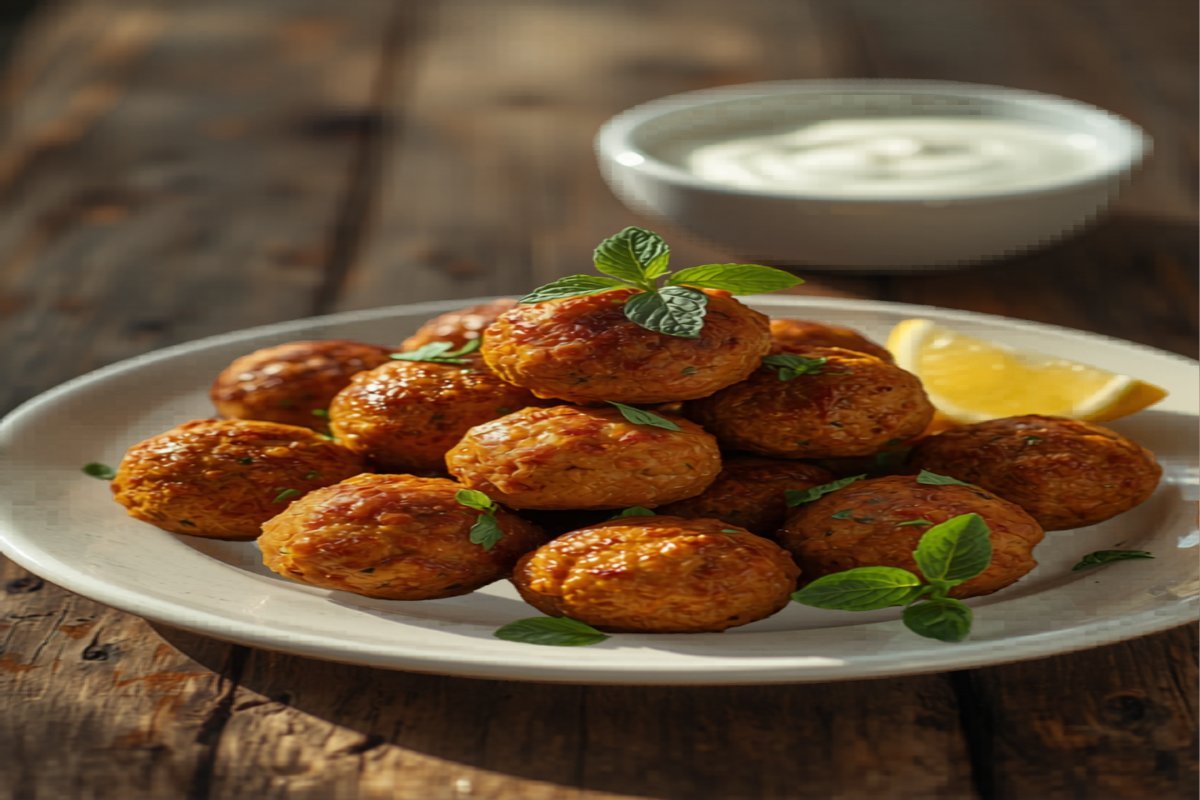
The most natural pairing is Quick Tzatziki Sauce — the cool, cucumber-thick yogurt dip cuts through the richness of the fried meat in a way nothing else quite matches. Served as a meze alongside olives, bread, and a glass of chilled white wine, a plate of 30 keftedes is a full evening in itself.
For a sit-down meal, I serve them with a Traditional Greek Village Salad (Horiatiki) and warm Homemade Pita Bread for wrapping and scooping.
Keftedes (Greek Fried Meatballs)
Ingredients
For the Keftedes
- 500 g ground pork 80/20 fat ratio
- 500 g ground beef 80/20 fat ratio
- 150 g stale white bread 2-3 thick slices, crusts removed
- 1 medium red onion finely grated
- 2 garlic cloves minced
- 3 tablespoons fresh mint finely chopped (or 2 tsp dried mint)
- 1 teaspoon dried Greek oregano
- 1 tablespoon flat-leaf parsley finely chopped
- 2 tablespoons ouzo or dry white wine
- 1 large egg
- 1 teaspoon fine sea salt
- 1/2 teaspoon freshly ground black pepper
- 1/2 teaspoon sweet paprika
For Frying
- 1/2 cup all-purpose flour for dredging
- 1 cup Greek extra-virgin olive oil
Instructions
- Tear the stale bread into rough pieces and place them in a bowl of cold water. Let them soak for 10 minutes until fully saturated. Then gather the bread in both hands and squeeze firmly until you cannot extract another drop of moisture.
- Use the fine side of a box grater over a bowl to grate the red onion. You want juice and pulp, not pieces. A finely grated onion disperses throughout the mixture and flavors every bite evenly.
- In a large mixing bowl, add the ground pork, ground beef, squeezed bread, grated onion, garlic, mint, oregano, parsley, ouzo, egg, salt, pepper, and paprika. Using clean hands, mix gently until just combined — three to four passes is enough. Do not overwork.
- Cover the bowl with plastic wrap and refrigerate for a minimum of 30 minutes, ideally one full hour. This step is not optional. The cold rest allows the meat to firm, the bread to finish absorbing moisture, and the flavors to integrate.
- Set out a plate with the flour. Wet your hands lightly with cold water. Take a portion of the meat mixture (approximately 35-40g each). Roll briefly into an oval shape, then press gently to flatten slightly. Dredge each shaped keftedas lightly in flour and tap off the excess.
- Pour the olive oil into a large, heavy frying pan to a depth of about 1cm. Heat over medium-high heat until the oil shimmers. Target temperature: 175-180C (350F).
- Lay the keftedes into the oil in a single layer with clear space between each one — never crowd the pan. Fry for 3-4 minutes on the first side without moving them. Flip once and fry for another 3-4 minutes until deeply golden-brown.
- Transfer the finished keftedes to a plate lined with kitchen paper. Serve immediately with tzatziki and lemon wedges, or keep warm in a low oven (120C/250F) while you fry the remaining batches.
Notes
Nutrition
Chef’s Notes
On the bread: Do not substitute dried breadcrumbs. Stale bread — at least 2–3 days old, soaked and squeezed absolutely dry — keeps the meat mixture tender and light. Fresh bread cannot be squeezed dry enough; only truly stale bread works correctly.
On the ouzo: This is a traditional Aegean addition that gives keftedes a faint anise background note. It is not dominant — you will not identify “ouzo” in the finished meatball — but the flavor changes without it. If you prefer not to use spirits, dry white wine is the best substitute.
On fresh mint: Fresh mint is the herb that defines a properly made keftedas. Dried mint works in winter — use about two-thirds the amount — but if fresh mint is available, use it.
Make-ahead: The meat mixture can be prepared and refrigerated up to 24 hours before frying. You can also shape and dredge the keftedes up to two hours before cooking; keep them covered in the refrigerator.
FAQ
What is the difference between keftedes and regular meatballs?
The main differences are in the seasoning, the binding agent, and the cooking method. Keftedes are seasoned with fresh mint and Greek oregano rather than basil or fennel; they use soaked stale bread rather than dried breadcrumbs as a binder; and they are always pan-fried in olive oil rather than baked or braised.
Can I make keftedes ahead of time?
Yes, and the mixture actually improves with time. The meat mixture can be made and refrigerated up to 24 hours before frying. Fully cooked keftedes keep well for 3–4 days refrigerated.
Why do my keftedes fall apart when I fry them?
The two most common causes are insufficient squeezing of the soaked bread and skipping the cold rest before frying. Cold, firmly bound keftedes hold their shape; warm, wet ones spread and crack. Also ensure the oil is properly hot before adding the meatballs.
Can I use lamb instead of pork?
You can replace the pork component with ground lamb for a more earthy, pronounced flavor. A lamb-beef blend works well with a slightly reduced amount of ouzo and an added pinch of cumin. The technique remains the same.
Can keftedes be frozen?
Yes, both raw and cooked. To freeze raw: shape and dredge, then freeze in a single layer on a baking sheet before transferring to a freezer bag. Fry directly from frozen, adding 2–3 extra minutes per side. To freeze cooked: allow to cool completely, then freeze in a single layer. Reheat in a 180°C/350°F oven for 10–12 minutes to restore the exterior texture.