
Introduction
On Kos, pastitsio was not an everyday dish. It appeared on the Easter table, or on a Sunday when my grandmother had decided — without announcement — that the family was gathering. You would arrive at her house on the hillside above Zia and know something was happening the moment you reached the courtyard gate. The smell of cinnamon and braised meat drifting through the window told you before she did.
My grandmother made pastitsio in a deep aluminum pan that could feed twelve people without trying. She never hurried it. The kima went on first, low and slow, until the meat was dry and fragrant and the cinnamon had worked its way through every grain. The béchamel came last — thick, pale yellow, stirred without stopping until it could hold its own shape on a spoon. When the pan came out of the oven, she set it on the sideboard and made everyone wait. Twenty minutes, minimum. She said it was for the layers to settle. I think she also enjoyed watching us wait.
That patience — and the structure behind it — is what pastitsio Greek baked pasta is really about. This is not a quick weeknight dinner. It has three components, each of which must be made properly. But once you understand the architecture, it becomes logical rather than complicated. And if you’ve already made Greek moussaka, you will find that you already know more than you think — the two dishes share the same foundation.
This post walks you through every step, component by component, with the technique explained at each stage. Follow it through once, and you will have a dish worth the wait.
Table of Contents
- Why This Recipe Works
- Ingredients by Component
- Step-by-Step Instructions
- Recipe Card
- Chef’s Notes: Tips, Make-Ahead, and Storage
- FAQ
Why This Recipe Works
- The pasta shape is structural, not decorative. Greek #2 macaroni — long, hollow tubes — does two things a short pasta or flat noodle cannot. The tubes stand upright in the pan, creating a stable base. During assembly, the meat sauce drops down into the tubes and anchors itself there. When you cut the finished dish, those tubes hold their shape. A substitute pasta is not a substitute for this.
- The kima is cooked until genuinely dry. Many recipes undercook the meat sauce and stop when the meat has changed color. For pastitsio, the sauce must simmer long enough that most of the liquid has evaporated and the mixture is dense and fragrant. Wet meat sauce makes a wet pastitsio. Dry, aromatic kima makes a pastitsio with clean, compact layers.
- The béchamel is thick enough to set. The béchamel here is richer and heavier than what you’d pour over vegetables. Eggs are added — tempered in carefully — and the finished sauce is thick enough to hold a furrow when you drag a spoon through it. That thickness is what allows the top layer to bake into a firm, sliceable crust rather than a loose cap.
- Resting time is non-negotiable. Twenty to thirty minutes between the oven and the knife. During this time the béchamel finishes setting and the layers compact. Cut it early and the whole thing slides apart. This is not a suggestion; it is the structure of the dish.
Ingredients by Component
The Pasta
- 500g Greek #2 macaroni (long tubular pasta — this is not substitutable)
- 1 tablespoon kosher salt, for the pasta water
- 1 tablespoon olive oil, to toss the drained pasta
- 2 eggs, beaten (to bind the pasta layers)
- 60g grated kefalotyri or Pecorino Romano
The Kima (Meat Sauce)
- 3 tablespoons olive oil
- 1 large yellow onion, finely diced
- 4 cloves garlic, minced
- 700g ground beef (80/20, or a blend of beef and lamb)
- 200ml dry white wine
- 400g canned whole peeled tomatoes, crushed by hand
- 2 tablespoons tomato paste
- 1 teaspoon ground cinnamon — do not reduce this
- ½ teaspoon ground allspice
- ¼ teaspoon ground black pepper
- 1 teaspoon kosher salt, or to taste
- 1 bay leaf
- Small handful of flat-leaf parsley, chopped (optional, added at the end)
The Béchamel
- 120g unsalted butter
- 120g all-purpose flour
- 1 litre whole milk, warmed
- ½ teaspoon freshly grated nutmeg
- 1 teaspoon kosher salt
- White pepper to taste
- 3 eggs, beaten
- 80g grated kefalotyri or Pecorino Romano, divided (half in the sauce, half for the top)
Step-by-Step Instructions
1. Make the Kima First
The meat sauce needs the most time, so it goes first. You want it fully cooked and cooled slightly before it goes into the pan.
Warm the olive oil in a wide, heavy pan over medium heat. Add the onion and cook gently for 8 to 10 minutes — you want it soft and translucent, not browned. Add the garlic and stir for one minute.
Turn the heat to medium-high and add the ground meat. Break it up thoroughly with a wooden spoon. The goal here is to cook the meat until the liquid it releases has fully evaporated and the meat is beginning to fry, not steam. This takes longer than most people expect — 12 to 15 minutes of patient stirring.
Once the meat is dry and starting to catch a little colour on the bottom of the pan, pour in the wine. Stir everything up and let the wine reduce almost completely. Then add the crushed tomatoes, tomato paste, cinnamon, allspice, black pepper, salt, and bay leaf.
Stir to combine, reduce the heat to low, and simmer uncovered for 25 to 30 minutes. The sauce should be thick and fragrant, with very little liquid remaining. Remove the bay leaf. Taste and adjust salt. If you’re using parsley, stir it in now. Set the kima aside to cool slightly.
Chef’s note: The cinnamon is always present in Greek kima. It is not an accent — it is the character of the dish. If it seems like a lot, trust the tradition. This same spiced meat sauce appears in moussaka and keftedes, and the warm spice is what ties them all together as Greek cooking rather than generic Mediterranean.
2. Cook the Pasta
Bring a very large pot of water to a boil. Salt it generously — it should taste like mild seawater.
Cook the Greek #2 macaroni for 2 minutes less than the package direction. You want it slightly underdone — it will finish cooking in the oven. Drain it well and return it to the pot.
Drizzle with olive oil and toss to coat. Allow it to cool for 5 minutes. Then pour the beaten eggs over the pasta, add the grated cheese, and toss until the pasta is evenly coated. This egg-and-cheese mixture will bind the pasta layers together when baked.
3. Make the Béchamel
This is the step that rewards attention. Do not rush it and do not walk away from it.
Warm the milk in a separate saucepan until it is just below a simmer — hot but not boiling. Keep it warm on a low burner.
In a wide, heavy saucepan, melt the butter over medium heat. Once it is foaming but not browning, add all the flour at once and stir constantly with a wooden spoon or silicone spatula. Cook this roux for 2 to 3 minutes, stirring the whole time. You want to cook out the raw flour taste without adding color to the roux.
Begin adding the warm milk, a ladleful at a time, stirring thoroughly after each addition. Do not rush this stage — adding too much milk at once creates lumps that are difficult to work out. Once you’ve added about half the milk and the mixture is smooth and flowing, you can add the rest in a steadier stream while whisking.
Continue to cook over medium heat, stirring frequently, until the béchamel has thickened substantially — it should coat a spoon heavily and hold a clear line when you drag your finger across the back of a coated spoon. Season with salt, white pepper, and nutmeg.
Remove the pan from the heat. Now you temper the eggs: beat the 3 eggs in a bowl, then slowly pour in several ladlefuls of the hot béchamel while whisking constantly. This raises the temperature of the eggs gradually without scrambling them. Once you’ve added 3 or 4 ladlefuls, pour the egg mixture back into the béchamel pan and stir to combine. Stir in half the grated cheese.
The béchamel should be thick, glossy, and smooth. If it seems thin, return it briefly to medium heat and stir until it tightens. It should hold its shape when dropped from a spoon rather than pour freely.
4. Assemble the Pastitsio
Preheat your oven to 180°C (350°F) fan, or 190°C (375°F) conventional.
Butter a deep baking dish — approximately 33 x 23 cm (13 x 9 inches) and at least 7 cm (3 inches) deep. The depth matters: pastitsio needs room for three full layers.
First layer: Spread half the pasta evenly across the bottom of the pan. Press it down gently with your hands or a spatula to compact it. The tubes should be roughly upright — this is the natural position they fall into when you press down, and it is exactly right.
Second layer: Spread all of the kima evenly over the pasta. Work it into an even, level layer, pressing it down gently. The meat sauce will fall into the pasta tubes as you do this, which is correct behavior — this is how the layers bind together.
Third layer: Spread the remaining pasta over the kima in an even layer, pressing down again to compact.
Béchamel top: Pour the béchamel over the pasta. Use a spatula to spread it evenly to the edges. Scatter the remaining grated cheese over the top.
The dish should be full but not overflowing. If your dish is shallower than expected, you may have a small amount of pasta left — that is fine.
5. Bake
Place the pan on the middle rack of the oven. Bake for 45 to 55 minutes, until the béchamel is deeply golden — not pale, not light brown, but genuinely golden with some darker patches at the edges. The color is flavor, and a well-colored top also tells you that the interior has had time to fully set.
If the top is browning faster than you expect, tent loosely with foil after 35 minutes.
Remove from the oven and set on a wire rack or folded towel. Do not cut into it yet.
6. Rest Before Cutting
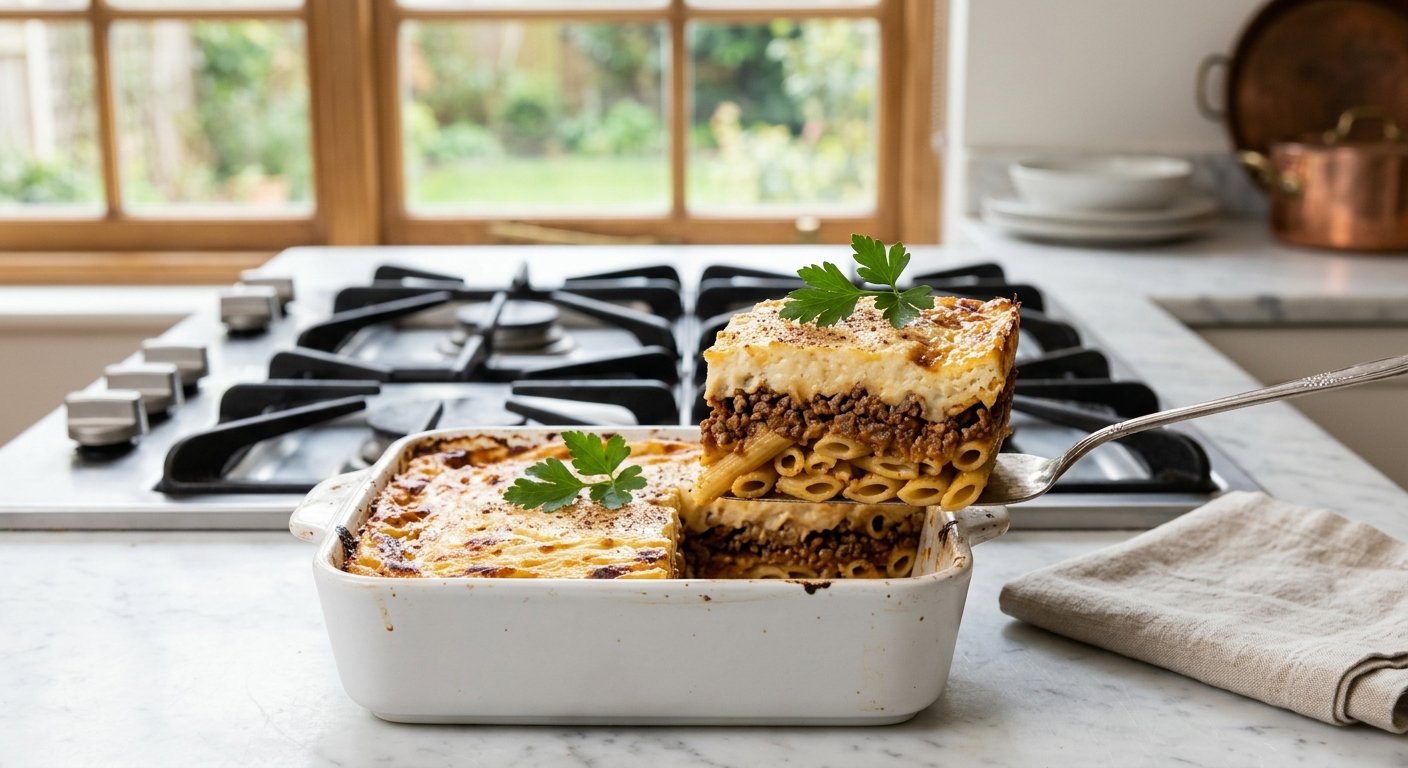
Wait a minimum of 20 minutes. Thirty is better. During this time the béchamel top completes its set and the internal layers compact. This is not optional patience — it is structural. A pastitsio cut at 5 minutes is not just messy; the layers have not finished their work.
When you cut it, use a sharp knife and a clean, confident cut. Cut the full depth in one motion rather than sawing. Use a wide spatula or fish slice to lift out the first piece, which is always the most difficult — the rest will come cleanly.
Recipe Card
Authentic Pastitsio (Greek Baked Pasta)
Ingredients
Pasta Layer
- 500 g Greek #2 macaroni or bucatini/ziti
- 1 tbsp kosher salt for pasta water
- 1 tbsp olive oil
- 2 eggs, beaten
- 60 g kefalotyri or Pecorino Romano, grated
Kima (Meat Sauce)
- 3 tbsp olive oil
- 1 large yellow onion, finely diced
- 4 clove garlic, minced
- 700 g ground beef (80/20, or beef/lamb blend)
- 200 ml dry white wine
- 400 g canned whole peeled tomatoes, crushed by hand
- 2 tbsp tomato paste
- 1 tsp ground cinnamon
- 0.5 tsp ground allspice
- 0.25 tsp ground black pepper
- 1 tsp kosher salt
- 1 bay leaf
Bechamel
- 120 g unsalted butter
- 120 g all-purpose flour
- 1 litre whole milk, warmed
- 0.5 tsp freshly grated nutmeg
- 1 tsp kosher salt
- white pepper to taste
- 3 eggs, beaten
- 80 g kefalotyri or Pecorino Romano, grated and divided
Instructions
- Make the kima: Warm olive oil in a wide heavy pan over medium heat. Cook onion 8-10 minutes until soft. Add garlic, cook 1 minute. Raise heat to medium-high, add ground meat and cook, breaking up, until all liquid has evaporated and meat is beginning to color, about 12-15 minutes. Add wine and reduce almost completely. Add tomatoes, tomato paste, cinnamon, allspice, pepper, salt, and bay leaf. Simmer uncovered over low heat for 25-30 minutes until thick and fragrant. Remove bay leaf. Adjust salt. Cool slightly.
- Cook the pasta: Boil a large pot of salted water. Cook #2 macaroni 2 minutes less than package directions. Drain well, toss with olive oil, cool 5 minutes. Add beaten eggs and grated cheese, toss to coat evenly.
- Make the bechamel: Warm milk until just below simmering. In a separate wide saucepan, melt butter over medium heat. Add flour all at once and stir constantly for 2-3 minutes. Add warm milk one ladleful at a time, stirring after each addition, until smooth. Cook, stirring frequently, until thick enough to coat a spoon heavily. Season with salt, white pepper, and nutmeg. Remove from heat. Temper the eggs: whisk beaten eggs, slowly add several spoonfuls of hot bechamel while whisking, then return to pan. Stir in half the grated cheese.
- Preheat oven to 180C (350F) fan / 190C (375F) conventional. Butter a deep 33x23cm baking dish.
- Assemble: Spread half the pasta in the base; press down. Spread all the kima over the pasta in an even layer; press down. Spread remaining pasta over the kima; press down. Pour bechamel evenly over the top. Scatter remaining cheese over the surface.
- Bake 45-50 minutes until the bechamel is deeply golden, firm to the touch across the center, and pulling very slightly from the sides. The top should have distinct caramelization.
- Remove from oven. Rest 20-25 minutes before cutting -- this is not optional. The layers must set completely or they will slide. Slice with a sharp knife, lifting portions with a wide spatula.
Nutrition
Chef’s Notes: Tips, Make-Ahead, and Storage
On the pasta: Greek #2 macaroni is sold at Greek and Middle Eastern grocery stores, and is increasingly available online. In Greece it is simply called makaronia tou fournou — oven macaroni. If you genuinely cannot source it, a large tubular pasta like rigatoni will get you closer than any short-cut pasta, but the structural integrity of the final dish will be reduced. Long-grain pasta is not an appropriate substitution.
On the cheese: Kefalotyri is the traditional choice — a sharp, firm sheep’s milk cheese that grates like Parmesan and adds a specific salty depth. Pecorino Romano is a reasonable substitute. Regular Parmesan will work in a pinch but adds a different character. Avoid anything pre-grated from a canister.
On the cinnamon: Some cooks are tempted to reduce the cinnamon, especially those unfamiliar with Greek kima. I would encourage restraint about restraint. The cinnamon is not a background note; it is structural to the flavor of the dish. Greek spiced meat sauces have been built this way for a long time, and the combination of cinnamon and allspice is what makes them identifiably Greek rather than generic.
Make-ahead options: Pastitsio is genuinely better made in stages. The kima can be cooked up to two days ahead and refrigerated. The whole assembled, unbaked dish can be refrigerated overnight — in fact, the layers settle well during an overnight rest and the final baked result is often cleaner. Add 10 minutes to the bake time if going from refrigerator to oven. The fully baked dish also refrigerates well for up to three days and reheats cleanly in a moderate oven (160°C / 325°F) covered with foil for 20–25 minutes.
Storage: Cover tightly and refrigerate for up to 3 days. Freeze, well-wrapped, for up to 2 months. Thaw overnight in the refrigerator before reheating.
The moussaka connection: If this recipe feels familiar in structure, it should. Greek moussaka uses the same kima, the same béchamel, and the same layered architecture — the difference is that fried aubergine replaces the pasta as the base and middle layer. Once you’ve made pastitsio, moussaka is the same set of skills with different vegetables. Conversely, if moussaka is already in your repertoire, you already know how to make this dish. The techniques are the same triangle.
Other Greek recipes to explore: If you enjoy the spiced warmth of Greek kima, you’ll find the same flavor profile in avgolemono soup — a completely different dish, but one that shows how Greek home cooking builds on a consistent set of flavors. The lemon-and-egg technique in avgolemono also shares its logic with the egg-tempering step in béchamel: you are warming eggs gradually to avoid scrambling them, in both cases.
A note on dish depth: Do not try to make pastitsio in a standard 5cm-deep casserole dish. The béchamel layer alone needs room, and the whole assembled dish needs at least 7–8 cm of clearance. If your baking dish is too shallow, the béchamel will overflow before it sets.
FAQ
Can I use a different pasta for pastitsio?
The short answer is: not ideally. Greek #2 macaroni — long, straight, hollow tubes — is traditional for structural reasons, not just cultural ones. The tubes stand upright in the pan and allow the meat sauce to settle into them during assembly, which is what creates the compact, sliceable layers. A long tubular pasta like rigatoni is a workable substitute if you genuinely cannot source Greek #2. Short-cut pastas, small pasta shapes, and flat noodles are not appropriate substitutes — they don’t hold their shape the same way during baking, and the layers will not compact cleanly. Long-grain pasta is not a substitute under any circumstances.
Can I make pastitsio ahead of time?
Yes, and it often turns out better when you do. The kima can be made up to two days in advance and stored in the refrigerator. You can also assemble the entire dish — pasta, kima, and béchamel — the night before baking, cover it tightly, and refrigerate it overnight. The layers settle during the rest, which actually improves the final texture. Add about 10 minutes to the bake time when cooking from cold. The baked dish keeps well in the refrigerator for up to three days and reheats cleanly in a covered pan at 160°C (325°F) for 20–25 minutes.
What is the difference between pastitsio and moussaka?
They are the same dish in different clothes — and if you understand one, you understand the other. Both use a spiced Greek meat sauce (kima) as the middle layer. Both use a thick, egg-stabilized béchamel as the top layer. The difference is in the base: pastitsio uses tubular pasta; moussaka uses layered slices of fried aubergine (and sometimes potato). The technique for building both dishes is identical. The flavors are closely related. You can read more about the technique and history of the sauce in our Greek moussaka recipe.
For a broader history of pastitsio and its regional variations across Greece and Cyprus, the Wikipedia article on pastitsio provides useful background on how the dish evolved from Italian pasta traditions into a distinctly Greek preparation.
Why does pastitsio need to rest before cutting?
Because the béchamel top needs time to finish setting. When the dish comes out of the oven, the béchamel layer is set on the surface but still fluid underneath. The resting period — 20 to 30 minutes — allows the internal heat to continue working and the layers to compact. If you cut into pastitsio before it has rested, the layers separate, the meat sauce runs, and the béchamel cap slides. The result is still edible but not presentable. The wait is part of the recipe.
Can I make pastitsio without meat (vegetarian)?
The dish can be adapted, though it becomes a different thing. A vegetarian filling can be built from lentils or finely chopped mushrooms and walnuts, seasoned with the same cinnamon and allspice as the traditional kima. The béchamel remains the same. The texture of the middle layer will be different — less dense — but the three-component architecture still works. This adaptation is worth experimenting with, but it is worth making the traditional version at least once first, so you understand what you’re adapting from.