
There is a dish I have been making since my first years cooking professionally, and I still reach for it whenever I need the table happy and fast. Saganaki — Greek pan-fried cheese — takes five minutes from pan to plate. It looks dramatic. It tastes extraordinary. And it requires almost no skill, just the discipline not to fiddle with it while it sears.
Growing up on Kos, saganaki was the dish my mother put on the table before anything else when guests arrived. The smell of the cheese hitting a hot pan would come from the kitchen, and whatever conversation was happening at the table would stop. That is still what it does. It is the oldest trick in the hospitality playbook, and it works every time.
The recipe is genuinely simple: a thick slice of hard Greek cheese, dredged in flour, seared on both sides in a very hot pan with a small amount of olive oil, and served immediately with lemon squeezed at the table. The flour creates a golden, slightly crisp exterior while the cheese inside softens but does not melt into a puddle. The lemon cuts through the richness and brightens the whole thing.
Saganaki pairs beautifully with a glass of ouzo, a cold beer, or served as part of a wider meze spread alongside my Traditional Greek Village Salad (Horiatiki) and Tirokafteri (Spicy Feta Spread).
What Is Saganaki?
Saganaki takes its name from the small, two-handled frying pan — a sagani — in which it is traditionally cooked and served. The dish itself is one of the most straightforward in Greek cooking: a thick slice of firm, salty cheese is dredged in flour and pan-fried until golden on both sides.
The result is a cheese that has a warm, slightly crisp crust and a soft, yielding interior. It is served immediately — it does not wait, and it does not hold. You bring it from the pan to the table in the pan itself, or transfer it to a plate quickly, and you eat it hot. This is not negotiable.
According to Greek food historians, saganaki has roots in both Greek home cooking and taverna culture across the Aegean and mainland Greece. It is particularly associated with meze — the small plates served with drinks before a meal.
The Right Cheese for Saganaki
This is where most saganaki recipes written outside Greece go wrong. The cheese must be firm enough to hold its shape when heated. It must also have enough salt to be interesting without anything added. And it needs enough fat to brown properly.
Kefalotyri is the traditional choice. It is a hard, salty yellow cheese made from sheep and goat milk, with a firm texture and a sharp, rich flavor. It sears beautifully and holds its shape perfectly. If you can find it — at a Greek or Middle Eastern grocery — use it.
Graviera is a sweeter, slightly nuttier alternative made from sheep milk. It is softer than kefalotyri and the flavor is more gentle. The sear works well. Graviera saganaki is common in Crete and many parts of Greece — it is not a compromise, it is a regional variation.
Kasseri is another Greek option: a semi-hard, mild, slightly elastic cheese. It sears acceptably but is milder than the above two.
Halloumi is the most practical substitute outside Greece. It is widely available, designed for high-heat cooking, and holds its shape better than almost any other cheese. The flavor is saltier and more rubbery than kefalotyri, but a well-seared halloumi is still very good.
Whatever cheese you use, cut it into slices approximately 1/2 inch thick. Thinner and it will cook too fast and the interior will not warm properly. Thicker and the outside will overbrown before the inside softens.
Why Flour, Not Egg
Many pan-fried preparations use an egg wash or a breadcrumb coating. Saganaki uses only flour — a light dredge, shaken off so only a thin coating remains.
The reason is texture. Flour creates a thin, unified crust that fuses with the exterior of the cheese as it sears. Breadcrumbs create a thicker, crunchier coating that separates from the cheese. Egg alone creates an exterior that is too soft and can stick to the pan. Shake off the excess before the cheese goes in the pan.
The Flaming Restaurant Version
At a certain category of American Greek restaurant, saganaki arrives theatrically, set alight at tableside, and extinguished with lemon juice as someone shouts “opa.” It was popularized in Chicago in the 1960s and is not traditional Greek cooking.
I do not make it this way. The flame adds nothing to the flavor. But if you want to try it for a dinner party: heat the pan, sear the cheese as normal, add a tablespoon of brandy or ouzo, tip the pan away from you, ignite with a long lighter, and extinguish with a squeeze of lemon. Stand back, and have a towel nearby.
Step-by-Step Instructions
Step 1: Prepare the cheese. Cut the cheese into slices approximately 1/2 inch (1.5 cm) thick. Pat each slice dry with a paper towel — moisture on the surface will cause the flour to clump and the cheese will steam rather than sear.
Step 2: Dredge in flour. Press each slice lightly into flour on both sides, then shake gently to remove the excess. You want a thin, even coating — no clumps, no bare patches.
Step 3: Heat the pan properly. This is the most important step. Place a heavy-bottomed skillet — cast iron or stainless steel, not nonstick — over medium-high heat. Let it heat until it is genuinely hot. Add the olive oil and let it come up to temperature. You are looking for the oil to shimmer.
Step 4: Sear the cheese. Add the cheese slices in a single layer, without crowding. Do not move them. Let them sear undisturbed for 2 to 3 minutes until the underside is deep golden-brown. Flip and sear the second side for another 2 minutes.
Step 5: Serve immediately. Transfer directly from pan to plate — or bring the pan to the table. Serve with lemon wedges. The lemon is not optional. Eat it now. Saganaki does not hold.
Recipe Card
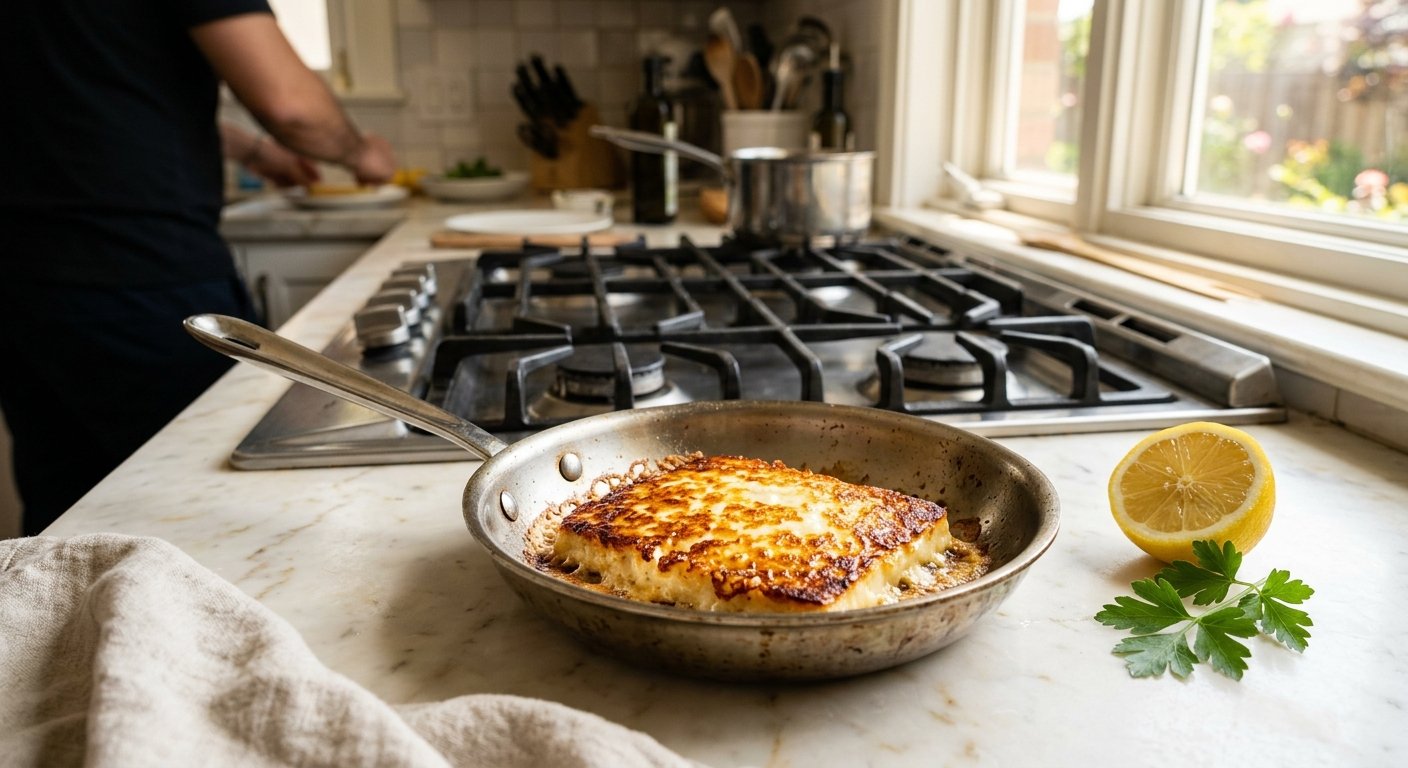
Classic Saganaki (Greek Fried Cheese)
Ingredients
- 200 g kefalotyri, graviera, kasseri, or halloumi about 7 oz
- 3 tablespoons all-purpose flour
- 1-2 tablespoons olive oil
- 1 lemon cut into wedges for serving
- freshly ground black pepper optional
Instructions
- Cut cheese into 1/2-inch-thick slices. Pat dry thoroughly with a paper towel.
- Dredge each slice in flour on both sides. Shake off excess — coating should be thin and even.
- Heat a heavy-bottomed skillet (cast iron or stainless) over medium-high heat until very hot. Add olive oil and let it come up to temperature.
- Add cheese slices. Do not move them. Sear 2–3 minutes until deep golden-brown. Flip once the cheese releases cleanly from the pan.
- Sear second side for 2 minutes until golden.
- Transfer immediately to a plate. Serve with lemon wedges. Squeeze lemon over the cheese at the table before eating.
Notes
Nutrition
How to Serve Saganaki
Saganaki is a meze dish, which means it belongs in the company of other small plates.
As a starter: Bring the pan directly to the table — the sizzle is part of the experience. Lemon wedges alongside. Bread for the table to sop up any melted cheese that escapes.
As part of a meze spread: Saganaki alongside Tirokafteri (Spicy Feta Spread) and Hummus with warm pita gives you a proper meze table.
With drinks: Ouzo is the canonical pairing, but a cold lager or a dry white wine works just as well. The point is something cold to cut through the richness.
What not to do: Do not let it sit. Do not make it ahead. Do not reheat it. Saganaki is a now dish. You sear it, you serve it, you eat it.
Chef’s Notes
Choosing the pan: Cast iron or heavy stainless steel is essential. Nonstick pans do not get hot enough to sear properly. You want a pan that holds high heat evenly across the surface.
Oil: Use just enough to coat the pan — 1 to 2 tablespoons maximum. You are searing, not shallow-frying.
Moisture: Dry the cheese very well before flouring. Any surface moisture causes the coating to become gummy and prevents the proper sear. For halloumi, press between paper towels for a minute before dredging.
Storage: Saganaki does not store cooked. Buy the cheese fresh and make it to order. Raw kefalotyri or graviera keeps in the refrigerator, well-wrapped, for up to 2 weeks.
FAQ
What cheese is used in saganaki?
Traditionally kefalotyri — a hard, salty Greek sheep and goat milk cheese. Graviera and kasseri are common Greek alternatives. Outside Greece, halloumi is the most practical substitute since it is widely available and holds its shape well under high heat.
Is saganaki the same as fried halloumi?
Not exactly. Saganaki uses a flour dredge and a sear in oil; it can be made with halloumi but is more traditionally made with kefalotyri or graviera. Fried halloumi is typically prepared without flour. The result is similar but distinct.
Why do you dredge saganaki in flour?
Flour creates a thin, unified crust that helps the exterior caramelize and protects the cheese from drying out. It also helps the cheese release cleanly from the pan. The flour dredge is thin enough that you can almost see through it once seared.
What does “opa” mean with saganaki?
The “opa and flame” saganaki is an American-Greek restaurant tradition originating in Chicago in the 1960s. “Opa” is a general Greek exclamation of enthusiasm. The flaming version is not traditional Greek cooking, but it makes for good theater.
Can saganaki be made ahead?
No. Saganaki must be made and served immediately. The crust softens within minutes of coming off the heat, and the cheese re-firms as it cools. This is a live-fire, serve-now dish.