
By the end of September on Kos, the produce stands at the morning market are doing what they do every year: piling up everything at once. The summer has not quite finished but autumn is pressing in, and the vendors know it. Zucchini the length of your forearm, eggplants heavy and dark, the last of the fat tomatoes still warm from the vine, peppers in four colors, and potatoes that have been curing in storage since August. My mother looked at that stand every September and saw one dish: briam. Briam Greek roasted vegetables — every summer vegetable in a single pan, swimming in olive oil, baked until they collapse into something far more beautiful than the sum of their parts. She called it tourlou sometimes, which is the older name for the dish on many of the Dodecanese islands. Either way, it meant the same thing: the oven does the work, the vegetables tell you when they are ready, and tomorrow the leftovers will taste even better.
I have been cooking this dish for thirty years, and the recipe has not changed much from what I watched my mother make on Kos. What has changed is my understanding of why it works — the layering logic, the ratio of olive oil to vegetables, why you never pre-sauté anything, and what “done” actually looks like. This post covers all of it. If you have ever made briam Greek roasted vegetables and felt the result was watery or flat, something went wrong with the technique. By the end of this, you will know exactly what.
Table of Contents
- What Is Briam?
- Briam vs. Ratatouille: A Clear Difference
- Why This Recipe Works
- Ingredients
- How to Make Briam Greek Roasted Vegetables
- Chef’s Notes
- FAQ
What Is Briam?
Briam (pronounced BREE-am) is a Greek baked vegetable dish from the family of ladera cooking — dishes where olive oil functions as both the fat and the sauce. The word ladera comes from the Greek ladi, meaning oil, and the category covers everything from lentil soup to green beans stewed in tomato. What ladera dishes share is their reliance on good olive oil, not as a finishing drizzle but as a foundational ingredient that carries the flavor of the whole dish.
In briam, summer vegetables — primarily zucchini, eggplant, potato, onion, tomato, and bell pepper — are cut into even pieces, layered raw into a baking dish, seasoned generously, drenched in olive oil, and baked low and slow until they become very tender and the tomatoes break down into a concentrated, oily sauce that coats everything. The dish is vegan by nature, requires no stock or meat, and is served warm or at room temperature. It is a staple of Greek home cooking from June through September, when all of these vegetables are at their peak.
Tourlou is the older regional name for the same dish, used particularly in parts of the Aegean and Dodecanese. The two words refer to the same preparation.
Briam vs. Ratatouille: A Clear Difference
People compare briam to ratatouille often, and the comparison is understandable — the vegetables are similar. But the cooking method is fundamentally different, and the result tastes different.
Ratatouille, in its classical French preparation, involves sautéing each vegetable separately in a pan before combining them. This gives each component a firmer texture and a more distinct flavor profile. The dish is precise, structured, and the cook controls each element independently.
Briam goes raw. Nothing is pre-cooked. The vegetables go into the baking dish in their raw state, layered and seasoned, and the oven does everything from start to finish. As a result, the vegetables cook in each other’s juices and in the olive oil simultaneously. The tomatoes break down completely into a sauce. The eggplant absorbs olive oil and collapses into a silky texture. The potatoes soak up the tomato liquid. The distinction matters both technically and in flavor: briam is softer, more unified, with a deeper, more concentrated taste where everything has merged.
Neither dish is better. They are simply different. If you expect the textural separation of ratatouille, briam will surprise you. If you let it be what it is — a slow, unified meld of summer vegetables — it is one of the most satisfying things you can make with a few pounds of produce and a generous pour of olive oil.
Why This Recipe Works
- Everything goes in raw. This is the single most important rule of briam. Pre-sautéing any of the vegetables — especially eggplant — changes the moisture content and the texture in ways that undermine the dish. The whole point is that the vegetables cook together, releasing liquid that mingles with the olive oil and tomatoes to create the sauce. Sautéing first robs you of that process.
- The layering order is not arbitrary. Potatoes and onions go on the bottom because they take the longest to cook. Eggplant and zucchini go next. Tomatoes and peppers go on top, where they will break down and baste everything below. Reversing this order leads to undercooked potatoes or overcooked tomatoes.
- Olive oil is measured generously, not cautiously. A proper briam uses at least 100ml — approximately 7 tablespoons — of good olive oil. This is a ladera dish. The olive oil is the sauce. If you are tempted to use less, the dish will be dry and flat. This is where the depth of flavor comes from.
- The uncovered baking phase finishes the dish. Covering the pan for the first 30 minutes traps steam and helps the vegetables cook through. Removing the foil for the final 45 to 60 minutes allows moisture to evaporate, the edges to caramelize, and the olive oil to concentrate on the surface. That surface color is not incidental — it is flavor.
Ingredients
Serves 6
The vegetables:
- 3 medium potatoes (about 600g / 1.3 lbs), peeled and sliced 5mm thick
- 2 medium onions, halved and sliced into half-rings
- 2 medium zucchini (about 400g / 14 oz), sliced 5mm thick
- 1 medium eggplant (about 350g / 12 oz), cut into 2–3cm cubes or half-rounds
- 2 medium bell peppers (any color), seeded and sliced into strips
- 4 ripe medium tomatoes (about 500g / 1.1 lbs), roughly chopped, or one 400g can of crushed tomatoes
- 4 garlic cloves, thinly sliced
The olive oil and seasoning:
- 120ml (½ cup / 7–8 tablespoons) extra-virgin olive oil, plus extra for finishing
- 120ml (½ cup) water
- 1½ teaspoons fine sea salt, divided across layers
- ½ teaspoon freshly ground black pepper, divided across layers
- 1½ teaspoons dried oregano, divided across layers
- Optional: a small handful of fresh parsley or basil for serving
A note on the tomatoes: Fresh, ripe tomatoes in late summer give the best result. The tomatoes should be soft enough that you can feel the juice when you press them. Out of season, canned crushed tomatoes work perfectly well — do not use fresh winter tomatoes that have no flavor; the canned version will outperform them significantly.
A note on the eggplant: Some cooks salt the eggplant and let it drain before adding it to the pan. For briam, I do not do this. The eggplant cooks long enough in the oven that any bitterness disappears, and the moisture it releases is part of what makes the sauce. Salting and draining is a technique for pan-frying, not slow roasting.
A note on the olive oil: Use a Greek or Mediterranean extra-virgin olive oil with some fruitiness and body. This is not the place for a very delicate or light-flavored oil — you want something that holds up to the oven temperature and contributes to the flavor.
How to Make Briam Greek Roasted Vegetables
Prep time: 20 minutes | Cook time: 90 minutes | Total: about 1 hour 50 minutes
Step 1: Preheat the oven
Preheat your oven to 200°C (180°C fan / 400°F). You want a genuinely hot oven at the start — this helps the vegetables begin releasing their moisture efficiently.
Step 2: Prepare all the vegetables
Peel the potatoes and slice them about 5mm thick — not too thin or they will dissolve, not too thick or they will remain hard when everything else is done. Halve and slice the onions. Cut the eggplant into cubes or thick half-rounds, roughly 2–3cm. Slice the zucchini to match the potato thickness. Seed and strip the peppers. Roughly chop the tomatoes. Slice the garlic thin.
Take a moment to look at the volume of vegetables you have. If one vegetable is cut much larger than the others, trim it down. Uniform sizing means uniform cooking — this matters more in briam than in most dishes because you cannot stir or adjust once the pan goes in.
Step 3: Layer the first tier
Use a large baking dish — at least 30 x 25cm (12 x 10 inches) or a 35cm round dish with high sides. Spread the potato slices across the bottom in an even layer, overlapping slightly. Scatter the onion slices over the potatoes, then the garlic slices. Season this layer with one-third of the salt, pepper, and oregano. Drizzle about 2 tablespoons of olive oil over the top.
Step 4: Layer the second tier
Add the eggplant cubes and zucchini slices over the onion layer. Spread them as evenly as possible. Season again with another third of the salt, pepper, and oregano. Another 2 tablespoons of olive oil.
Step 5: Add the tomatoes and peppers
Scatter the chopped tomatoes and pepper strips over the top. Season with the remaining salt, pepper, and oregano. Pour the rest of the olive oil — generously — over the entire surface. Then pour the water into the dish, not over the vegetables but down the sides, so you are adding moisture to the base without washing the seasonings off the top.
Step 6: Cover and bake
Cover the dish tightly with foil and place in the preheated oven. Bake covered for 30 minutes.
Step 7: Uncover and continue baking
Remove the foil. The vegetables should have released significant liquid and the dish should be bubbling. Return it to the oven uncovered. Bake for a further 45 to 60 minutes, until the liquid has mostly evaporated, the top has taken on some color, and the potatoes at the bottom are completely tender when tested with a knife. The edges of the zucchini and eggplant should look slightly caramelized — this is what you are waiting for.
If the top is browning too fast before the potatoes are done, reduce the temperature to 180°C (160°C fan) and give it more time.
Step 8: Rest before serving
Remove from the oven and let the briam rest for 10 to 15 minutes before serving. During resting, the olive oil settles back into the vegetables and the temperature throughout the dish equalizes. Serve warm or at room temperature, with crusty bread alongside.
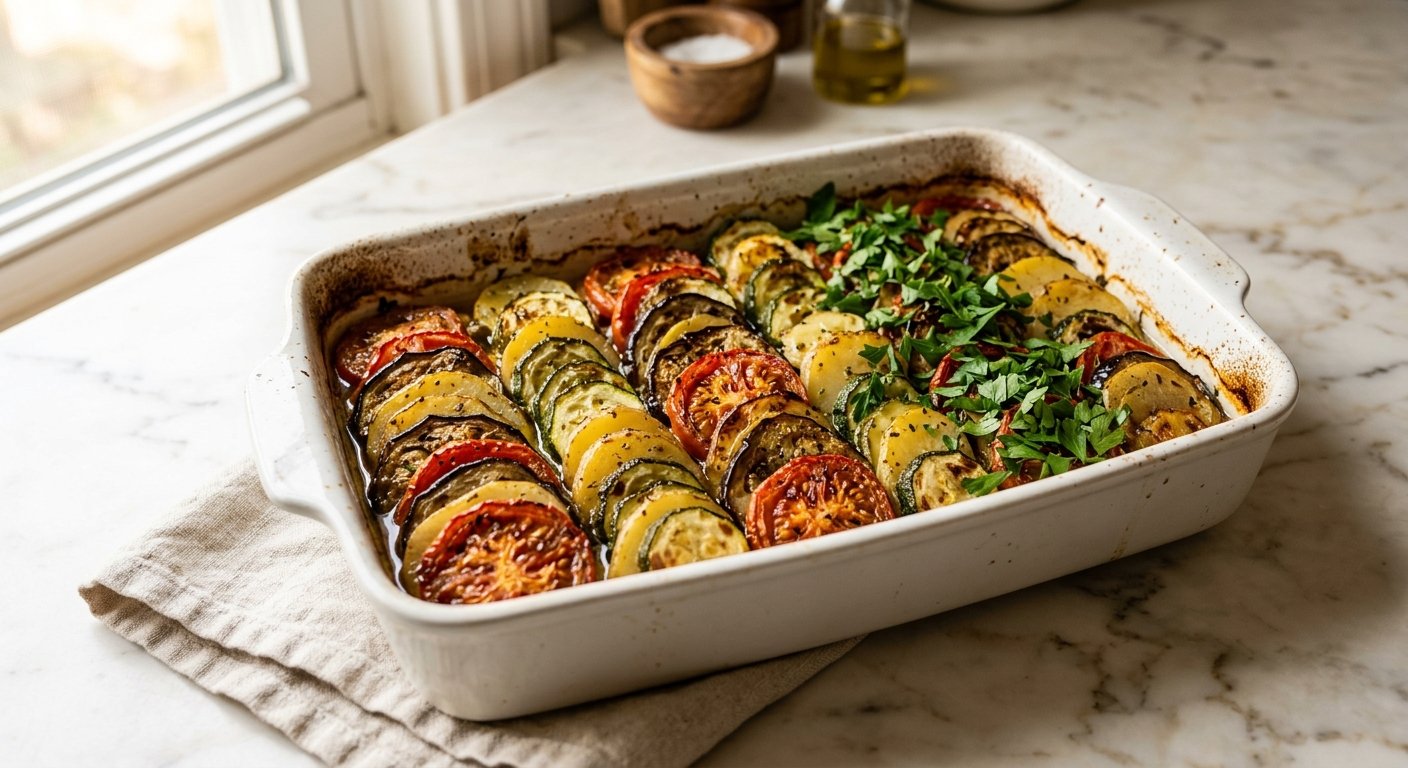
Classic Briam: Greek Roasted Vegetables (Tourlou)
Ingredients
The vegetables
- 3 medium potatoes about 600g / 1.3 lbs, peeled, sliced 5mm thick
- 2 medium onions halved and sliced into half-rings
- 2 medium zucchini about 400g / 14 oz, sliced 5mm thick
- 1 medium eggplant about 350g / 12 oz, cut into 2-3cm cubes
- 2 medium bell peppers any color, seeded and sliced into strips
- 4 ripe medium tomatoes about 500g / 1.1 lbs, roughly chopped (or 1 can 400g crushed tomatoes)
- 4 garlic cloves thinly sliced
Seasoning and liquid
- 120 ml extra-virgin olive oil ½ cup
- 120 ml water ½ cup
- 1½ teaspoons fine sea salt divided
- ½ teaspoon freshly ground black pepper divided
- 1½ teaspoons dried oregano divided
- Fresh parsley or basil to serve, optional
Instructions
- Preheat oven to 200°C (180°C fan / 400°F).
- Peel and slice potatoes 5mm thick. Slice onions, zucchini, and garlic. Cut eggplant into 2–3cm cubes. Seed and strip peppers. Roughly chop tomatoes.
- Layer potatoes across the bottom of a large baking dish (at least 30 x 25cm). Scatter onions and garlic over the top. Season with one-third of the salt, pepper, and oregano. Drizzle with 2 tablespoons of olive oil.
- Layer eggplant and zucchini over the onions. Season with another third of salt, pepper, and oregano. Drizzle with 2 more tablespoons of olive oil.
- Scatter tomatoes and peppers over the top. Add the remaining seasonings and the remaining olive oil.
- Pour the water down the sides of the dish (not over the vegetables).
- Cover tightly with foil. Bake for 30 minutes.
- Remove foil. Bake uncovered for a further 45–60 minutes, until liquid has reduced, the top is slightly caramelized, and a knife slides easily through the potatoes.
- Rest 10–15 minutes before serving. Serve warm or at room temperature with crusty bread.
Notes
Nutrition
Chef’s Notes
The next-day rule. Briam is one of those dishes that genuinely improves overnight. As it cools and sits, the olive oil redistributes, the flavors deepen, and the vegetables reach a texture that is softer and more harmonious than they were fresh from the oven. If you can plan ahead, make this the day before you want to serve it. Reheat gently in a low oven, or serve at room temperature as Greeks often do.
Variations. The core vegetables — potato, onion, zucchini, eggplant, tomato — are non-negotiable for a traditional briam. But the dish accommodates additions: a handful of green beans, a few slices of fennel, or some quartered mushrooms can go in with the middle layer. What you should not do is change the cooking method — adding protein, pre-cooking anything, or adding stock fundamentally changes the dish.
Herb choices. My mother used dried oregano exclusively. I sometimes add a few fresh thyme sprigs in the middle layer, or scatter fresh basil over the finished dish. Fresh parsley works well as a finishing garnish. Do not add fresh herbs at the start — they will burn during the uncovered baking phase.
Storage. Briam keeps well refrigerated for up to 4 days. In fact, it is one of the most reliable leftover dishes I know: it reheats without losing quality and tastes excellent cold from the refrigerator the morning after, alongside good feta and bread. I do not recommend freezing it — the texture of the zucchini and eggplant suffers too much.
What to serve alongside. Briam works as a side dish alongside grilled fish or roasted chicken, or as a vegetarian main course with crusty bread and a wedge of feta. A simple salad is the natural companion — try the Traditional Greek Village Salad (Horiatiki) alongside it. For another ladera dish to serve as part of a meze spread, my Classic Spanakorizo — Greek spinach rice — shares the same olive-oil-forward approach.
On the olive oil. Briam belongs to the Mediterranean tradition of olive-oil-based vegetable cooking, a tradition deeply embedded in the Greek approach to eating vegetables as a main course rather than a side. The relationship between olive oil and vegetable cooking in the Greek diet is part of what makes the Mediterranean diet one of the most studied dietary patterns in nutritional research. The olive oil in this dish is not excessive by the standards of the cuisine — it is foundational.
FAQ
What does briam mean in Greek?
Briam (also spelled “briami”) is the Greek word for this baked mixed vegetable dish. The name is thought to derive from Turkish, reflecting the Ottoman-era culinary exchanges across the Eastern Mediterranean. In some parts of Greece, particularly the Dodecanese islands, the same dish is called tourlou. Both names refer to the same preparation: summer vegetables baked in olive oil.
Can I use different vegetables in briam?
The traditional combination is potato, onion, zucchini, eggplant, tomato, and bell pepper. You can add green beans, sliced fennel, or mushrooms to the middle layer without compromising the dish. What you should keep consistent is the ratio of olive oil to vegetables and the layering order — potatoes and onions at the bottom, where they benefit from the longest direct contact with heat and liquid.
Why do my briam vegetables come out watery?
This usually happens for one of two reasons: the oven temperature was too low, or the uncovered baking phase was cut short. Briam needs the steam from the covered phase to cook through, but it also needs the uncovered phase to reduce that liquid and concentrate the sauce. If your dish is still very wet when you remove it, continue baking uncovered — check every 10 minutes until the surface liquid has evaporated and the edges have taken on some color. Another possible cause: very high-moisture zucchini. If your zucchini are exceptionally large, they will release more water. Larger, older zucchini can be seeded before slicing to reduce moisture.
Is briam vegan and gluten-free?
Yes on both counts. Briam Greek roasted vegetables contain no animal products and no gluten. It is one of the most naturally vegan dishes in Greek cuisine. If you are serving it to guests with dietary restrictions, it is worth confirming that the olive oil brand you use has no cross-contamination, but the dish itself is clean.
How is briam different from Greek moussaka?
They are very different dishes. Greek moussaka is a layered oven dish made with minced meat sauce, eggplant, and a thick bechamel topping — rich, substantial, and involving multiple cooked components assembled before baking. Briam is entirely vegetable-based, uses no meat or dairy, and involves no pre-cooking of any component. Both are oven dishes central to Greek home cooking, but they represent different sides of the tradition: moussaka is festive and elaborate; briam is everyday and economical.
Can I make briam ahead of time?
Yes, and I encourage it. Briam is genuinely better on the second day. Make it the day before, let it cool completely at room temperature, then refrigerate it overnight. Reheat in a 160°C (140°C fan / 325°F) oven covered with foil for about 20 minutes, or serve at room temperature. If you are bringing it to a gathering, it travels better than almost any other Greek dish.