
There is a week every August on Kos when the tomatoes become something else entirely. The vines in my family’s garden would be nearly collapsing under the weight of them — deep red, splitting at the shoulders, skin stretched thin over flesh that had absorbed weeks of Aegean sun. My mother would pick them in the early morning, still cool from the night, and by the time I came down for breakfast the kitchen already smelled of concentrated tomato and warm olive oil.
She made strapatsada on those mornings. Not because she had planned it. Because the tomatoes demanded it.
Strapatsada is one of the simplest things in the Greek kitchen: ripe tomatoes cooked down into a thick sauce, eggs scrambled softly into that sauce at the last moment, finished with crumbled feta. Three main ingredients. Twenty minutes. A meal that has fed Greek families for generations across the islands and the mainland.
It is not shakshouka. It is Greek, and it tastes like Greece in the way that only the simplest dishes do: like a specific time of year, a specific place, a particular quality of late-summer light on the Aegean.
The word strapatsada likely derives from the Italian strapazzare — to scramble, or to handle roughly. Here are the five things that make it right.
What Is Strapatsada?
Strapatsada is a traditional Greek dish of scrambled eggs cooked in a reduced tomato sauce, finished with crumbled feta cheese. Found across mainland Greece and the Greek islands, it is eaten as a breakfast, a light lunch, or a quick weeknight supper. On Kos and throughout the Dodecanese, it is a fixture of late-summer mornings when the tomatoes are at their peak.
The dish is sometimes described as Greek shakshouka, but this comparison misses the point. Shakshouka uses poached eggs set in a spiced tomato sauce with cumin, paprika, and harissa. Strapatsada uses none of these. The eggs are scrambled, not poached. The tradition is entirely Greek.
Why This Recipe Works
- Grating the tomatoes rather than chopping them releases the pulp and juice together, leaving the skin behind in your hand. No stringy pieces in the sauce, and the grated pulp cooks down faster and more evenly.
- Reducing the tomato sauce alone first — for a full 10 to 15 minutes — is non-negotiable. You are driving off excess water so the sauce concentrates and the tomato flavor deepens.
- Adding the eggs over low heat and folding them slowly ensures they remain soft and custardy. Pulling the pan off the heat while the eggs look about 80% set lets residual heat finish the job.
- Feta belongs at the end, crumbled over the finished dish. Added during cooking, it melts and disappears into the sauce.
- The olive oil is the flavor base, and its quality carries through the entire dish. A good Greek extra-virgin olive oil transforms a simple combination of ingredients into something that tastes of a specific place.
Ingredients
Serves 2
For the tomato sauce
- 4 large ripe tomatoes (about 600g / 1.3 lbs) or 400g canned whole peeled tomatoes
- 2 tablespoons extra-virgin olive oil, plus extra for serving
- 1 small clove garlic, finely minced (optional)
- 1 pinch of sugar (only if tomatoes taste acidic)
- Salt and freshly ground black pepper
For the eggs
- 4 large eggs
- Small pinch of salt
To finish
- 60–80g (2–3 oz) Greek feta, crumbled
- 1 tablespoon fresh oregano leaves, or ½ teaspoon dried Greek oregano
- Extra olive oil for drizzling
- Thick crusty bread, for serving
Step-by-Step Instructions
Step 1 — Prepare the tomatoes
If using fresh tomatoes: cut each tomato in half crosswise. Hold one half over a large bowl, cut-side down against the coarse side of a box grater, and grate until only the flattened skin remains in your hand. Discard the skins. You should have a pulpy, juice-rich mixture in the bowl.
If using canned whole tomatoes: empty them into a bowl and crush each one by hand. Include all of the juice from the can.
Step 2 — Build the sauce
Set a wide, heavy skillet or sauté pan over medium heat. Add the 2 tablespoons of olive oil and let it warm until it shimmers — about 30 seconds. If you are using garlic, add it now and stir for 30 seconds until fragrant. Add the tomato pulp and all its juice. Season with salt and black pepper. Add the pinch of sugar if needed. Stir to combine.
Step 3 — Reduce the sauce
Raise the heat to medium-high. Cook the sauce, stirring occasionally, for 10–15 minutes. Watch for the sauce to thicken noticeably, deepen in color from bright red to brick-red, and hold a trail when a spoon is dragged through it. This step is the heart of strapatsada. Season once more. Taste — it should be clearly, deeply tomato.
Step 4 — Beat the eggs
While the sauce finishes, crack all four eggs into a bowl. Add a small pinch of salt. Beat lightly with a fork — just enough to break the yolks and combine them with the whites. Do not beat vigorously or create foam.
Step 5 — Add the eggs
Reduce the heat to low. Wait about 30 seconds for the pan to lose some of its direct heat. Pour the beaten eggs over the tomato sauce in one steady movement. Let them sit without touching them for 15 to 20 seconds — the edges will begin to set. Then pick up a wooden spoon or wide spatula and begin folding in long, sweeping strokes, encouraging the eggs to form soft, irregular curds within the tomato sauce.
Step 6 — Pull from the heat
Watch the eggs carefully. When they reach roughly 80% set — still slightly underdone in places, with some areas still glossy and a little wet — remove the pan from the heat entirely. By the time you plate and carry to the table, residual heat will have finished them. The target texture: soft, just-set curds of egg, creamy rather than dry.
Step 7 — Serve immediately
Spoon the strapatsada into shallow bowls or onto warmed plates. Crumble the feta generously over the top. Add a few fresh oregano leaves and a thin drizzle of good olive oil over everything.
Serve at once with crusty bread. The bread is not optional; it exists to catch the sauce.
Strapatsada pairs beautifully with a Traditional Greek Village Salad (Horiatiki) — both dishes share the same late-summer tomato character and the same feta.
Recipe Card
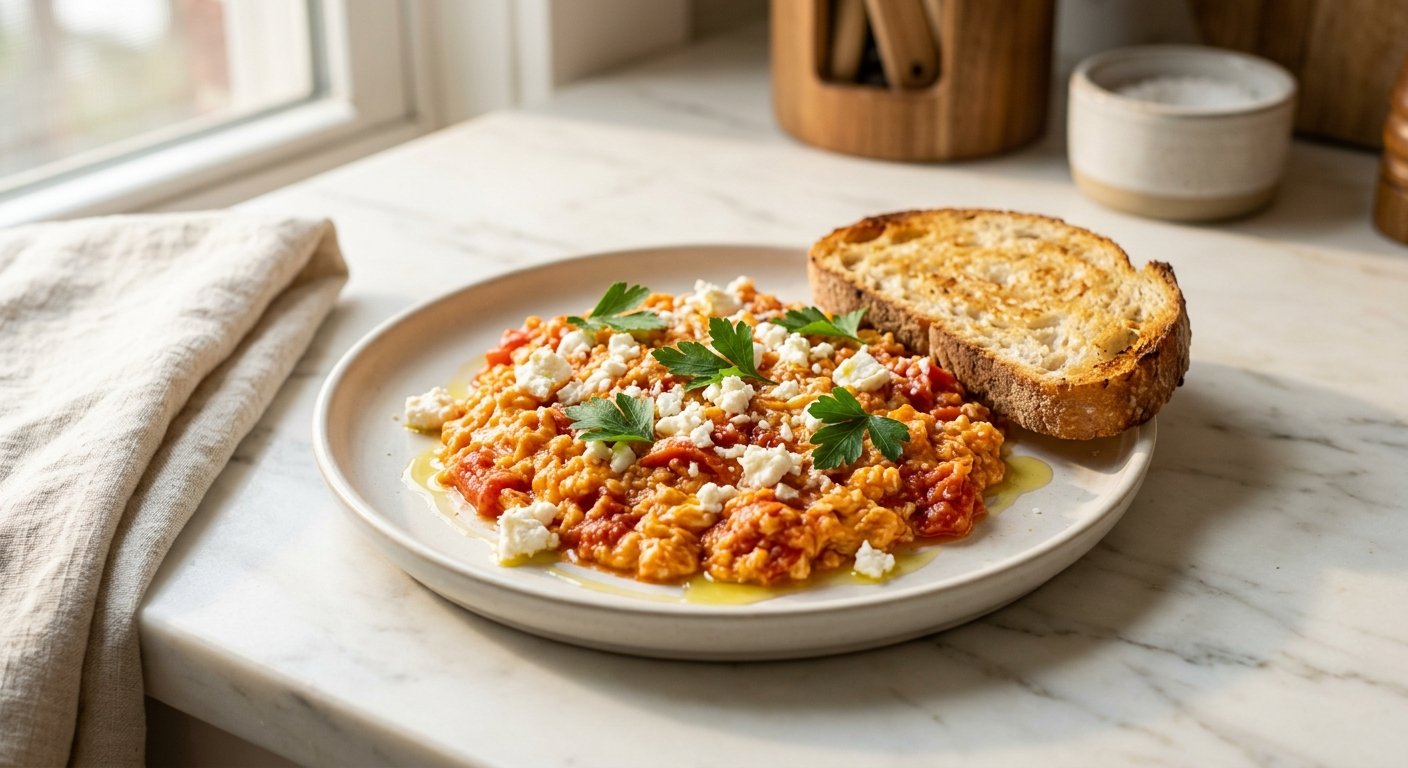
Strapatsada (Greek Scrambled Eggs with Tomato)
Ingredients
For the tomato sauce
- 4 large ripe tomatoes (about 600g / 1.3 lbs) or 400g canned whole peeled tomatoes in winter
- 2 tablespoons extra-virgin olive oil plus more for serving
- 1 small clove garlic finely minced (optional)
- 1 pinch sugar only if tomatoes taste acidic
- salt and freshly ground black pepper to taste
For the eggs
- 4 large eggs
- 1 small pinch salt
To finish
- 60-80 g Greek feta crumbled
- 1 tablespoon fresh oregano leaves or 1/2 teaspoon dried Greek oregano
- extra olive oil for drizzling
- crusty bread, for serving
Instructions
- Cut each tomato in half crosswise and grate on the coarse side of a box grater into a bowl, discarding the skins. (For canned tomatoes: crush by hand in the bowl, including all juices.)
- Warm olive oil in a wide skillet over medium heat. If using garlic, cook 30 seconds until fragrant. Add the tomato pulp, season with salt, pepper, and sugar if needed. Stir to combine.
- Cook over medium-high heat, stirring occasionally, for 10 to 15 minutes until the sauce thickens, deepens in color, and holds a trail when a spoon is dragged through it. Taste and season again.
- Crack eggs into a bowl with a pinch of salt. Beat lightly with a fork -- just enough to combine yolks and whites.
- Reduce heat to low. Wait 30 seconds. Pour the eggs over the sauce. Let sit 15 to 20 seconds, then fold gently with a wooden spoon in slow, sweeping strokes until soft curds form throughout the sauce.
- When eggs are about 80% set -- still slightly underdone and glossy in places -- remove the pan from the heat. Residual heat finishes them.
- Spoon into bowls. Crumble feta generously on top. Add fresh oregano and a drizzle of olive oil. Serve immediately with crusty bread.
Notes
Nutrition
Chef Notes
On the tomatoes. There is no substitute for a genuinely ripe, in-season tomato in strapatsada. Between August and September, source the best tomatoes you can find. The rest of the year, a can of good San Marzano whole tomatoes will produce a more honest dish than flavorless out-of-season fresh ones.
On the olive oil. Use a good Greek extra-virgin olive oil for everything in this dish. In strapatsada, the olive oil is a flavor ingredient, not just a cooking medium. Neutral oil produces a flat dish.
On the feta. Use proper Greek feta — made from sheep’s milk or a blend of sheep and goat milk, PDO if you can source it. Seek out a block stored in brine and crumble it yourself.
Serving ideas. For a full Greek island breakfast in summer, serve strapatsada with Tirokafteri — Spicy Greek Feta Spread and warm pita. My Greek Moussaka uses a similar technique for the meat sauce — the same patient reduction, the same respect for what tomatoes become when you give them time.
Storage. Strapatsada does not keep. Make it fresh and serve immediately. Do not attempt to reheat leftovers.
Scaling. The recipe scales cleanly — use 2 eggs and 2 medium tomatoes per person.
FAQ
What is strapatsada?
Strapatsada is a traditional Greek dish of scrambled eggs cooked in a reduced tomato sauce and finished with crumbled feta. It is eaten as a breakfast, brunch, or light lunch across Greece and the Greek islands. The name likely comes from the Italian strapazzare, meaning to scramble or rough-handle. The dish is at its best in late summer when ripe, in-season tomatoes are available.
Is strapatsada the same as shakshouka?
No. Strapatsada uses scrambled eggs rather than poached, contains none of the spices associated with shakshouka (no cumin, paprika, or harissa), and is finished with Greek feta. They are different dishes with different textures, flavor profiles, and histories.
Can I make strapatsada with canned tomatoes?
Yes. In autumn and winter, when fresh tomatoes have little flavor, canned whole San Marzano tomatoes produce a very good result. Crush them by hand before adding to the pan. The sauce still needs to reduce for 10–15 minutes.
Why grate the tomatoes instead of chopping them?
Grating the tomatoes on the coarse side of a box grater releases the pulp and juice together while leaving the skin behind in your hand. The result is a smooth, even tomato base with no stringy skin and no irregular chunks. Grated tomato pulp also cooks down faster and more evenly than chopped pieces.
What do you serve with strapatsada?
Crusty bread is essential — a thick slice of Greek country bread or sourdough to absorb the sauce. A Traditional Greek Village Salad (Horiatiki) alongside is the natural island pairing: both dishes use ripe tomatoes and feta, and the freshness of the salad contrasts well with the warmth of the eggs.