
On Easter morning in Kos, the first thing you smelled was never the lamb on the spit. It was the spring onions. My mother would be up before anyone else, heating olive oil in a heavy pot she had used since before I was born, and the moment those spring onions hit the pan, the whole house would change. That was the smell of greek lamb fricassee coming together, and it meant the day had properly begun.
Frikasee is not a showy dish. It doesn’t have the architectural drama of moussaka or the golden crust of spanakopita. What it has is depth — bone-in lamb that has spent an hour quietly releasing everything it has into a broth with spring onions, dill, and romaine, then the bright, silky avgolemono sauce folded in at the end to tie it all together. My mother called it a dish that cooked itself. She was mostly right.
But there is one moment in this frikasee recipe that demands your full attention, and that is the avgolemono. The technique itself is straightforward — eggs, lemon, tempering — but get it wrong and you end up with curdled eggs in lamb broth instead of the smooth, glossy sauce that makes this dish what it is. I’ve spent years teaching people how to do it correctly, and I’ll walk you through it step by step here.
This recipe serves 6 people and takes about 90 minutes from start to finish. It is a natural Easter dish, but on Kos we ate it through late spring and into early summer whenever spring lamb was good and the first romaine was coming in from the gardens. There is no wrong time to make it.
What Is Frikasee?
Frikasee (Φρικασέ in Greek) is a braised meat dish finished with avgolemono — the Greek egg-and-lemon sauce that appears in everything from soups to stuffed vegetables. The name comes from the French fricassée, brought to Greek cooking centuries ago via the cooking traditions of the Byzantine court and later the Ottoman-era urban kitchens of Smyrna and Constantinople. But where the French fricassée relies on cream for its richness, the Greek frikasee relies on avgolemono, which gives it a lighter, brighter finish.
The most beloved version is greek lamb fricassee, made with bone-in shoulder pieces, romaine lettuce, spring onions, and dill. It is above all a spring dish — lamb at its youngest and most tender, romaine coming in fresh from the garden, the season’s first lemons. On most Greek islands and in much of northern Greece, it appears on the Easter table as naturally as lamb on the spit. You can read more about the science and history of avgolemono as a sauce at the Wikipedia article on avgolemono, which covers its Greek and Middle Eastern roots in detail.
The dish is also made with pork in some regions — hirino frikasee — and occasionally with chicken, though the lamb version remains the classic.
Why This Recipe Works
- Bone-in shoulder is the right cut. Lamb shoulder cooked on the bone releases collagen steadily over a long braise. This enriches and lightly thickens the braising liquid, giving it the body the avgolemono needs to bind to properly. Boneless meat simply doesn’t produce the same result.
- Romaine goes in late, not early. Many home cooks add the romaine at the beginning and end up with a grey-green mush. Added in the final 15 minutes, the romaine wilts into the broth while retaining a little texture and its fresh, slightly bitter flavour — the right counterpoint to the richness of the lamb.
- Tempering the avgolemono is non-negotiable. Cold eggs poured directly into hot broth will scramble. Gradually whisking hot broth into the egg-lemon mixture first raises the eggs’ temperature before they hit the pot, producing a stable, silky sauce every time.
- Fresh dill, not dried. Dried dill loses the volatile aromatic compounds that give fresh dill its brightness. In this frikasee recipe, dill is a structural flavour, not a garnish. Use the real thing.
- Wine before water. Deglazing with white wine before adding stock lifts the browned bits from the bottom of the pot and adds an acidity to the braising liquid that the avgolemono later builds on. It’s a short step that makes a measurable difference.
Ingredients
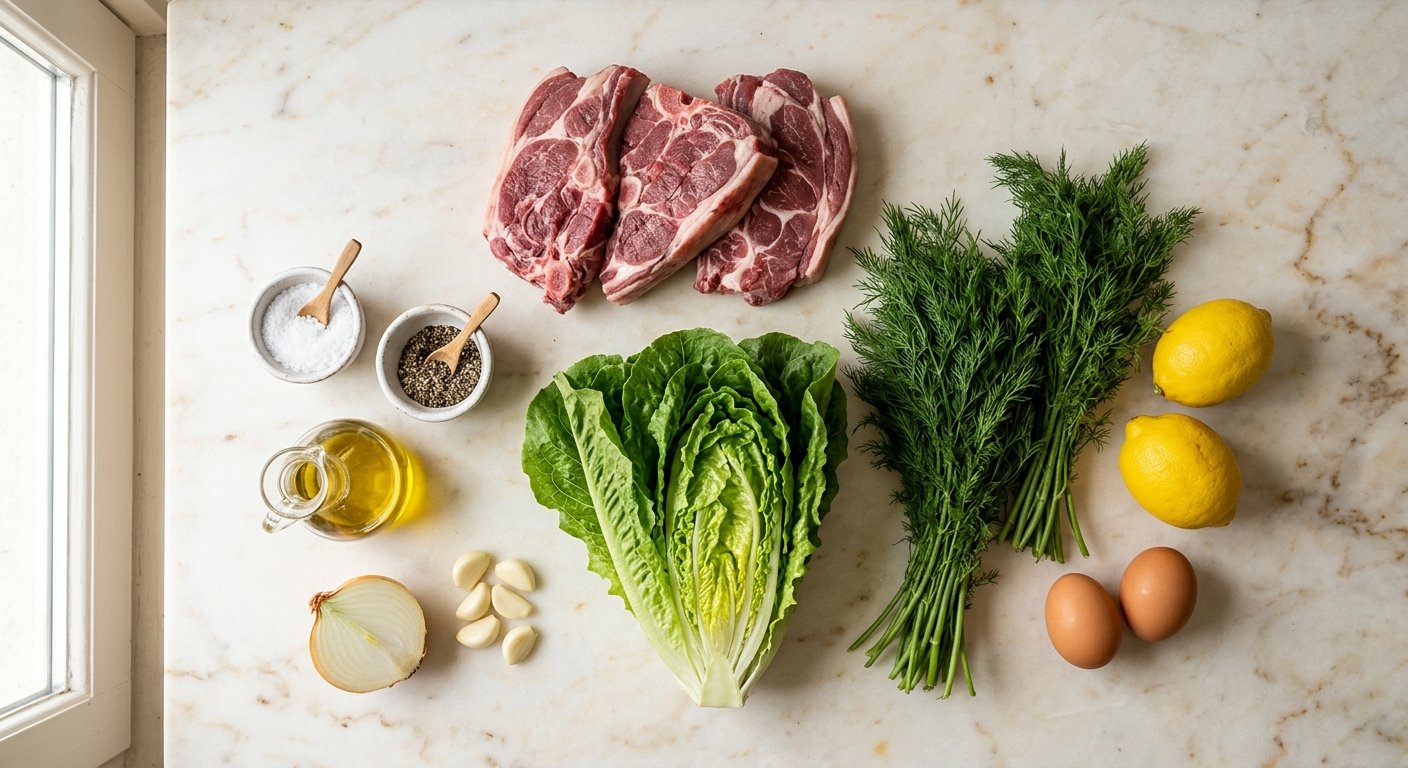
For the Lamb
- 1.5 kg (3.3 lbs) bone-in lamb shoulder, cut into 6–8 serving pieces
- Salt and freshly ground black pepper, to taste
- 3 tablespoons extra-virgin olive oil
For the Braise
- 1 large yellow onion, roughly chopped
- 6–8 spring onions (green onions), white and light green parts only, sliced
- 1 cup (240ml) dry white wine
- 500ml (2 cups) chicken stock or water
- 2 heads romaine lettuce, washed and roughly chopped (about 400g)
- 40g (1.5 oz) fresh dill, roughly chopped
- Salt and freshly ground black pepper, to taste
For the Avgolemono
- 3 large eggs, at room temperature
- 80ml (⅓ cup) freshly squeezed lemon juice (about 2 lemons)
- 1 tablespoon cornstarch (optional — helps stabilize the sauce)
A note on the lamb: Ask your butcher to cut the shoulder into serving pieces, each with some bone attached. If you can’t find shoulder, lamb breast (sterna) is an excellent alternative — fattier and even more tender after braising. Avoid leg of lamb for this recipe; it’s too lean for the long cook time.
Step-by-Step Instructions
Step 1 — Season and brown the lamb
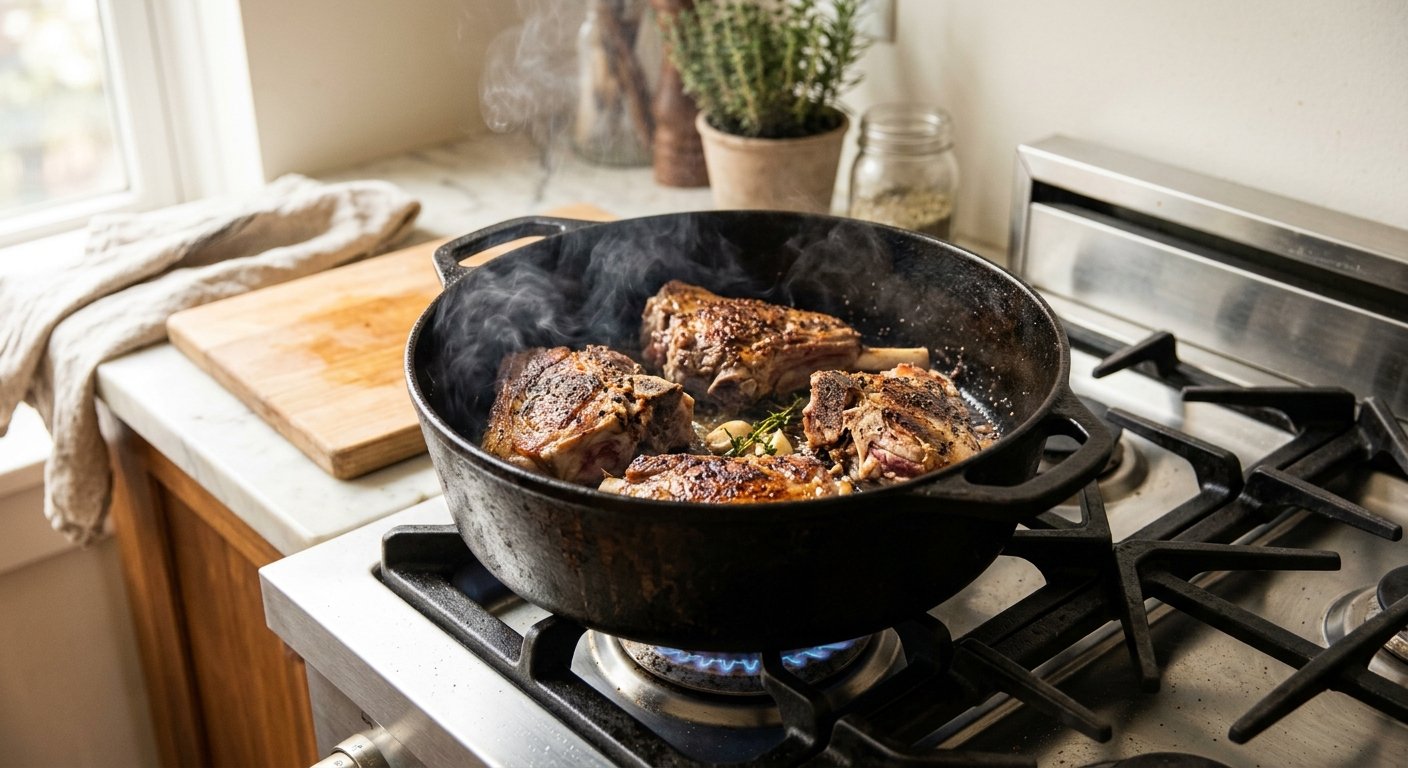
Pat the lamb pieces dry with paper towels. Season generously on all sides with salt and pepper. Heat the olive oil in a large, heavy pot or Dutch oven over medium-high heat until shimmering.
Add the lamb in a single layer — do not crowd the pot. Sear for 3–4 minutes per side, undisturbed, until each piece has a deep golden-brown crust. Work in batches if necessary and give the pot time to come back to temperature between batches. When browned, remove the lamb to a plate and set aside.
Browning is where the base flavour of this greek lamb fricassee is built. The Maillard reaction happening in that crust will carry through the entire braise.
Step 2 — Soften the onions
Reduce the heat to medium. Add the chopped yellow onion and spring onions to the same pot. Cook, stirring occasionally, for 5–6 minutes until softened and translucent. As you stir, scrape up any browned bits stuck to the bottom of the pot — those caramelized residues are pure flavour and should not be left behind.
Do not rush this step. Properly softened onions create a sweet, gentle backbone for the braise. Undercooked onions at this stage will be noticeable at the table.
Step 3 — Braise the lamb
Return the browned lamb pieces to the pot, nestling them into the softened onions. Pour in the white wine and let it bubble actively for 2 full minutes — this cooks off the alcohol and concentrates the wine’s flavour.
Add the stock (or water), pouring in just enough to come about three-quarters up the sides of the lamb pieces. Season the braising liquid with salt and pepper. Bring to a boil over medium-high heat, then reduce the heat to low, cover the pot tightly, and simmer for 50–60 minutes. The lamb should be nearly tender at this point — a fork should enter with mild resistance, not free-falling through.
Step 4 — Add the greens
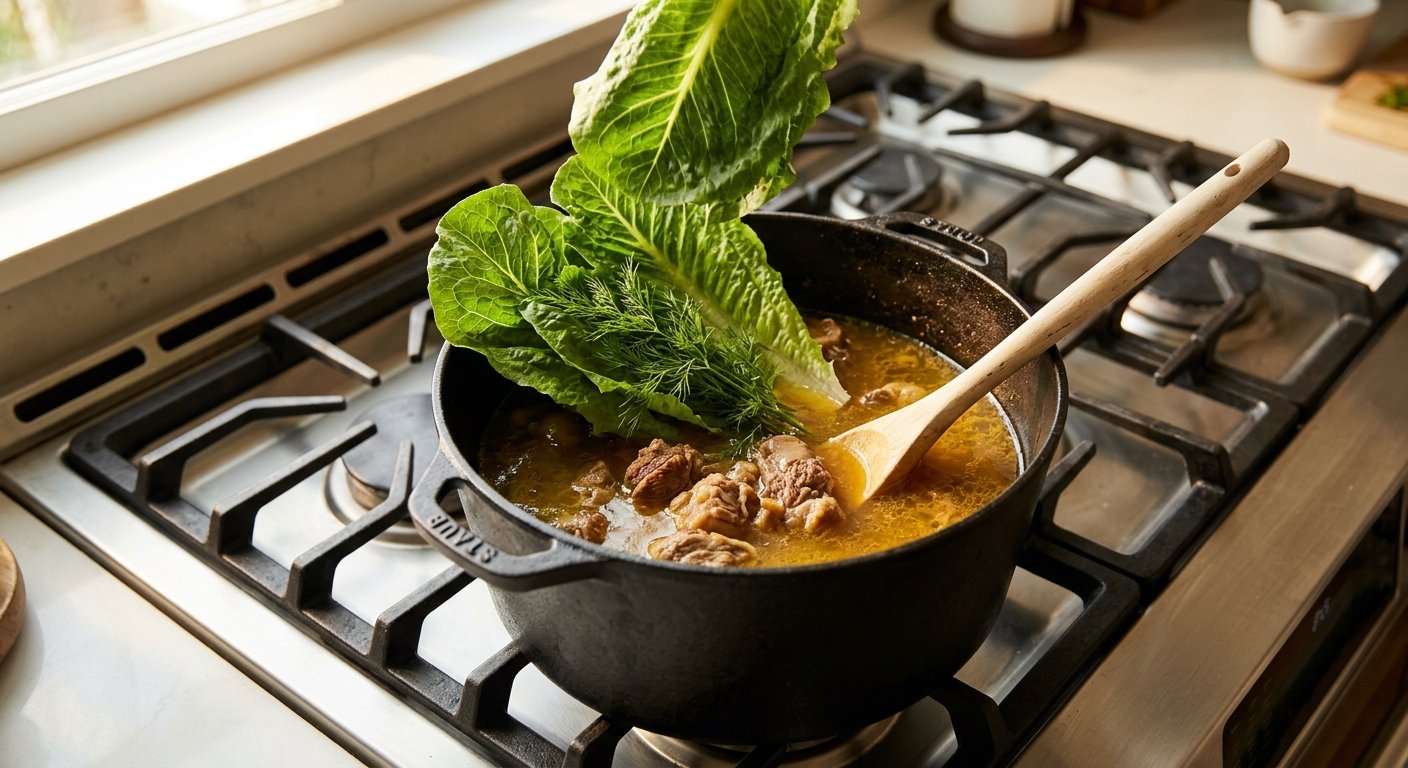
Add the chopped romaine lettuce and fresh dill to the pot all at once. The volume will look alarming. Stir everything together firmly so the greens are submerged in the broth, then replace the lid and cook for a further 15 minutes.
The romaine will wilt entirely, releasing moisture that loosens the broth slightly. After 15 minutes, the lamb should be fully tender and pulling slightly from the bone. This is the right moment for the avgolemono.
Step 5 — Make the avgolemono
This is the step that separates a memorable frikasee recipe from a forgettable one. Treat it with care.
In a medium bowl, whisk together the eggs, lemon juice, and cornstarch (if using) until smooth and slightly frothy — about 30 seconds of vigorous whisking. The mixture should look uniform, not streaky with yolk.
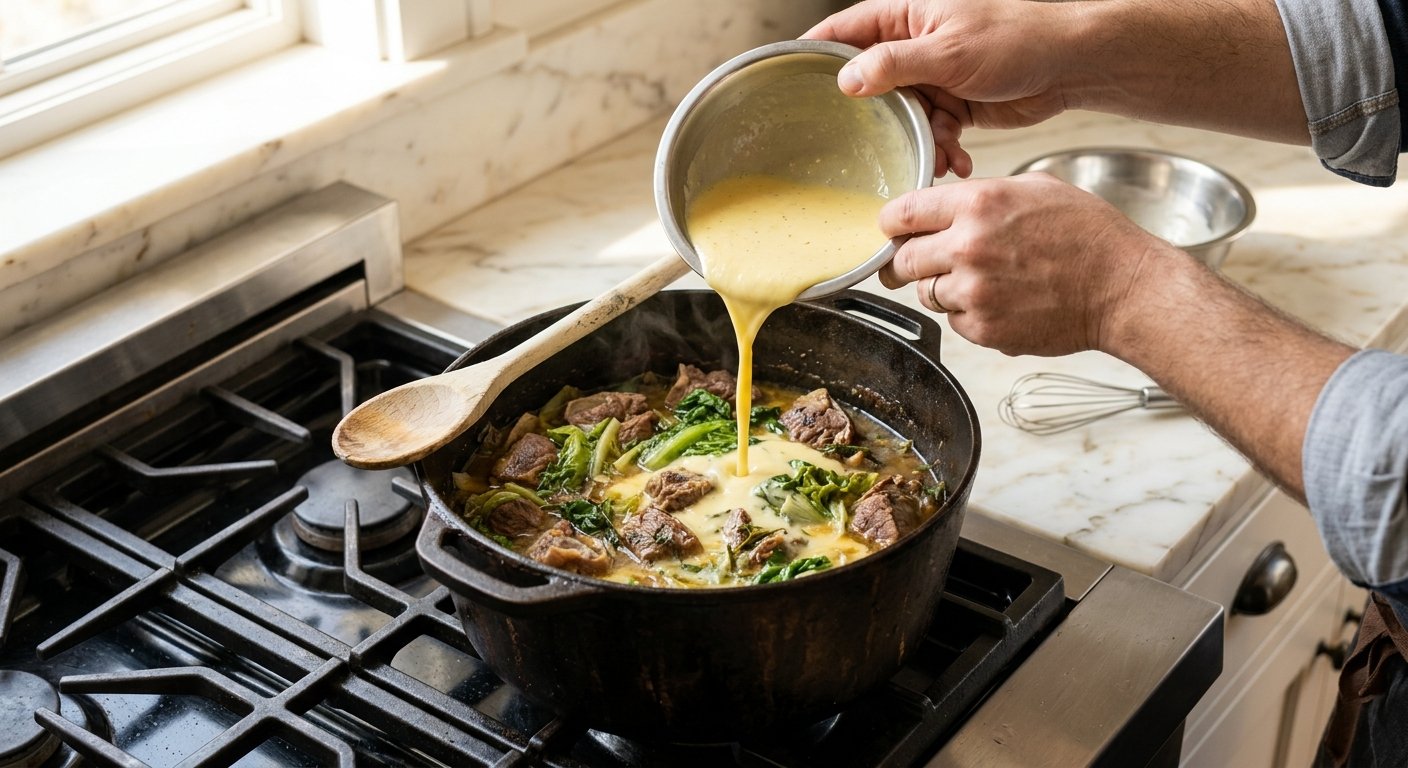
Now take a ladle and scoop out 3–4 ladles of hot broth from the pot. Add the hot broth to the egg-lemon mixture one ladle at a time, whisking constantly as you pour. This process — tempering — raises the eggs’ temperature gradually so they don’t scramble on contact with the full pot of hot liquid. After 3–4 ladles, the egg mixture should feel warm to the touch.
Pour the tempered avgolemono back into the pot in a slow, steady stream, stirring the broth gently as you pour. If you want more background on why avgolemono works this way and its history in Greek and Middle Eastern cooking, the Avgolemono Wikipedia article is a thorough starting point.
Step 6 — Finish and serve
Reduce the heat to the absolute lowest setting and cook, uncovered, for 2–3 minutes, stirring gently a few times. The broth will thicken slightly and develop a glossy, slightly opaque quality — this is the avgolemono binding to the braising liquid. Do not let the pot return to a simmer. Boiling at this point will break the sauce.
Taste for seasoning. Adjust salt and lemon as needed — some batches of lamb will have reduced the broth more than others, so the seasoning needs a final check. Serve the greek lamb fricassee immediately, in deep wide bowls with plenty of the broth ladled over the lamb. A piece of crusty village bread alongside is not optional.
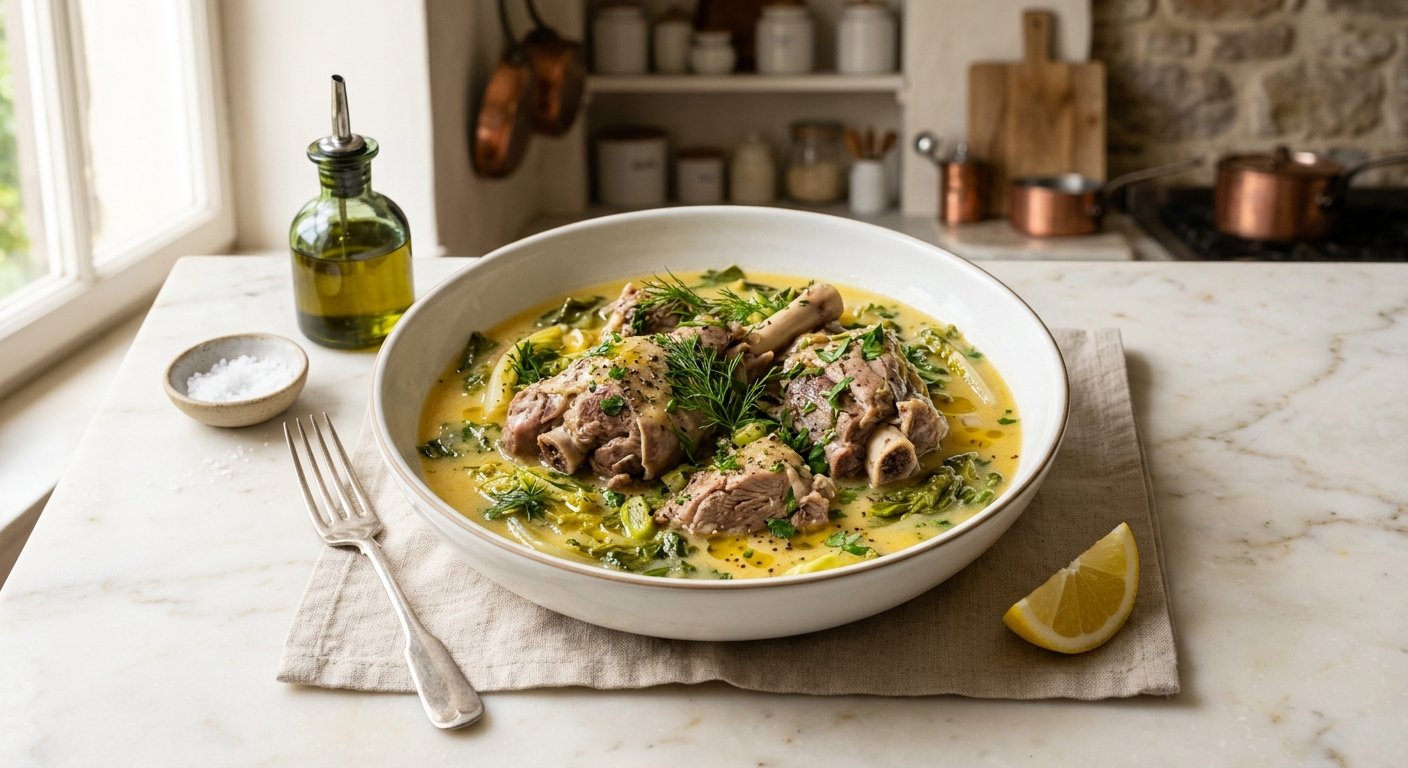
Greek Lamb Fricassee (Frikasee) with Avgolemono
Ingredients
- 1.5 kg 3.3 lbs bone-in lamb shoulder, cut into 6-8 serving pieces
- Salt and freshly ground black pepper to taste
- 3 tablespoons extra-virgin olive oil
- 1 large yellow onion roughly chopped
- 6-8 spring onions green onions, white and light green parts only, sliced
- 1 cup 240 ml dry white wine
- 500 ml 2 cups chicken stock or water
- 2 heads romaine lettuce washed and roughly chopped (about 400 g)
- 40 g 1.5 oz fresh dill, roughly chopped
- 3 large eggs at room temperature
- 80 ml 1/3 cup freshly squeezed lemon juice (about 2 lemons)
- 1 tablespoon cornstarch optional, helps stabilise the sauce
Instructions
- Pat the lamb pieces dry and season generously on all sides with salt and pepper. Heat the olive oil in a large heavy pot or Dutch oven over medium-high heat until shimmering. Add the lamb in a single layer without crowding and sear undisturbed for 3-4 minutes per side until deeply golden-brown. Work in batches, letting the pot come back to temperature between them. Remove the lamb to a plate.
- Reduce the heat to medium. Add the chopped yellow onion and spring onions to the same pot and cook, stirring occasionally, for 5-6 minutes until softened and translucent, scraping up the browned bits from the bottom as you go.
- Return the lamb to the pot, nestling it into the onions. Pour in the white wine and let it bubble actively for 2 full minutes to cook off the alcohol. Add the stock or water, enough to come three-quarters up the sides of the lamb. Season, bring to a boil, then reduce to low, cover tightly and simmer for 50-60 minutes until the lamb is nearly tender.
- Add the chopped romaine and dill all at once. Stir firmly so the greens are submerged, replace the lid and cook a further 15 minutes until the lamb is fully tender and pulling from the bone.
- Whisk the eggs, lemon juice and cornstarch together in a medium bowl for about 30 seconds until smooth and slightly frothy. Ladle out 3-4 ladles of hot broth and add them to the egg mixture one at a time, whisking constantly, until the mixture feels warm to the touch. Pour the tempered avgolemono back into the pot in a slow steady stream, stirring gently as you pour.
- Reduce the heat to the absolute lowest setting and cook uncovered for 2-3 minutes, stirring gently, until the broth thickens slightly and turns glossy. Do not let it return to a simmer or the sauce will break. Taste and adjust salt and lemon, then serve immediately in deep wide bowls with plenty of broth and crusty bread alongside.
Chef’s Notes
On choosing your lamb. Shoulder is the correct cut for this dish — not leg, not rack. The bones and marbled fat in the shoulder break down over the long braise, producing a broth that is naturally rich and full-bodied. If you cannot find shoulder, ask your butcher for lamb breast (sterna). It is fattier, slightly cheaper, and will give you an even more deeply flavoured broth. Avoid leg of lamb: it’s too lean for a 70-minute braise and will come out stringy and dry.
On avgolemono without cornstarch. My mother never used cornstarch. She relied on proper tempering, vigorous whisking, and low heat. If you’re making this frikasee recipe for the first time, the cornstarch gives you a slightly wider margin for error without changing the taste of the finished dish. Once you’ve made this a few times and the tempering technique feels natural, you won’t need it. If you love avgolemono and want to explore it as a standalone dish, my Avgolemono Soup uses the same technique in a chicken and orzo soup — it’s a good companion recipe.
On the greens. Romaine is the classic choice for greek lamb fricassee and the one I use in this recipe. Its mild bitterness and slight crunch make it ideal. If you want a more rustic, assertive version, escarole or wild greens (horta) work well. Avoid spinach — it wilts to the point of sliminess in this dish and discolours the broth.
Variations. Replace the lamb with pork shoulder for hirino frikasee — the cooking process is identical. You can also add 4–5 halved, cleaned artichoke hearts in Step 4 alongside the romaine: this is a common variation in Attica and certain island kitchens, and adds a beautiful meaty depth to the broth. If you enjoy lamb in general, my Paidakia (Greek Grilled Lamb Chops) are worth exploring as a contrast — everything this dish is not: quick, charred, bold.
Storage and reheating. Greek lamb fricassee keeps well in the refrigerator for up to 3 days in a covered container. Reheat on the stovetop over low heat only, stirring occasionally and never allowing it to boil — boiling will break the avgolemono and produce a grainy, separated sauce. Do not freeze: the avgolemono does not survive the freeze-thaw cycle intact.
What to serve alongside. The dish is complete with crusty bread and nothing else. If you want a starch, Greek Lemon Potatoes are the natural partner — their lemony, olive-oil-rich flavour echoes the avgolemono without competing with it.
FAQ
What is Greek lamb fricassee (frikasee)?
Greek lamb fricassee, known as frikasee (Φρικασέ), is a braised dish made with bone-in lamb, spring onions, romaine lettuce, and dill, finished with avgolemono — a sauce of whisked eggs and fresh lemon juice. It is one of the classic spring dishes of Greek cooking, closely associated with Easter, and is particularly common in the islands and throughout northern Greece.
What cut of lamb should I use for greek lamb fricassee?
Bone-in lamb shoulder is the best choice. The bones and connective tissue release gelatin during the braise, which enriches and naturally thickens the broth. Lamb breast is an excellent alternative. Avoid lamb leg — it is too lean and will dry out over a long cook.
Why is my avgolemono grainy or curdled?
Curdled avgolemono is almost always caused by one of two things: adding the eggs too quickly to very hot liquid, or bringing the pot to a boil after the sauce goes in. Fix the first problem by tempering — add hot broth to the egg-lemon mixture slowly, whisking constantly, before pouring it into the pot. Fix the second problem by keeping the heat at the lowest possible setting after the avgolemono is added, and by not walking away from the pot.
Can I make this frikasee recipe without wine?
Yes. Simply skip the wine and add the same volume of extra stock when you deglaze. The wine adds acidity and a faint fruity note to the broth, but the dish is fully functional without it. If you want to approximate the acidity, add a tablespoon of fresh lemon juice when you add the stock.
What greens can I substitute for romaine in frikasee?
Escarole, endive, or wild greens (horta) all work well and will give the dish a more pronounced bitter edge. Chicory is another traditional choice in some parts of Greece. Avoid spinach — it breaks down too completely and muddies the colour and texture of the broth.
Can I make greek lamb fricassee ahead of time?
You can braise the lamb and greens up to a day ahead — stop before the avgolemono step, refrigerate, and reheat gently. Add the avgolemono fresh when you’re ready to serve. The finished dish with avgolemono does not reheat cleanly from cold to hot without risk of breaking, so completing the sauce to order gives you the best result.