
Every week, without fail, my mother made kolios. On Kos, mackerel is not a delicacy — it is just fish. The morning boats bring it in, the harbor market sells it fast, and by midday half the island has a pan of it in the oven or on the grill. That was the rhythm of life on the island when I was growing up, and it gave me a relationship with this particular fish that I carry into every kitchen I have ever worked in.
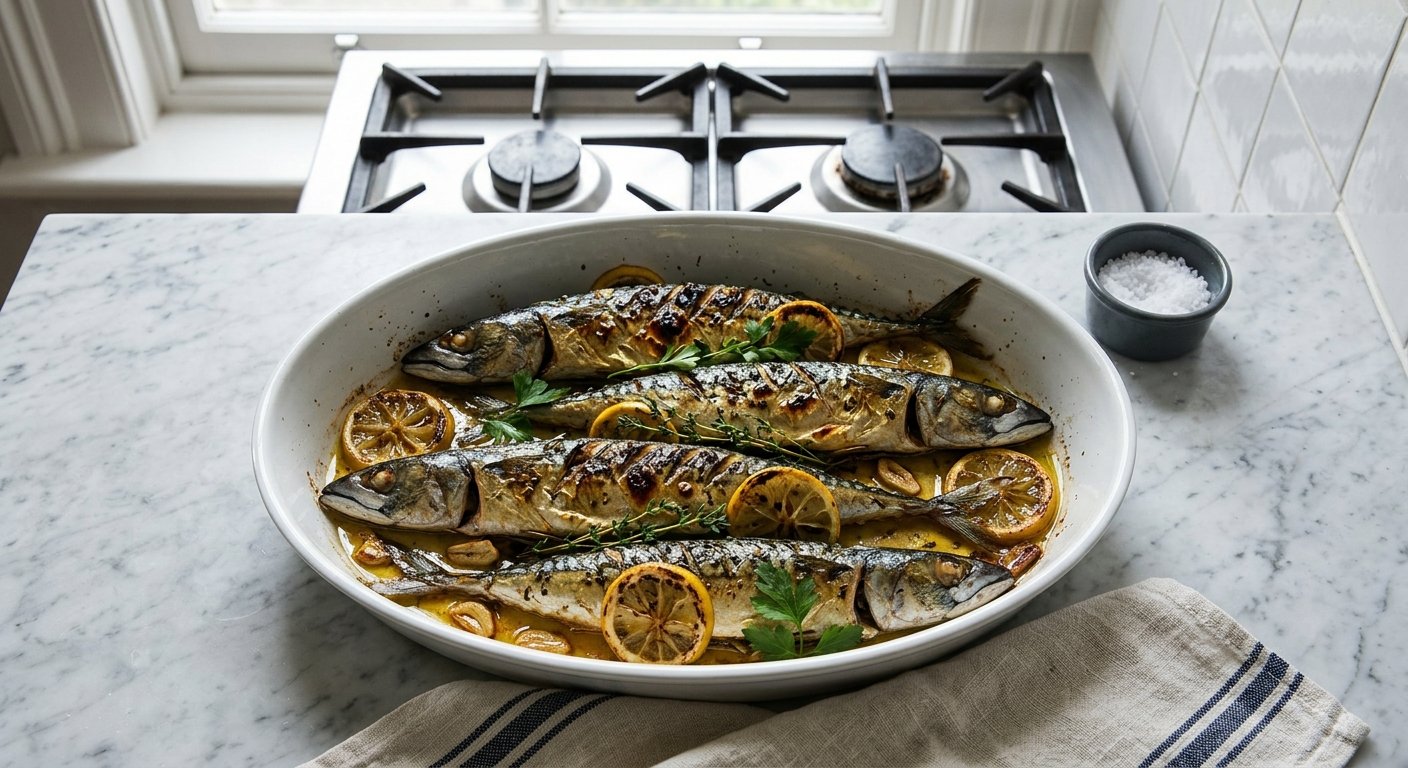
My mother’s version of Greek baked mackerel — kolios sto fourno — was almost aggressive in its simplicity. She scored the fish deeply on both sides, rubbed it with coarse sea salt, pressed a few garlic slivers and a sprig of fresh thyme into the cuts, and laid it over lemon rounds in a well-oiled pan. A pour of olive oil, a squeeze of lemon juice, and into a very hot oven it went. Twenty-five minutes later, the skin was crackling at the edges and the kitchen smelled like the sea.
What she understood, and what took me years of cooking to articulate, is that mackerel needs almost nothing from the cook. The fish has an assertive, rich flavor that stands up to bold herbs and acid. It is one of the few fish that actually improves when it is cooked with confidence rather than caution. Too much fussing, too many additions, and you lose what makes it special.
This recipe stays close to her version. It is the kind of Greek baked mackerel that does not require a trip to a specialty fishmonger — your local fishmonger or even a good supermarket fish counter will have everything you need. The technique is simple, the results are impressive, and it comes together in thirty-five minutes from start to table.
Table of Contents
What Is Kolios sto Fourno?
Kolios sto fourno translates directly from Greek as “mackerel in the oven.” Kolios (κολιός) is the Greek word for chub mackerel — a smaller, fattier member of the Scomber family that is found abundantly throughout the Aegean and Mediterranean. In Greek fishing communities, kolios has always been a working-class fish: plentiful, cheap, and deeply nutritious.
The “sto fourno” preparation is the most common home-cooking method. The fish is seasoned, sometimes stuffed with aromatics, placed in a baking dish with olive oil and lemon juice, and roasted at high heat until the skin blisters and the flesh pulls cleanly from the bone. It is one of the foundational dishes of Greek island cooking — taught from parent to child, cooked in the same battered aluminum pans for generations.
Though simple, kolios sto fourno is not a trivial dish. It belongs to the same category of Greek cooking as roasted lamb or braised greens: unshowy preparations that reveal their quality through the honesty of the ingredients and the precision of the technique.
Why This Recipe Works
- Scoring the fish deeply matters. Cuts through the skin and into the flesh allow the heat to penetrate more evenly, preventing the outside from overcooking before the center is done. Scoring also allows the seasoning — salt, lemon juice, and herb aromatics — to work into the flesh rather than sitting only on the surface. Most home cooks score too shallowly; cut all the way to the bone.
- High heat is non-negotiable. Mackerel has a high fat content, and that fat renders and bastes the flesh from within when exposed to a very hot oven (200–220°C / 400–425°F). A lower temperature produces steamed, soft fish. You want roasted, caramelized fish with blistered skin at the edges — that requires real heat.
- Olive oil does double duty. A generous pour of extra-virgin olive oil protects the fish from drying out while simultaneously carrying the flavor of garlic and herbs across the whole dish. Do not be timid. Greeks are not timid with olive oil.
- The lemon goes in at the start, not the end. Unlike with more delicate fish, mackerel can handle acid throughout the cooking process. Lemon rounds placed under the fish and lemon juice poured over the top before roasting perfume the flesh, mellow the fish’s natural richness, and produce a concentrated pan sauce that is worth spooning over the finished dish.
Ingredients
Serves 4
For the Fish:
- 4 whole mackerel (kolios), cleaned and scaled, about 400–500g / 14–17oz each
- 1½ teaspoons coarse sea salt
- ½ teaspoon freshly ground black pepper
- 1 teaspoon dried Greek oregano
For the Baking:
- 4 tablespoons extra-virgin olive oil, plus more for the pan
- Juice of 2 large lemons (about 80ml / ⅓ cup)
- 1 lemon, thinly sliced into rounds
- 6 garlic cloves, peeled and thinly sliced
- 4 sprigs fresh thyme
- 4 sprigs fresh flat-leaf parsley, plus more for serving
- 2 sprigs fresh rosemary (optional but recommended)
For Serving:
- Extra lemon wedges
- Fresh flat-leaf parsley leaves
- Crusty bread or Greek lemon potatoes on the side
A note on the fish: Ask your fishmonger to clean and scale the mackerel. If you can get them gutted and scaled but otherwise whole, all the better — the head and tail help hold the fish together in the oven. Mackerel is sold whole in most fishmongers and Mediterranean fish markets. If you can only find fillets, see the Chef’s Notes section below for the adjustment.
Step-by-Step Instructions
Step 1: Prepare the oven and the pan. Position the oven rack in the upper third of your oven. Preheat to 220°C / 425°F (200°C fan-assisted). Lightly coat a large, rimmed baking dish — ideally ceramic or stainless steel — with olive oil. You want the dish to be large enough that the fish sit side by side without overlapping.
Step 2: Score the mackerel. Using a sharp knife, make three or four diagonal cuts on each side of each fish, cutting through the skin and down to the bone. The cuts should be about 2cm deep and angled slightly backward (toward the tail). Season the fish generously inside and out with coarse sea salt, black pepper, and dried oregano. Work the seasoning into the scored cuts with your fingers.
Step 3: Layer the baking dish. Arrange the lemon slices across the bottom of the oiled baking dish. Scatter half the sliced garlic and a few thyme sprigs over the lemon rounds. This creates a fragrant bed that elevates the fish slightly off the pan floor and prevents sticking.
Step 4: Stuff the cavities. Into the cavity of each fish, tuck a few slices of garlic, a sprig of thyme, and a sprig of flat-leaf parsley. If using rosemary, tuck a short sprig into each cavity as well. The aromatics inside the fish perfume the flesh from within as it cooks.
Step 5: Place the fish and dress the pan. Lay the fish on top of the lemon rounds, arranging them so they all face the same direction. Drizzle the olive oil evenly over all four fish, making sure it flows down into the score marks. Pour the lemon juice over the fish and around the pan. Scatter the remaining garlic slices over the fish.
Step 6: Roast the mackerel. Slide the pan into the preheated oven and roast, uncovered, for 22–25 minutes. The exact time depends on the size of the fish. You are looking for skin that has blistered and browned at the edges of the score marks, flesh that pulls away from the bone cleanly when you press the side of a fork near the backbone, and a pan with golden, slightly reduced juices at the bottom.
Do not flip the fish. Mackerel breaks easily, and the bottom — against the lemon rounds — steams gently from below while the top roasts from above. Let the oven do the work.
Step 7: Rest briefly, then serve. Remove the pan from the oven and let the fish rest for 3–4 minutes before serving. Spoon the pan juices over each fish. Garnish with fresh flat-leaf parsley leaves and lemon wedges. Bring the pan to the table — this is a dish that should be served from the baking dish, not individually plated.
Recipe Card
Kolios sto Fourno (Greek Baked Mackerel with Lemon and Herbs)
Notes
Nutrition
Chef’s Notes
On buying mackerel. Freshness is everything with this fish. Mackerel is one of the species that deteriorates fastest after being caught — the flesh turns soft, the flavor turns sharp in the wrong direction, and no amount of lemon juice will save it. The eyes should be bright and clear, the skin lustrous and metallic, the gills (if present) a deep crimson. A fresh mackerel smells like clean seawater. If it smells strongly of fish, walk away.
On Kos, mackerel arrives in the market in the morning and is gone by noon. That is the standard I try to hold myself to. If you can find a fishmonger who sells day-boat fish, kolios sto fourno is the recipe to cook on the day you pick it up.
Fillets instead of whole fish. If whole mackerel are not available, skin-on mackerel fillets work well with a shorter cooking time. Skip the scoring, lay the fillets skin-side up in the baking dish over the lemon rounds, and roast at the same temperature for 12–15 minutes. The skin will not blister quite the same way, but the flavor will be similar.
A tomato and caper variation. In the Dodecanese, a popular variation adds a handful of cherry tomatoes and a tablespoon of brined capers to the baking dish. The tomatoes collapse into the pan juices and the capers add a briny, sharp counterpoint to the fish’s richness. This version is particularly good in late summer when Aegean tomatoes are at their sweetest.
Skordalia — the Greek garlic and bread or potato dip — is the traditional accompaniment for baked and fried fish in Greece. The garlicky, dense dip is made to be scooped up with flakes of fish and a piece of bread. My skordalia recipe walks through both the bread version and the potato version, and either works beautifully alongside this Greek baked mackerel.
Storage. Leftovers can be refrigerated for up to two days in an airtight container. Mackerel reheats reasonably well in a low oven (160°C / 325°F) for 10 minutes. It is, however, also excellent eaten cold the next day — flaked over a simple green salad with olive oil and capers, it makes a fine lunch.
The pan juices. Do not discard them. The juices that accumulate in the baking dish — olive oil, lemon, rendered mackerel fat, garlic — are one of the best things in this recipe. Spoon them over the fish before serving and offer bread to soak up what remains.
FAQ
What does kolios sto fourno mean in English?
Kolios sto fourno is Greek for “mackerel in the oven.” Kolios (κολιός) is chub mackerel — a small, oily fish found throughout the Aegean and Mediterranean — and sto fourno simply means “baked” or “in the oven.” The dish is one of the simplest and most common preparations for mackerel in Greek island cooking.
What temperature should I bake mackerel at?
For whole Greek baked mackerel, 220°C / 425°F is the right temperature. Mackerel is an oily, robust fish that benefits from high heat — it produces blistered, lightly caramelized skin and juicy, fully cooked flesh in 22–25 minutes. At lower temperatures, the fish tends to steam rather than roast, and the skin never crisps properly.
What do Greeks eat with baked mackerel?
The most traditional accompaniments are horta vrasta (boiled wild greens dressed with olive oil and lemon), Greek lemon potatoes, and skordalia — the dense garlic dip that pairs naturally with any baked or fried fish. Crusty bread is essential for mopping up the pan juices.
Is mackerel healthy?
Mackerel is one of the most nutritious fish available. It is rich in omega-3 fatty acids, which support heart and brain health, and contains high levels of vitamin B12, selenium, and niacin. According to the USDA FoodData Central, a 100g serving of cooked mackerel provides approximately 200 kcal, 20g protein, and 13g of fat — the majority of which is heart-healthy unsaturated fat. It is also a relatively sustainable choice compared to many other popular fish.
Can I use frozen mackerel for kolios sto fourno?
Yes, with one important caveat: the fish must be fully thawed and patted dry before it goes into the oven. Frozen-thawed mackerel carries more surface moisture, which will steam rather than roast if not removed. Defrost overnight in the refrigerator, pat completely dry with paper towels, then proceed with the recipe as written. The result will be slightly less impressive than fresh — the skin will not blister quite as dramatically — but the flavor will be close.
Can I make this recipe with other fish?
Kolios sto fourno works best with other oily, full-flavored fish: sardines (sardella), horse mackerel (saurídi), or small sea bream will all respond to this technique. For more delicate fish like sea bass (lavraki) or sea bream (tsipoura), reduce the oven temperature slightly and shorten the cooking time. If you enjoy cooking Greek seafood, my garides saganaki (Greek shrimp in tomato sauce and feta) uses a similarly direct, bold flavor approach from the other end of the Greek seafood repertoire.