
Introduction
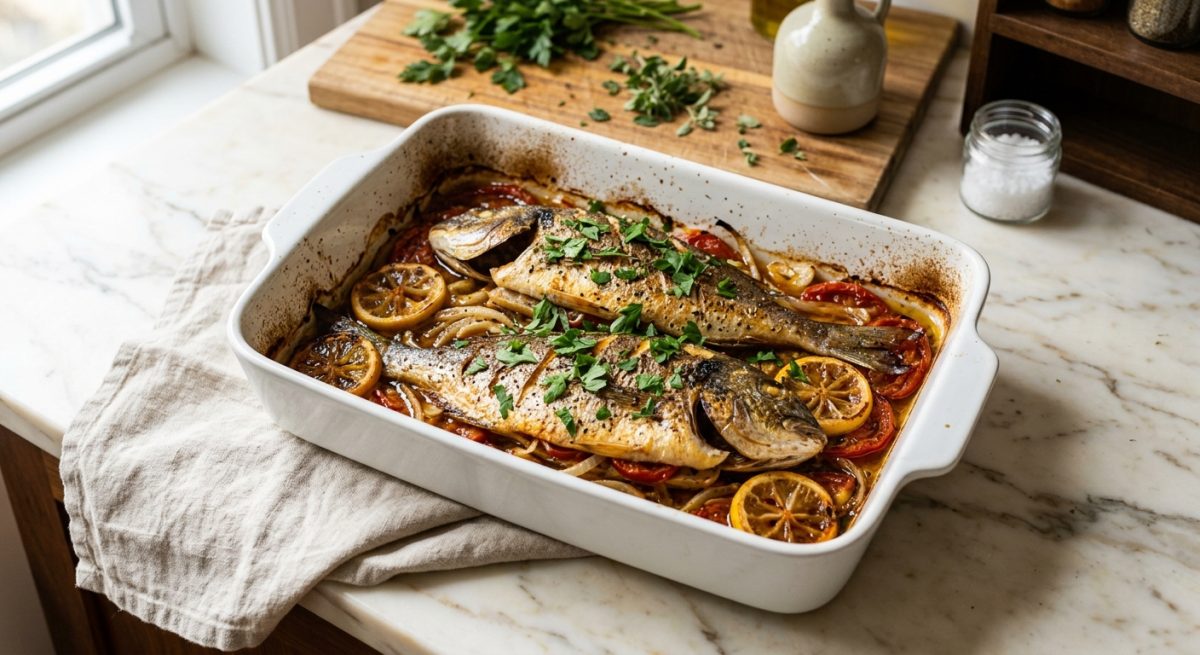
The fish market on the Kos harbor front opens before the sun comes up fully. I grew up walking those docks with my father — past the old wooden caiques tied at their moorings, past men in rubber boots hosing down their catch onto beds of crushed ice. The smell is clean and sharp, all brine and cold stone. By the time we carried our parcel of sea bream home, wrapped in newspaper and still cold from the sea, my mother was already heating olive oil in the oven pan.
That is where I first learned psari plaki Greek baked fish — not from a recipe, but from watching her layer sliced onions and tomatoes into the dish with unhurried care, slide it into the oven, and trust the heat to do its work. Plaki is not a complicated technique. It is a patient one. The word itself comes from an ancient Greek term for the flat stone or iron plate used for oven cooking, and that simplicity has changed very little in a thousand years.
What makes psari plaki Greek baked fish so reliable is the ladera approach: the fish sits on a bed of softened vegetables, braised gently in good olive oil and a splash of white wine, in an open pan at moderate heat. The tomatoes collapse into a thick, brick-red sauce. The fish stays moist without a single drop of cream or butter. This is how the Aegean eats its fish — nothing hidden, nothing fussy.
This version follows my mother’s proportions exactly, with a few observations I’ve added after years of cooking it professionally.
Table of Contents
Why This Recipe Works
- The vegetable bed cooks first. Onions, garlic, and tomatoes go into the pan and soften in the oven for 20 minutes before the fish arrives. This prevents the fish from overcooking while the vegetables catch up, and it means the sauce already has depth when the fish releases its juices into it.
- An open pan is non-negotiable. Covering the dish turns plaki into a braise and softens the top of the fish. Leaving it uncovered lets the tomato sauce reduce, concentrate, and develop a slight caramelized edge around the pan while the fish stays tender.
- Low heat preserves the texture. At 180°C (350°F), white fish takes its time — 25 to 30 minutes depending on thickness. That slower pace means the proteins tighten gradually rather than seizing, which keeps the flesh moist and pulls cleanly from the bone.
- Olive oil is the sauce. This is a ladera dish — the word means “oiled” — and a restrained hand with olive oil produces a greasy result. Use a full 80ml (⅓ cup) of good-quality extra virgin. It emulsifies with the tomato juices as the dish bakes and becomes the sauce.
Ingredients
Serves 4
For the vegetable base:
- 2 medium onions, thinly sliced into half-moons
- 4 garlic cloves, sliced (not minced — you want them to hold their shape)
- 500g (about 1 lb) ripe tomatoes, roughly chopped — or one 400g tin of good whole plum tomatoes, crushed by hand
- 1 green pepper, sliced into thin rings
- 80ml (⅓ cup) extra virgin olive oil
- 100ml (scant ½ cup) dry white wine
- 1 teaspoon dried oregano
- ½ teaspoon sweet paprika
- Salt and freshly ground black pepper
- Small bunch of flat-leaf parsley, stems and leaves separated
For the fish:
- 4 portions of firm white fish, 180–200g each (sea bream, sea bass, or cod fillets — skin on if possible)
- Salt and black pepper
- 2 tablespoons extra virgin olive oil, for drizzling
- ½ lemon, sliced into thin rounds (optional, for the top)
Step-by-Step Instructions
- Preheat the oven to 180°C (350°F) fan, or 190°C conventional. Place the rack in the middle of the oven. Get out your largest baking dish — you want a wide, shallow pan, not a deep roasting tray. The fish should sit in a single layer.
- Build the vegetable base. Scatter the sliced onions, garlic, and green pepper into the baking dish. Add the parsley stems (save the leaves for the end), the chopped tomatoes, oregano, and paprika. Pour over the olive oil and white wine. Season well with salt and pepper, then toss everything together directly in the pan.
- Par-bake the vegetables. Slide the dish into the oven, uncovered, for 20 minutes. The onions will soften and the tomatoes will begin to break down. This is the step most home cooks skip — don’t. It is what separates a cohesive sauce from raw vegetables with fish on top.
- Prepare the fish. While the vegetables cook, pat the fish fillets dry with kitchen paper. Season generously on both sides with salt and black pepper. Drying the surface helps the fish develop a little color in the oven rather than steaming.
- Nestle the fish into the sauce. Remove the pan from the oven. Spoon some of the softened vegetables over the top of the fish fillets to partly bury them, then drizzle the extra 2 tablespoons of olive oil over everything. If using lemon slices, lay them on top now.
Chef’s tip: Tilt the pan and use a spoon to baste the fish with the juices in the base of the pan. This is the most important thing you can do during the bake.
- Return to the oven for 25–30 minutes. The exact time depends on the thickness of your fillets. The fish is done when it flakes easily at its thickest point when pressed with a fork, and the tomato sauce has reduced and thickened around the edges of the pan. Do not cover the dish.
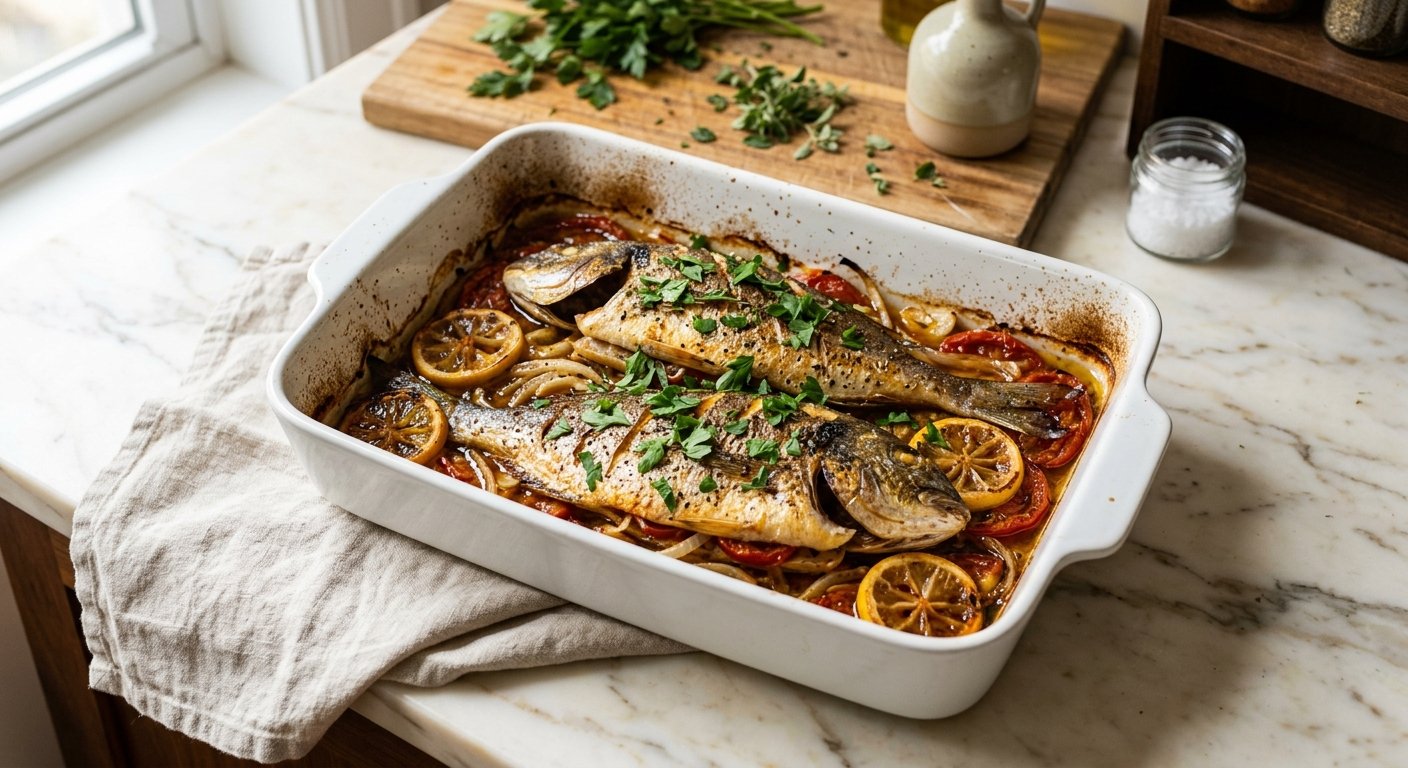
- Rest and serve. Remove from the oven and rest for 5 minutes. Scatter over the reserved parsley leaves. Serve directly from the baking dish with crusty bread to catch the sauce, alongside my Greek lemon potatoes or a simple Greek salad.
Psari Plaki (Greek Baked Fish with Tomatoes and Olive Oil)
Ingredients
Vegetable base
- 2 medium onions, thinly sliced into half-moons
- 4 garlic cloves, sliced (not minced)
- 500 g ripe tomatoes, roughly chopped (or 400g tin whole plum tomatoes)
- 1 green pepper, sliced into thin rings
- 80 ml extra virgin olive oil
- 100 ml dry white wine
- 1 tsp dried oregano
- ½ tsp sweet paprika
- Salt and freshly ground black pepper
- Small bunch flat-leaf parsley, stems and leaves separated
Fish
- 4 portions firm white fish fillets (sea bream, sea bass, or cod), 180–200g each, skin on
- Salt and black pepper
- 2 tbsp extra virgin olive oil for drizzling
- ½ lemon, thinly sliced optional
Instructions
- Preheat oven to 180°C fan / 190°C conventional. Position rack in middle.
- Combine onions, garlic, green pepper, parsley stems, tomatoes, oregano, and paprika in a large shallow baking dish. Pour over 80ml olive oil and white wine. Season and toss.
- Bake vegetable mixture uncovered for 20 minutes until onions soften and tomatoes begin to break down.
- Pat fish dry. Season both sides with salt and pepper.
- Nestle fish fillets into the par-cooked vegetable sauce. Spoon vegetables over the top of the fish. Drizzle with remaining 2 tbsp olive oil. Add lemon slices if using.
- Return to oven uncovered for 25–30 minutes, until fish flakes easily and sauce is reduced.
- Rest 5 minutes. Scatter parsley leaves over and serve from the dish.
Notes
Nutrition
Chef’s Notes
On the fish: Sea bream (tsipoura) is the Aegean choice — it holds up to the heat without falling apart, and the skin crisps slightly against the sauce. Sea bass works equally well. Cod fillets are excellent if you prefer a meatier texture. Avoid delicate fish like sole or tilapia, which will overcook before the sauce has time to develop. The Oxford Companion to Food notes that ladera-style dishes are among the most ancient cooking techniques of the Aegean, dating to a time when oil was the primary cooking medium across the region.
On the tomatoes: In July and August on Kos, the local tomatoes are deeply sweet and need nothing added. In winter, reach for a good tin of Italian whole plum tomatoes rather than fresh ones that have no flavor. Crush them by hand before adding — a few larger pieces give more texture to the finished sauce.
On wine: The wine should be dry and something you would drink. A sharp, cheap wine will make the sauce taste thin. Assyrtiko from Santorini is traditional and excellent, but any dry white works.
Variations:
- Add sliced courgettes or fennel to the vegetable base
- Finish with a handful of Kalamata olives and capers added in the last 10 minutes
- For a whole fish version: score the sides, stuff the cavity with herbs and garlic, increase total baking time by 10–15 minutes
Storage: Leftovers keep refrigerated for 2 days. Reheat gently in a low oven (160°C), covered loosely with foil, with a splash of water if the sauce has thickened too much. Do not microwave — it toughens the fish.
FAQ
What does psari plaki mean in Greek?
“Psari” (ψάρι) means fish, and “plaki” refers to a traditional Greek cooking method in which food is baked in the oven with olive oil, tomatoes, and aromatics. The word plaki is thought to derive from the ancient Greek “plakion,” a flat stone or iron slab used for baking. Together, psari plaki describes a dish where fish is slow-baked in an oiled, vegetable-rich sauce.
What is the best fish for psari plaki?
Any firm white fish that holds its shape during oven baking works well. Sea bream (tsipoura) and sea bass are the traditional Aegean choices. Cod, hake, and halibut are also excellent. Avoid thin or delicate fillets like sole or tilapia — they cook too quickly and fall apart before the sauce reduces.
Can I make psari plaki ahead of time?
Yes, and it is actually better the next day. The sauce deepens and the fish absorbs the flavors more fully after resting. You can bake it completely, refrigerate overnight, and reheat gently at 160°C covered with foil. Add a small splash of water before reheating if the sauce looks dry.
Do I need to cover the fish when baking?
No — and this is important. Plaki is traditionally baked uncovered. The open pan allows the tomato sauce to reduce and concentrate, and it gives the fish a slightly firmer, better-textured surface. Covering the dish steams the fish and produces a watery result.
What do you serve with psari plaki?
Crusty bread for the sauce is essential. Beyond that, this dish pairs naturally with my Greek lemon potatoes — the lemony, oven-crisped potatoes work beautifully against the tomato-forward sauce. A simple Greek salad alongside completes the meal in the way any Kos taverna would present it.