
Introduction
On the south-facing walls around my family’s property on Kos, grapevines grew in a way that suggested permanence — thick trunks wound around old stone, the new growth climbing higher each spring. From late May onward, the young leaves were tender enough to roll. My mother would go out with a basket in the early morning before the day got too hot, choosing leaves roughly the size of her palm, dark green and pliable, still faintly damp with dew.
Then the kitchen would fill with everyone. Rolling dolmadakia Greek stuffed grape leaves is one of the few kitchen tasks that draws the whole family to the table, not because it is particularly difficult but because it goes faster with more hands, and because the conversation flows naturally when everyone’s fingers are busy. My grandmother sat at the corner and worked twice as fast as anyone else, her rolls impossibly tight and uniform, and she rarely looked down at what she was doing.
This is the yalantzi version — the word means “without meat” in Turkish, a linguistic inheritance from the Ottoman centuries that shaped the food of the Aegean. These rice-stuffed grape leaves are cooked in olive oil and lemon juice, finished with fresh dill, and served at room temperature. They are vegan and they are one of the best things you can set on a meze table. My lahanodolmades uses cabbage leaves with a meat filling — a different dish entirely, though the rolling technique is identical.
The techniques here are specific and they matter: how you rinse the jarred leaves, how you manage the rice-to-liquid ratio, how tightly you roll each piece, and how you pack the pot. All of it is in the details.
Table of Contents
Why This Recipe Works
- The rice cooks inside the leaf. The filling uses raw rice, not cooked. The rice swells as the dolmades steam in the pot, absorbing the olive oil and lemon cooking liquid from the inside out. This produces a more cohesive, tender filling than rice that is pre-cooked separately. It also means the rice-to-liquid ratio must be precise — too much rice and the rolls split; too little and the filling is soupy.
- Rolling tight prevents unraveling. A loosely rolled dolmade will fall open in the pot. The technique — leaf vein-side up, stem removed, filling in the center of the lower third, sides folded in, then rolled firmly up — is straightforward once you understand the logic, but it needs to be done with intention.
- Packing the pot tightly keeps them intact. Dolmadakia need to cook close together so they hold their shape and cannot unfurl during cooking. A heavy plate placed on top of the rolls in the pot functions as a weight, keeping them pressed down during the simmer.
- Serving at room temperature is not optional. Hot dolmadakia are good. Cold dolmadakia are good. Room-temperature dolmadakia are their best selves — the rice has had time to settle and firm, the olive oil has bloomed into the filling, and the lemon flavor is clearest when neither warm nor cold suppresses it.
Ingredients
Makes approximately 35–40 dolmadakia
For the filling:
- 200g (1 cup) long-grain rice, uncooked
- 1 medium onion, finely diced
- 4 spring onions (scallions), finely sliced
- Large bunch of fresh dill, finely chopped (about 40g / 1½ oz after picking)
- Small bunch of fresh mint, finely chopped (optional but traditional)
- 80ml (⅓ cup) extra virgin olive oil
- 2 tablespoons lemon juice (freshly squeezed)
- 1 teaspoon salt
- ½ teaspoon black pepper
For cooking:
- 1 jar (approximately 250g drained weight) preserved grape leaves in brine
- 80ml (⅓ cup) extra virgin olive oil
- 3 tablespoons lemon juice
- 250ml (1 cup) hot water
- ½ teaspoon salt
For serving:
- Extra lemon wedges
- A drizzle of good olive oil
- Thick Greek yogurt or tzatziki on the side
Step-by-Step Instructions
- Prepare the grape leaves. Open the jar of preserved grape leaves and unfold them into a large bowl of cold water. Rinse them well — change the water twice — to remove the brine, which is too salty if left in. Then blanch the leaves in boiling water for 2 minutes to soften them further and make them fully pliable. Drain and spread them flat on a clean work surface. Remove any tough stems by snipping them off at the base of the leaf.
Chef’s tip: Sort the leaves as you go. Choose the intact, palm-sized ones for rolling. Save very small or torn leaves — they will be used to line the pot.
- Make the filling. Combine the uncooked rice, diced onion, spring onions, dill, mint, olive oil, lemon juice, salt, and pepper in a bowl. Mix well. The filling will look rough and damp at this stage — that is correct.
- Line the pot. Cover the bottom of a wide, heavy-bottomed pot with a single layer of the torn or small grape leaves you set aside. This cushion prevents the dolmadakia from sticking to the pot bottom and scorching.
- Roll the dolmadakia. Work with one leaf at a time. Lay it flat on your work surface, vein-side up (the veins face up so the smoother side faces out on the finished roll). Place 1 heaped teaspoon of filling in the lower center of the leaf — don’t overfill, the rice will expand.
Fold the bottom of the leaf up over the filling. Fold both sides in toward the center, like an envelope. Then roll the leaf firmly away from you up to the top, keeping the sides tucked in as you go. The finished roll should be roughly the size and shape of a small cigar — tight, compact, and about 5–6cm long.
- Pack the pot. Place each finished dolmade seam-side down in the pot, nestling them snugly side by side in a single layer. If you have enough to fill a second layer, pack a second layer directly on top of the first. The tighter the pack, the better.
- Add the cooking liquid. Mix together the 80ml olive oil, 3 tablespoons lemon juice, and 250ml hot water with ½ teaspoon salt. Pour this over the dolmadakia.
- Weight them down. Place a heavy, heat-proof plate directly on top of the rolls, pressing them down. The plate should be slightly smaller than the pot so it sits flat on top of the dolmadakia. This is the traditional method for keeping them in place during cooking.
- Simmer on low. Bring the pot to a gentle simmer over medium heat, then reduce to the lowest heat your stove allows. Cover the pot (with the plate still in place) and cook for 50–60 minutes, until the rice is cooked through and the liquid is absorbed. Check at 45 minutes — press one dolmade open and taste the rice. It should be fully tender with no raw center.
- Cool and serve. Remove from heat and leave the dolmadakia in the pot to cool completely with the lid on. Do not rush this — at least 30 minutes at room temperature. The rice sets further as it cools and the dolmadakia firm up to the right texture. Serve on a plate with lemon wedges and a drizzle of olive oil, alongside a bowl of tzatziki or a fresh horiatiki salad.
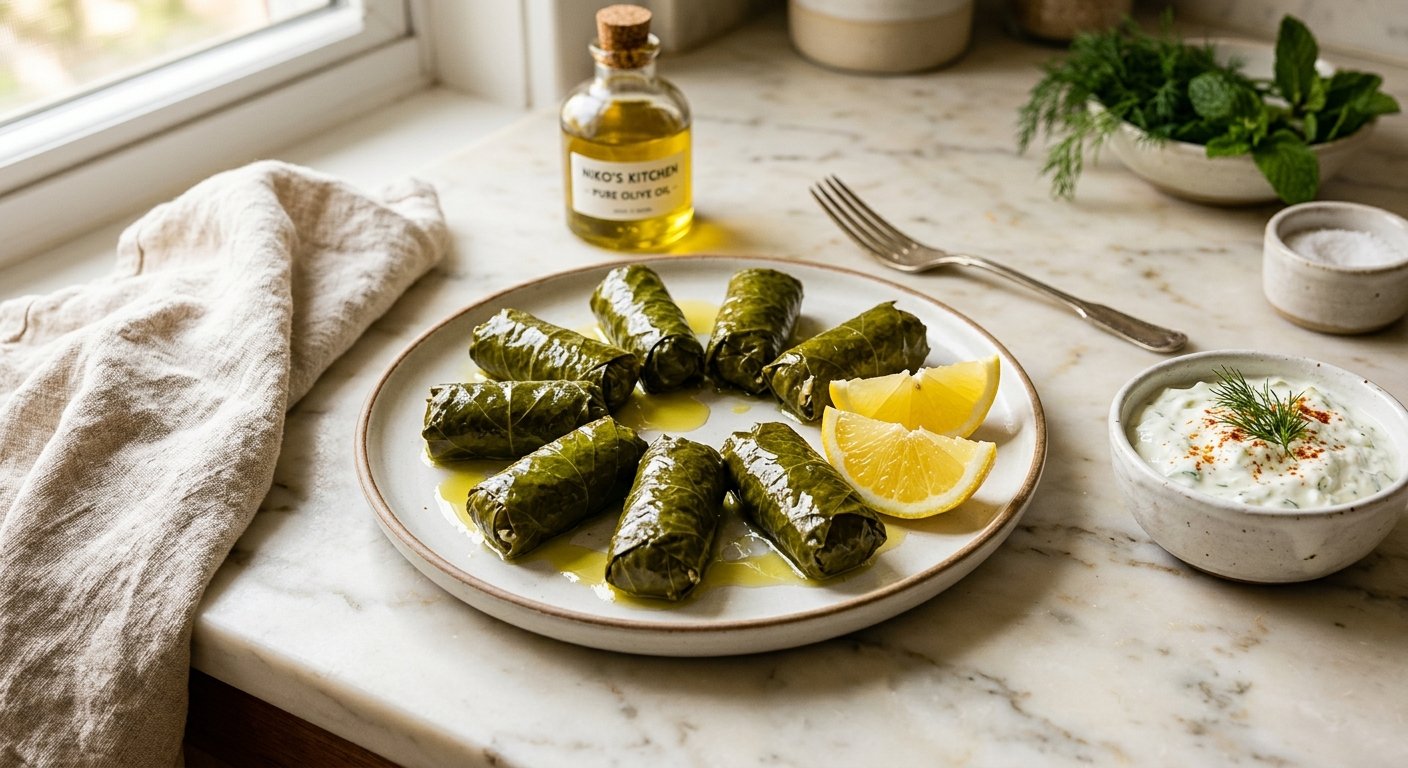
Dolmadakia Yalantzi (Greek Stuffed Grape Leaves with Rice)
Ingredients
Filling
- 200 g long-grain rice, uncooked (1 cup)
- 1 medium onion, finely diced
- 4 spring onions, finely sliced
- 40 g fresh dill, finely chopped
- Small bunch fresh mint, finely chopped optional
- 80 ml extra virgin olive oil (1/3 cup)
- 2 tbsp fresh lemon juice
- 1 tsp salt
- 1/2 tsp black pepper
For cooking
- 1 jar preserved grape leaves in brine (approx 250g drained)
- 80 ml extra virgin olive oil (1/3 cup)
- 3 tbsp fresh lemon juice
- 250 ml hot water (1 cup)
- 1/2 tsp salt
To serve
- Lemon wedges
- Drizzle extra virgin olive oil
- Tzatziki or plain yogurt
Instructions
- Rinse grape leaves in 2 changes of cold water. Blanch in boiling water 2 minutes. Drain. Remove stems.
- Combine filling ingredients in a bowl. Mix well.
- Line pot bottom with torn or small grape leaves.
- Roll dolmadakia: leaf vein-side up, 1 tsp filling in lower center. Fold bottom up, sides in, roll firmly to top. Place seam-side down in pot.
- Pack rolls tightly in a single or double layer in the pot.
- Mix olive oil, lemon juice, hot water, and salt. Pour over rolls.
- Weight with heavy plate on top.
- Bring to simmer, cover, cook on lowest heat 50-60 minutes until rice is cooked through.
- Cool in pot with lid on for minimum 30 minutes. Serve at room temperature with lemon and tzatziki.
Notes
Nutrition
Chef’s Notes
On the word “yalantzi”: The term derives from the Turkish word meaning “false” or “without meat” — a legacy of the centuries when the Aegean islands existed within the Ottoman sphere and the cuisines mingled. Meat-filled dolmadakia cooked in a tomato-egg sauce are a completely different dish; the yalantzi version in olive oil and lemon is the one associated with summer meze, room-temperature service, and the island tradition of cooking without haste. Scholars of Mediterranean food history have traced stuffed-vegetable dishes across Greek, Ottoman, Persian, and Arabic culinary traditions, each culture adapting the form to its available ingredients and flavor preferences.
On the dill: This is the essential herb. Parsley works as a partial substitute, and many mainland Greek recipes use parsley, but dill is the Aegean marker. If you can only source dried dill, double the quantity — but fresh is significantly better here and worth seeking out.
On jarred vs. fresh grape leaves: Fresh leaves — young, picked in late spring — are lighter, more delicate, and cook to a more tender finish. They also require no rinsing. If you are lucky enough to have access to a grapevine, use them. For the rest of the year, jarred leaves from Greece or the Middle East work well, provided you rinse them thoroughly.
Storage: Dolmadakia Yalantzi keep well refrigerated for 5 days. They are arguably better on day two or three, once the flavors have had time to settle. Bring to room temperature before serving — they should never be served straight from the fridge.
FAQ
What is the difference between dolmadakia and dolmades?
The words refer to the same dish — “dolmades” is the plural of “dolma” (meaning stuffed, from Turkish), while “dolmadakia” is the diminutive form, literally “small dolmades.” In Greek, the diminutive signals affection as much as size. The dish is always rolled small enough to eat in one or two bites.
What is yalantzi mean?
Yalantzi (also spelled yalanchi or yalanci) comes from Turkish, meaning “false” or “lying” — in the sense of being without meat. It is the traditional name for olive oil-based stuffed grape leaves that contain no meat. The word is used across Greek, Armenian, and Lebanese culinary traditions for the rice-only version.
Can I use fresh grape leaves instead of jarred?
Yes — fresh young grape leaves picked in late spring (before they toughen) are excellent. Blanch them briefly in boiling water for 1 minute to soften, then drain and proceed. No rinsing is needed for fresh leaves. The finished dolmadakia will be slightly more delicate in texture.
Why are my dolmadakia falling apart?
Almost always this comes down to rolling too loosely, not packing the pot tightly enough, or not using the plate weight during cooking. Each of these steps serves a structural function. Loose rolls unravel when the rice expands; a loosely packed pot allows the dolmadakia to shift and unfurl; without the plate weight, they will float and loosen.
What do you serve with dolmadakia yalantzi?
At a meze table, dolmadakia sit naturally alongside tzatziki, a bowl of horiatiki salad, and olives. They also work well as part of a larger spread that includes my lahanodolmades — the cabbage leaf version with meat filling — which provides a good contrast in flavor, weight, and presentation.