
Introduction
The winters on Kos are mild compared to the Greek mainland, but they have their character. Rain comes in hard from the Aegean, the harbor gets rough and grey, and the tavernas close their shutters against the wind. The kitchen is where you want to be. I remember winters in my mother’s house where the smell of cinnamon and red wine was the smell of comfort — the specific, unmistakable smell of stifado reducing on the stove.
Stifado is one of the great Greek braised dishes, built around a sauce of tomato, red wine, and a spice combination — cinnamon, allspice, cloves, bay — that draws on the long history of spice trade in the Aegean. It is most commonly made with beef or rabbit, and I have published my version of beef stifado separately. But manitaria stifado Greek mushroom stew is not a compromise or a modern substitute. It is its own dish, and in many parts of Greece it predates meat-based versions during the fasting periods of the Orthodox calendar, when stifado spices would be applied to whatever was available.
The mushrooms here are chosen for their ability to absorb flavor and hold their structure through a long braise: cremini for earthiness and volume, portobello for a deep, meaty texture, shiitake for their particular savory quality. The pearl onions are not a garnish — they are structural, as essential to stifado as the wine and the cinnamon. They need to cook long enough to become completely tender and sweet, essentially dissolving into the sauce around their edges.
This is a winter dish. It takes time. It is better the next day. Put it on before dark and let the kitchen fill with that smell.
Table of Contents
Why This Recipe Works
- Browning in batches is not optional. Crowding the pan is the single most common mistake when cooking mushrooms. When mushrooms are too close together, they steam rather than brown, and they release all of their liquid at once instead of caramelizing on the surface. That surface browning — the Maillard reaction — is where the depth of flavor begins. Cook in small batches, in a very hot pan, until genuinely dark on both sides.
- The wine must reduce before liquid is added. After the wine goes in, it needs to cook down by at least half before the tomatoes or stock are added. Raw wine flavor in a braise produces harshness. Reduced wine becomes sweet, concentrated, and complex.
- Pearl onions are structural. In a stifado, the small pearl onions are meant to cook until they are completely tender and have released their sweetness into the sauce. They are not a textural element — they are meant to near-dissolve. If you cut corners here with larger onions, the dish is not a stifado.
- Long, low heat develops the spice. The cinnamon, allspice, and cloves need at least 45 minutes of gentle heat to fully integrate and mellow. Added too late or cooked too briefly, they sit on top of the dish as separate notes rather than becoming part of the sauce.
Ingredients
Serves 4
For the mushrooms:
- 500g cremini (chestnut) mushrooms, halved if large
- 300g portobello mushrooms, cut into thick wedges
- 200g shiitake mushrooms, stems removed, caps left whole or halved
- 3 tablespoons olive oil (for browning)
- Salt and black pepper
For the stifado base:
- 400g pearl onions (fresh or frozen)
- 4 garlic cloves, whole and peeled
- 3 tablespoons extra virgin olive oil
- 200ml dry red wine (something robust — Xinomavro or a Peloponnese red wine)
- 400g tin whole plum tomatoes, crushed by hand
- 150ml vegetable stock or water
- 2 tablespoons red wine vinegar
- 1 tablespoon tomato paste
Whole spices (tied in muslin or added directly and fished out at the end):
- 1 cinnamon stick
- 4 allspice berries
- 3 whole cloves
- 2 bay leaves
Seasoning:
- 1 teaspoon sugar
- Salt and black pepper to taste
- 1 tablespoon fresh flat-leaf parsley, roughly chopped (for serving)
Step-by-Step Instructions
- Prepare the pearl onions. If using fresh pearl onions, score a shallow cross in the root end of each. Blanch in boiling water for 2 minutes, then drain and slip off the papery outer skins. If using frozen pearl onions, thaw and pat dry — no blanching needed.
- Brown the mushrooms in batches. Heat 1 tablespoon of olive oil in a wide, heavy-bottomed pot or Dutch oven over high heat until shimmering. Add one-third of the mushrooms — do not crowd the pan. Season with salt and cook without moving them for 2–3 minutes until deeply browned on one side, then turn and brown the other side. Remove to a bowl and repeat with the remaining mushrooms in two more batches, adding more oil as needed.
Chef’s tip: You may need to work in more than three batches depending on the size of your pan. The mushrooms need room. A crowded pan is a steamed mushroom.
- Cook the pearl onions. In the same pot, add 3 tablespoons olive oil over medium heat. Add the pearl onions and cook for 8–10 minutes, turning occasionally, until golden brown on most surfaces. Add the whole garlic cloves and the cinnamon stick, allspice berries, cloves, and bay leaves. Cook for a further 2 minutes, stirring, until the spices are fragrant.
- Add the tomato paste and wine. Stir the tomato paste into the onion mixture and cook for 1 minute. Pour in the red wine. It will bubble vigorously. Increase the heat to medium-high and let the wine reduce by half — this takes about 5–7 minutes. You should be able to smell the harshness cook off, leaving a more rounded, sweet wine aroma.
- Build the sauce. Add the crushed plum tomatoes, vegetable stock, red wine vinegar, and sugar. Stir to combine. Season with salt and pepper.
- Return the mushrooms. Add all of the browned mushrooms back to the pot. Stir everything together gently. The mushrooms should be mostly submerged in the sauce.
- Braise low and slow. Bring to a gentle simmer. Reduce the heat to the lowest setting, cover the pot, and cook for 45–55 minutes, stirring occasionally. The sauce should thicken gradually, the mushrooms will absorb it, and the pearl onions will become completely tender. Remove the lid for the final 10 minutes to allow the sauce to reduce and intensify.
- Adjust and serve. Taste and adjust for salt, pepper, and vinegar. Remove and discard the cinnamon stick, bay leaves, and any whole spices you can find. The dish should smell deeply of cinnamon and red wine, with a sauce that coats the back of a spoon.
Serve in shallow bowls with crusty bread to catch the sauce, or over hilopites (Greek egg noodles) or orzo. Scatter with fresh parsley. This pairs naturally alongside my imam baildi and kolokithia yiahni for a full ladera and stew-style meze dinner.
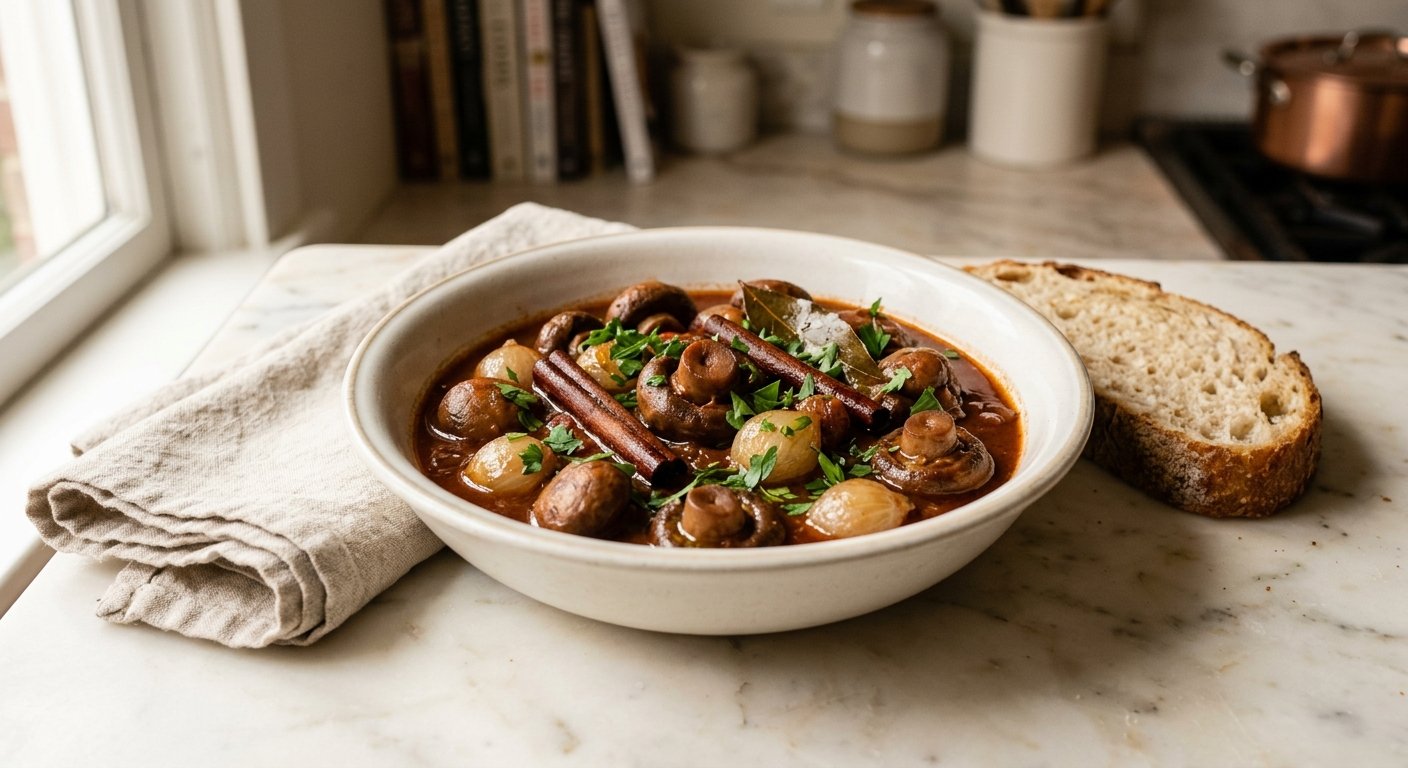
Manitaria Stifado (Greek Mushroom Stew with Pearl Onions, Cinnamon, and Red Wine)
Ingredients
Mushrooms
- 500 g cremini (chestnut) mushrooms, halved if large
- 300 g portobello mushrooms, cut into thick wedges
- 200 g shiitake mushrooms, stems removed
- 3 tbsp olive oil for browning
- Salt and black pepper
Stifado base
- 400 g pearl onions, peeled fresh or frozen
- 4 garlic cloves, whole and peeled
- 3 tbsp extra virgin olive oil
- 200 ml dry red wine Xinomavro or robust red
- 400 g tin whole plum tomatoes, crushed by hand
- 150 ml vegetable stock or water
- 2 tbsp red wine vinegar
- 1 tbsp tomato paste
- 1 cinnamon stick
- 4 allspice berries
- 3 whole cloves
- 2 bay leaves
- 1 tsp sugar
- Salt and black pepper to taste
- 1 tbsp fresh flat-leaf parsley, roughly chopped for serving
Instructions
- Blanch and peel pearl onions (or thaw frozen). Pat dry.
- Brown mushrooms in 3+ batches in hot oiled pot until deeply golden. Season. Set aside.
- In same pot, cook pearl onions in olive oil 8-10 minutes until golden. Add garlic and whole spices. Cook 2 minutes.
- Add tomato paste. Cook 1 minute. Pour in red wine. Reduce by half, 5-7 minutes.
- Add plum tomatoes, stock, vinegar, and sugar. Season.
- Return mushrooms to pot. Stir gently.
- Bring to simmer. Cover. Cook on lowest heat 45-55 minutes. Remove lid last 10 minutes.
- Remove whole spices. Adjust seasoning. Serve with bread or pasta, scattered with parsley.
Notes
Nutrition
Chef’s Notes
This is not a substitute dish. The framing of manitaria stifado as a “vegan version” of beef stifado misses something. Greek cooks applied stifado spices to mushrooms, octopus, and various vegetables during the Orthodox fasting calendar — long before plant-based cooking became a category anyone talked about. The spice profile — cinnamon, allspice, cloves, bay — is ancient and belongs to the Aegean’s history of trade with the eastern Mediterranean. Food historians studying Greek spice traditions have documented how this aromatic combination entered Greek cuisine through Byzantine-era trade routes and became embedded in festival and fasting cooking alike. The mushroom version is legitimate in its own right. My beef stifado is a different experience — richer, with more body — but not a better one.
On mushroom varieties: The three-mushroom combination here is deliberate. Cremini provide volume and a baseline earthiness. Portobello add a dense, almost chewy texture that satisfies in the way meat does. Shiitake contribute umami — the savory depth that keeps the dish from feeling thin. If you can only find cremini, double the quantity and add a tablespoon of soy sauce at the end for depth. Avoid button mushrooms — they lack the flavor and texture needed for a long braise.
On the wine: Use something you would drink — a Xinomavro, a Nemea, or any robust red. Cheap wine makes a harsh sauce. The wine reduces significantly during cooking, so its character matters more than in dishes where it plays a minor role.
Storage: Manitaria stifado keeps refrigerated for 4 days and freezes well for up to 3 months. The texture of the mushrooms becomes even more integrated after a day in the fridge. Reheat gently over low heat with a splash of water or stock.
FAQ
What is stifado?
Stifado is a traditional Greek braise built on a specific spice combination — cinnamon, allspice, cloves, and bay — cooked with red wine, tomatoes, and pearl onions. The word derives from the Italian “stufato” (stew), a linguistic inheritance from the Venetian influence on Greek islands, including the Ionian islands and parts of the Aegean. It is one of the oldest and most characteristic of the Greek braised dishes.
Can I use just one type of mushroom?
Yes, but the result is less complex. Cremini or portobello mushrooms alone work well. If using only one variety, use 1 kg total to account for the shrinkage during browning. A tablespoon of soy sauce or a small piece of dried porcini added to the braise can help deepen the flavor when you are working with fewer mushroom varieties.
Is manitaria stifado the same as beef stifado?
It shares the same spice profile, the same pearl onions, and the same slow-braise technique, but the experience is different. Beef stifado has more body and richness from the collagen released during cooking. Manitaria stifado is lighter with a more mineral, earthy quality. Neither is better — they are appropriate to different moods and seasons. I recommend reading my beef stifado post alongside this one for a comparison of the technique applied to different proteins.
Why must I brown the mushrooms in batches?
Mushrooms release a large amount of water when heated. If you add too many to the pan at once, the temperature drops and the mushrooms steam in their own liquid rather than browning. Browning is what creates depth of flavor — the Maillard reaction produces complex, roasted notes that carry the whole dish. A crowded pan produces grey, watery mushrooms that lack the intensity the stifado needs.
What do you serve with manitaria stifado?
Crusty bread is essential for the sauce. For a more substantial meal, serve over hilopites (Greek egg noodles), orzo, or thick-cut pasta. For a full table, it pairs well alongside imam baildi and kolokithia yiahni — all three dishes belong to the Greek tradition of slow-cooked vegetable and mushroom preparations with olive oil and aromatics.