
The first time I truly understood the power of warm spices in savory cooking, I was standing in my mother’s kitchen on Kos, watching her lower two cinnamon sticks and a small fistful of whole cloves into a bubbling pot of chicken. I must have been seven or eight years old. The kitchen filled with something I can only describe as the smell of warmth itself — not heat exactly, but comfort, depth, and the unmistakable fragrance of Sunday. That dish was Kapamas.
Greek braised chicken on its own is already deeply satisfying. Kapamas, though, transforms it into something memorable. The word derives from the Turkish for “covered” or “sealed,” and that is exactly what this preparation does — it seals a complex, spiced tomato sauce into every fiber of the meat. What comes out of the pot is fragrant, yielding, slightly sweet from the tomatoes, and shot through with that long, warm undercurrent of cinnamon and cloves that carries in every bite.
On Kos, my mother served her Kapamas over hilopites — the small, flat egg noodles made by hand in the autumn and dried on the roof in the Aegean sun. The pasta soaked up the braising sauce and became as much the point of the dish as the chicken. I still serve it the same way. Orzo or a simple rice pilaf work beautifully too, and I’ll give you guidance on all three options in the notes below.
This Greek braised chicken recipe asks nothing of you beyond a little patience. You brown the chicken, build the sauce, and let the pot do the rest. After roughly 75 minutes over a quiet flame, you have a dish that tastes as though it spent the whole day on the stove. Kapamas is one of those recipes — like my Chicken Vegetable Avgolemono Soup — that proves the most deeply satisfying Greek food rarely requires technical complexity. It requires only good ingredients and time.
Table of Contents
What Is Kapamas?
Kapamas — sometimes written as kota kapama or kapamas kotopoulo (kota being the Greek word for chicken) — is a slow-braised chicken dish made with whole aromatic spices and a rich tomato sauce. What distinguishes it from an ordinary Greek chicken stew is the specific blend of cinnamon sticks, whole cloves, and allspice berries, which give the dish its distinctive warm, slightly sweet depth and its connection to the layered culinary history of the Aegean.
The Kapamas recipe belongs to a family of Greek braised dishes that reflect centuries of Byzantine and Ottoman culinary influence, particularly strong in Dodecanese island cooking and throughout the eastern Aegean. On Kos, these spiced braises were Sunday food — dishes started in the morning, left to simmer while the family went to church, and eaten at a table that always had too many people around it.
According to the Oxford Companion to Food, spiced braises of this kind echo the long trade-route history of the Aegean region, where cinnamon, cloves, and allspice moved through the islands centuries before they became European pantry staples.
Today, Kapamas is made throughout Greece, with subtle regional variations — some cooks add a splash of red wine instead of white, others include a pinch of sugar to balance the tomatoes, and a few island kitchens still add a small piece of dried orange peel. My version is the one that has always made sense to me, shaped by what I watched in my mother’s kitchen and what I’ve tested in professional kitchens since.
Why This Recipe Works
- Bone-in, skin-on chicken is non-negotiable for this Kapamas recipe. The rendered fat enriches the braising liquid and the bones give the sauce body. Boneless chicken dries out; never use it in a braise this long.
- Whole spices, not ground release their fragrance slowly and evenly throughout the cook. Ground cinnamon added to a pot like this turns the sauce muddy and one-dimensional within minutes.
- A proper browning step builds the Maillard crust that gives depth to the sauce. Pale, unseared Greek braised chicken produces a pale, thin sauce. Take your time here — don’t rush the color.
- Tomato paste caramelized separately before the liquid goes in creates a concentrated sweetness and richer color that transforms the sauce from ordinary to remarkable.
Ingredients
For the chicken
- 1 whole chicken, cut into 8 pieces (approximately 1.5 kg / 3.3 lbs), or 6 bone-in, skin-on chicken thighs and drumsticks
- 1 teaspoon fine sea salt
- ½ teaspoon freshly ground black pepper
- 3 tablespoons extra-virgin olive oil
For the braising sauce
- 1 large yellow onion, finely diced
- 4 garlic cloves, thinly sliced
- 2 tablespoons tomato paste
- 150 ml (⅔ cup) dry white wine
- 400 g (14 oz) canned crushed tomatoes
- 250 ml (1 cup) chicken stock or water
- 1 teaspoon sugar
- 2 cinnamon sticks
- 6 whole cloves
- 4 allspice berries
- 2 bay leaves
- ½ teaspoon ground nutmeg
- Fine sea salt and black pepper, to taste
For serving
- 500 g (1 lb) hilopites (Greek flat egg noodle pasta), orzo, or long-grain rice
- A generous handful of fresh flat-leaf parsley, roughly chopped
- Extra-virgin olive oil, for drizzling
Step-by-Step Instructions
Step 1 — Season the chicken. Pat the chicken pieces completely dry with paper towels — this step is essential. Wet chicken will steam rather than brown, and you will never get that deep golden crust that makes all the difference. Season generously on all sides with salt and pepper.
Step 2 — Brown the chicken. Heat the olive oil in a large, heavy-bottomed pot or Dutch oven over medium-high heat. When the oil shimmers and a drop of water flicks away instantly, add the chicken pieces skin-side down in a single layer, working in batches to avoid crowding. Brown without moving for 5–6 minutes until the skin is deep golden and pulls away cleanly from the pot. Flip and brown the other side for 3–4 minutes. Transfer to a plate. The goal is color, not cooked-through.
Step 3 — Soften the aromatics. Reduce the heat to medium. Add the diced onion to the same pot, scraping up any bits left behind. Cook, stirring occasionally, for 6–8 minutes until the onion is soft and beginning to color at the edges. Add the garlic and stir for 1 minute until fragrant.
Step 4 — Caramelize the tomato paste. Push the onions to one side and add the tomato paste directly to the cleared space. Let it sit undisturbed for 2 minutes over medium heat — you’ll notice it darkening and smelling almost jammy. This brief caramelization is one of the most important steps in building a Kapamas recipe worth eating.
Step 5 — Deglaze. Pour in the white wine and stir vigorously, scraping up every browned bit from the bottom of the pot. All of that fond is flavor. Let the wine reduce by half, about 2 minutes.
Step 6 — Build the braising sauce. Add the crushed tomatoes, chicken stock, and sugar. Stir to combine. Add the cinnamon sticks, whole cloves, allspice berries, bay leaves, and ground nutmeg. Give everything one more stir.
Step 7 — Return the chicken. Nestle the browned Greek braised chicken pieces back into the pot, skin-side up, partially submerged in the sauce but with the skin above the liquid line so it stays rather than steams. Bring to a gentle boil.
Step 8 — Braise slowly. Reduce the heat to low and cover with a lid slightly ajar. Simmer gently for 60–75 minutes, turning the chicken pieces once at the halfway point. The sauce will reduce and thicken into something glossy and concentrated. The chicken is done when the meat pulls easily from the bone and registers at least 74°C / 165°F at the thickest point.
Step 9 — Finish and serve. Lift out and discard the cinnamon sticks, whole cloves, allspice berries, and bay leaves. Taste the sauce and adjust salt. Serve the Greek braised chicken over hilopites, orzo, or rice, with scattered fresh parsley and a drizzle of good olive oil.
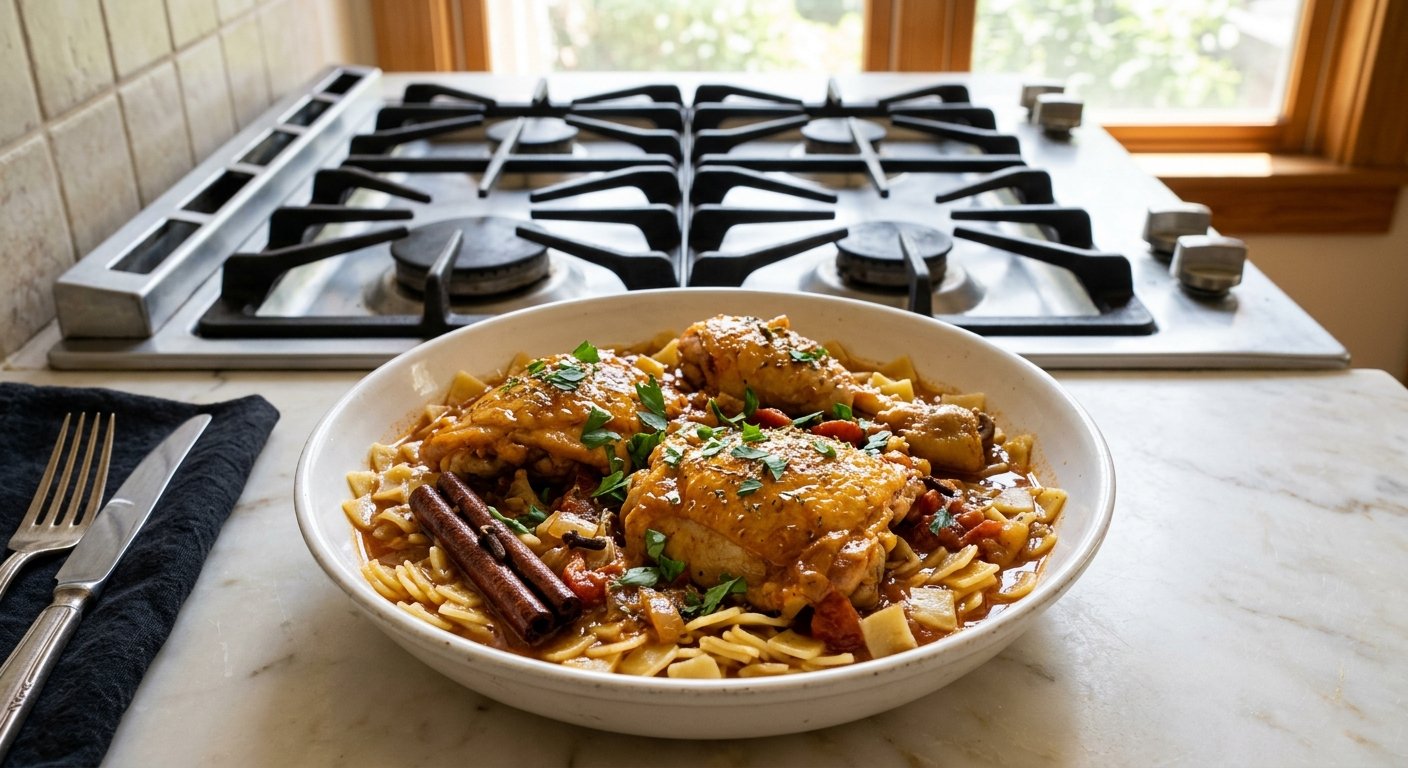
Greek Braised Chicken Kapamas
Notes
Nutrition
Chef’s Notes
On choosing the right chicken
You can make this Kapamas recipe with a whole bird cut into pieces or with thighs and drumsticks only. I lean toward a whole chicken when I’m cooking for a crowd — you get variety of texture across the different cuts, and the carcass adds body to the sauce. For a weeknight version, six bone-in, skin-on thighs are more forgiving and consistently give you well-cooked, juicy results.
What you should not use: boneless, skinless chicken breast. It will dry out completely in a braise this long, and the sauce will never develop the same richness without the rendered fat from the skin.
On the spices
The cinnamon and cloves are not a background note in Kapamas — they are the flavor. If yours taste faint, dusty, or more than a year old, your dish will be flat. Buy whole cinnamon sticks and whole cloves in small quantities and use them within six months.
I add a small amount of ground nutmeg alongside the whole spices. It does not dominate, but it rounds the flavor in a way that’s hard to explain and easy to miss if you leave it out.
Serving suggestions
The classic way on Kos was always hilopites — Greek egg noodles that absorb braising sauces beautifully. If you can find them at a Greek deli or online, use them. Orzo is an excellent and widely available substitute — it drinks up the sauce the same way. For a heartier table, serve alongside Greek Lemon Roasted Potatoes, which carry the olive oil and herb notes that complement this braised chicken perfectly.
If you enjoy orzo-based Greek one-pot dishes, my Giouvetsi recipe uses a similar technique — braised meat with orzo soaking up the sauce in the oven — and is well worth trying alongside this style of cooking.
Storage and reheating
Kapamas is arguably better the next day. The spices continue to perfume the sauce overnight, and the chicken becomes even more tender. Reheat gently in a covered pot over low heat with a splash of water or stock to loosen the sauce. It freezes well — portion the chicken pieces into containers with sauce, and defrost slowly in the fridge before reheating.
Frequently Asked Questions
What does Kapamas mean in Greek?
Kapamas is derived from a Turkish word meaning “covered” or “sealed.” The name refers to the cooking method — the chicken is braised in a tightly covered pot, sealing in the spiced tomato sauce and concentrating the flavors. In Greek, the dish is also called kota kapama, with kota meaning chicken.
What spices are in a Kapamas recipe?
The defining spices in Kapamas are cinnamon sticks, whole cloves, and allspice berries. Most versions also include bay leaves and a small amount of ground nutmeg. These whole spices should not be substituted with their ground equivalents — the slow-release fragrance of whole spices is what gives Greek braised chicken its characteristic warmth and depth.
Can I make Kapamas ahead of time?
Yes — and you should. This is one of those dishes that genuinely improves after a night in the refrigerator. The spiced tomato sauce has more time to meld, the fat settles on top and can be skimmed if you prefer, and the chicken absorbs even more of the braising liquid. Reheat gently on the stovetop with a splash of water or stock.
What is the difference between Kapamas and Stifado?
Both are Greek braised dishes with warm spices, but Stifado is specifically built around whole small onions (pearl onions) and is typically made with beef, rabbit, or octopus. The onion is structural in Stifado — it is as much an ingredient as the meat. In Kapamas, the onion is a flavoring base for the sauce, and the focus is entirely on the chicken and the cinnamon-clove fragrance.
What pasta do you serve with Greek braised chicken?
The traditional choice in Dodecanese cooking is hilopites — small, flat Greek egg noodles with a slightly rough surface that holds braising sauces well. If hilopites are unavailable, orzo (kritharaki) is the best substitute. Wide egg noodles or even pappardelle will also work. Cook the pasta separately and ladle the finished Greek braised chicken and sauce over the top just before serving.