
Garides me kritharaki holds a place in my kitchen that goes beyond a recipe. I first tasted this dish as a child on Kos, sitting with my father at a small waterfront taverna where the tables were set so close to the water you could hear the hulls of the fishing boats knocking against the dock. The cook would bring out a steaming clay dish — shrimp baked into tomato-braised orzo, the whole thing crowned with crumbled feta that had turned faintly golden in the oven. The Aegean was ten meters away. The bread on the table was thick and crusty. I have been trying to recreate that specific feeling ever since.
What makes garides me kritharaki so satisfying is the way the orzo absorbs the sauce as it bakes. Unlike pasta cooked separately and combined at the last moment, the orzo here drinks in every layer of flavor: the sweet tomatoes, the white wine, the olive oil, the faint brininess of the shrimp. By the time the dish comes out of the oven, you have something far greater than the sum of its parts.
This version follows the approach I watched my mother use in her kitchen on Kos. She always seared the shrimp briefly before baking — a step many home cooks skip — and the difference is unmistakable. The shrimp stay plump, tender, and full of flavor rather than turning dry and tight. I have made this dish dozens of times since then, adjusting the ratios until the orzo cooks perfectly in the oven without turning starchy or overabsorbing.
Whether you are cooking a relaxed weeknight dinner or a Sunday lunch for family, this garides me kritharaki recipe delivers that specific kind of Greek comfort food that feels effortless but tastes deeply considered. It comes together in one pan, serves four generously, and asks nothing more than good shrimp, ripe tomatoes, and a little patience.
Table of Contents
- What Is Garides me Kritharaki?
- Why This Recipe Works
- Choosing the Right Shrimp
- Ingredients
- Step-by-Step Instructions
- Recipe Card
- Chef’s Notes
- FAQ
What Is Garides me Kritharaki?
Garides me kritharaki is a traditional Greek baked dish combining shrimp (garides) with orzo pasta (kritharaki) in a rich, slow-cooked tomato sauce. The name is simple, descriptive Greek: garides means prawns or shrimp, me means “with,” and kritharaki is the Greek word for orzo — a small, rice-shaped pasta whose name translates roughly as “little barley” because of its grain-like form.
The dish belongs to the broader tradition of Greek oven-baked pasta dishes, most famously represented by giouvetsi (lamb or beef baked with orzo). Orzo itself has been a fixture of Mediterranean cooking for centuries, and the Greek technique of baking it directly in a seasoned sauce — rather than boiling it separately — gives these dishes their distinctive texture. The orzo absorbs the cooking liquid as it bakes, becoming slightly creamy and deeply flavored in a way that boiled pasta never achieves.
Garides me kritharaki is the seafood answer to giouvetsi: lighter, quicker to prepare, and ideally suited to spring and summer when fresh shrimp are plentiful. On Kos, tavernas along the harbor served variations throughout the warmer months — sometimes with ouzo in the sauce, sometimes with fresh chiles, always with good local olive oil and a wedge of lemon on the side. It is a dish that tastes unmistakably of the Aegean.
Why This Recipe Works
- Two-stage shrimp cooking prevents a rubbery texture. Searing the shrimp briefly before baking sets their structure. They finish gently in the oven without overcooking, staying plump and tender rather than tight.
- Dry orzo goes directly into the sauce. Adding uncooked orzo to the tomato sauce and then baking it means every grain absorbs flavor from the start. There is no boiling water diluting the taste.
- White wine in the sauce adds brightness. The acidity from the wine balances the richness of the tomatoes and olive oil, lifting the entire dish without overpowering the delicate shrimp.
- Feta finishes the dish rather than just garnishing it. Crumbled feta added before the final round of baking melts at its edges while remaining creamy at the center. It seasons the orzo from the top down as the dish bakes, working into the sauce instead of merely sitting on the surface.
Choosing the Right Shrimp for Garides me Kritharaki
The quality of your shrimp matters more in garides me kritharaki than almost any other variable. I recommend large or extra-large raw shrimp — 16/20 count per pound is ideal. Avoid pre-cooked shrimp entirely. By the time the orzo finishes baking, pre-cooked shrimp will have tightened to an unpleasant chewiness that no amount of sauce can rescue.
Fresh shrimp are best when you can find them. If you are working with frozen shrimp — which is the reality for most home cooks — thaw them overnight in the refrigerator rather than under running water. Gradual thawing preserves their texture and reduces the amount of excess water they release into the sauce, which would dilute the flavor.
Leave the tails on for a more rustic, dramatic presentation. Remove them if you want the dish easier to eat in a single clean bite. For family dinners, I remove the tails. When cooking for guests, I leave them on — the presentation reads as more festive and the tails add a trace of flavor to the sauce as they bake.
Peeling and deveining is essential. The dark vein along the back of each shrimp is the digestive tract. While it is harmless, it carries a faintly bitter taste that becomes noticeable in a dish where every element should be clean and bright. Take the two minutes to devein each shrimp before you begin.
Ingredients
Serves 4
For the shrimp:
- 500g (1.1 lb) large raw shrimp, peeled and deveined
- 2 tablespoons extra virgin olive oil
- 3 garlic cloves, minced
- Pinch of crushed red pepper flakes
- Salt and black pepper to taste
For the tomato sauce:
- 3 tablespoons extra virgin olive oil
- 1 medium yellow onion, finely diced
- 4 garlic cloves, minced
- ½ cup (120ml) dry white wine
- 1 can (400g / 14oz) crushed tomatoes
- 1 tablespoon tomato paste
- 1 teaspoon dried Greek oregano
- ½ teaspoon sugar
- Salt and black pepper to taste
For the orzo:
- 300g (1½ cups) orzo (kritharaki)
- 2 cups (480ml) hot seafood or chicken stock
- 1 cup (240ml) hot water, plus more as needed
To finish:
- 150g (5oz) feta cheese, crumbled
- Extra virgin olive oil, for drizzling
- Small handful of flat-leaf parsley, roughly chopped
- Lemon wedges, to serve
Step-by-Step Instructions
Step 1 — Preheat the oven. Set your oven to 200°C (400°F / Gas Mark 6). Position the rack in the center.
Step 2 — Season the shrimp. Pat the shrimp completely dry with paper towels. This step is not optional — surface moisture prevents a proper sear and leads to steaming rather than caramelization. Toss the shrimp with 1 tablespoon of olive oil, the minced garlic, red pepper flakes, salt, and black pepper.
Step 3 — Sear the shrimp. Heat a large, oven-safe skillet or wide braising dish over high heat. Add the remaining tablespoon of olive oil. When the oil shimmers and is very hot, add the shrimp in a single layer. Sear for 60 to 90 seconds per side — you want the outside just pink but the interior still translucent. Work in two batches if your pan is crowded. Transfer to a plate and set aside.
This two-stage method is the most important technique in the entire recipe. The shrimp will finish cooking in the oven. Do not cook them through at this stage or they will be overdone by the time the orzo is ready.
Step 4 — Start the sauce. Reduce the heat to medium. Add 3 tablespoons of olive oil to the same pan. Add the diced onion and cook, stirring occasionally, for 5 to 6 minutes until softened and translucent. Add the garlic and cook for another 60 seconds until fragrant and just beginning to color.
Step 5 — Deglaze with wine. Pour in the white wine. Let it bubble and reduce for about 2 minutes, using a wooden spoon to scrape up any browned bits from the bottom of the pan. Those caramelized bits carry concentrated flavor — do not skip this step.
Step 6 — Build the tomato base. Stir in the crushed tomatoes, tomato paste, dried oregano, and sugar. Season generously with salt and black pepper. Simmer over medium heat for 5 minutes, stirring occasionally, until the sauce thickens slightly and deepens in color.
Step 7 — Add the orzo. Pour the dry orzo directly into the tomato sauce. Stir for 1 to 2 minutes so every piece is coated in the sauce — this brief toasting adds a subtle nuttiness to the finished dish. Pour in the hot stock and hot water. Stir to combine. The liquid should barely cover the orzo. If not, add a splash more hot water.
Step 8 — First bake. Transfer the pan to the preheated oven. Bake uncovered for 12 minutes. The orzo will absorb most of the liquid and begin to set.
Step 9 — Add shrimp and feta. Remove the pan from the oven. Stir the orzo gently to check the texture — it should be almost cooked but retain a slight bite. If the pan looks dry, stir in a splash of hot water. Nestle the seared shrimp into the orzo, pressing them in gently so they are half-submerged. Scatter the crumbled feta evenly across the surface. Drizzle with a thread of olive oil.
Step 10 — Second bake. Return the pan to the oven for 8 to 10 minutes, until the feta is lightly golden at its edges and the shrimp are cooked through (opaque and curled into a loose C shape). The orzo should be fully tender and the sauce should have reduced to a coating consistency.
Step 11 — Rest and serve. Remove from the oven and allow the dish to rest for 3 to 4 minutes — this lets the sauce settle and the orzo firm up slightly. Scatter chopped parsley over the top, add lemon wedges on the side, and serve directly from the pan.
This garides me kritharaki pairs beautifully alongside a simple green salad or a portion of my Greek Lemon Chicken when feeding a larger group. A slice of crusty bread to mop up the sauce is not optional.
Recipe Card
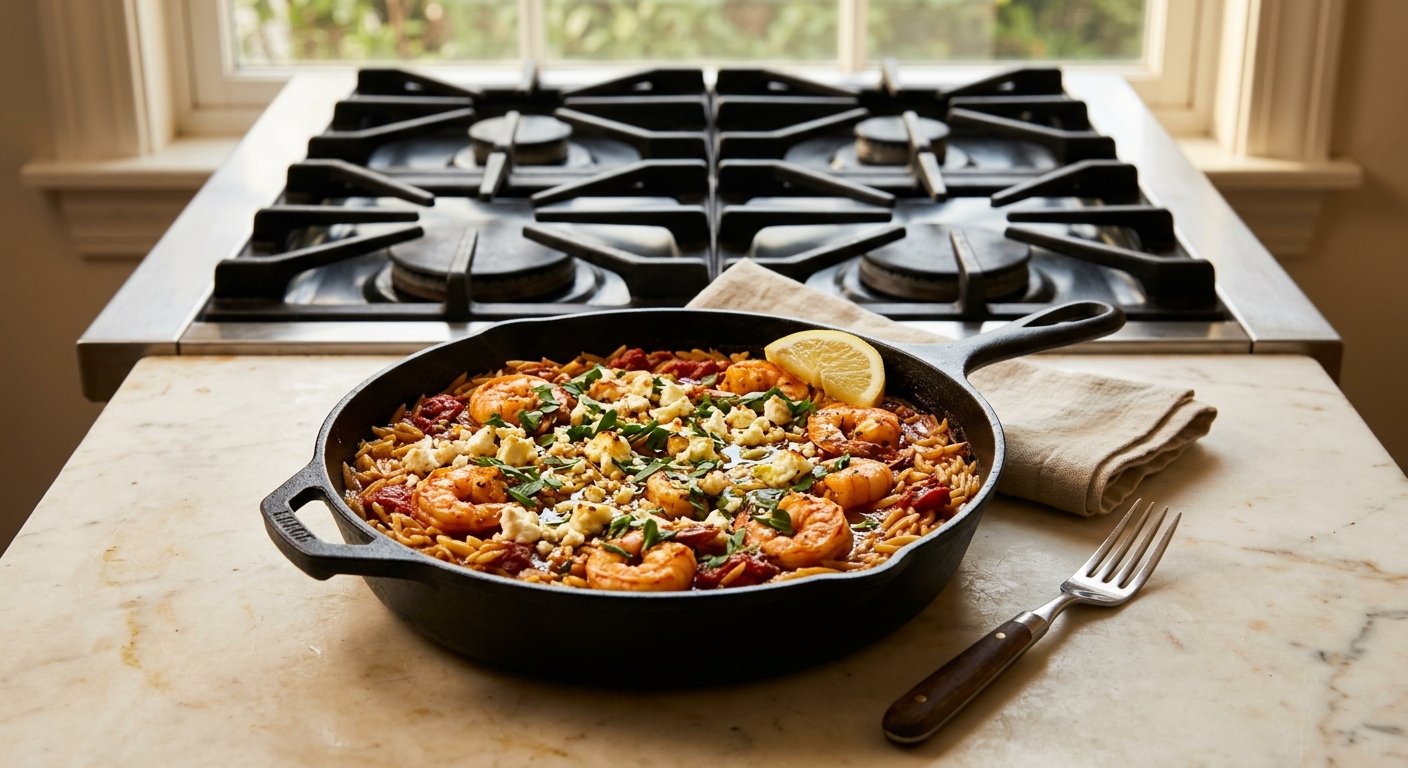
Garides me Kritharaki (Greek Baked Shrimp with Orzo)
Notes
Nutrition
Chef’s Notes
On the orzo: Greek kritharaki and Italian orzo are the same pasta — either works perfectly in this recipe. Look for it in the pasta or international aisle at most supermarkets. If you cannot find it, risoni is an identical product sold under a different name.
On the stock: Seafood stock gives the orzo a deeper oceanic flavor that reinforces the shrimp. If you only have chicken stock, it still works well. Avoid vegetable stock, which tends to make the sauce taste thin and slightly sweet.
On the wine: Use a dry Greek white wine if you have access to one — Assyrtiko from Santorini is ideal. Any dry, unoaked white wine works. Avoid anything labeled “cooking wine,” which is salted and will leave the dish overseasoned.
Variations:
- Add a handful of pitted kalamata olives to the sauce in Step 6 for a more briny, assertive flavor.
- Stir a tablespoon of ouzo into the pan after the wine reduces for an anise note that pairs beautifully with shrimp.
- Use a mix of shrimp and scallops, adding the scallops alongside the shrimp in Step 9.
- For a spicier version, increase the red pepper flakes and add a small fresh chile to the sauce.
Storage: Garides me kritharaki keeps in the refrigerator for up to 2 days in a covered container. The orzo will continue to absorb moisture as it sits, so reheat with a few tablespoons of water or stock stirred in over low heat. The dish does not freeze well — the texture of both the shrimp and orzo deteriorates significantly.
Serving suggestions: This dish is complete on its own but pairs well with a simple green salad, crusty bread, or, if you want to turn it into a full Greek spread, a starter of Spanakopita before the main.
FAQ
What is garides me kritharaki?
Garides me kritharaki is a traditional Greek dish of shrimp baked with orzo pasta in a tomato-wine sauce, finished with crumbled feta cheese. The name translates directly from Greek: garides (shrimp), me (with), kritharaki (orzo). It is one of the classic coastal dishes of the Greek islands, closely related to the lamb-based giouvetsi.
Can I use pre-cooked shrimp in this recipe?
I strongly advise against it. Pre-cooked shrimp will overcook and become rubbery by the time the orzo finishes baking — even with the shorter baking time in Step 10. Raw shrimp is essential for the correct texture in garides me kritharaki. If fresh raw shrimp is unavailable, frozen raw shrimp thawed overnight in the refrigerator is a perfectly good substitute.
Can I make garides me kritharaki without wine?
Yes. Replace the white wine with an equal volume of additional seafood or chicken stock. Add a small squeeze of lemon juice (about 2 teaspoons) at the deglazing stage to replicate some of the acidity the wine provides. The flavor will be slightly less complex but still very good.
Why is my orzo coming out mushy?
Two likely causes. First, the liquid ratio may be slightly high — orzo baked in the oven absorbs liquid more aggressively than pasta cooked on the stovetop. Start with the amounts in this recipe and resist adding extra liquid unless the pan looks completely dry. Second, the oven temperature may be too low. At 200°C, the liquid evaporates at the right rate to cook the orzo through without making it gluey. At lower temperatures, the orzo simmers in excess liquid and turns starchy.
What can I serve with Greek baked shrimp with orzo?
Garides me kritharaki is a complete one-pan meal on its own. For a larger spread, a simple Greek salad, crusty bread, and a chilled glass of Assyrtiko are all you need. If you are building a multi-course meal, consider starting with my Giouvetsi Recipe as inspiration for how the orzo style translates across different proteins — the comparison is genuinely interesting.