
There is a particular moment I have carried with me since childhood — a summer night on Kos, the kind where the heat from the day still rises off the stone walls after dark, and the whole family is gathered around the table in my mother’s courtyard. My uncle had been in the kitchen since early afternoon. The oven had been running at its lowest setting for hours, and when he finally brought out the tray, six parcels of parchment came with it, each one puffed and golden, their sealed edges glistening. He set one in front of me. I pulled the paper open. The steam rose first, then the smell — lemon and oregano and lamb, concentrated into something that had no right to be as intense as it was. I had eaten lamb before. I had not eaten kleftiko Greek lamb parchment before, not the real version, not like this.
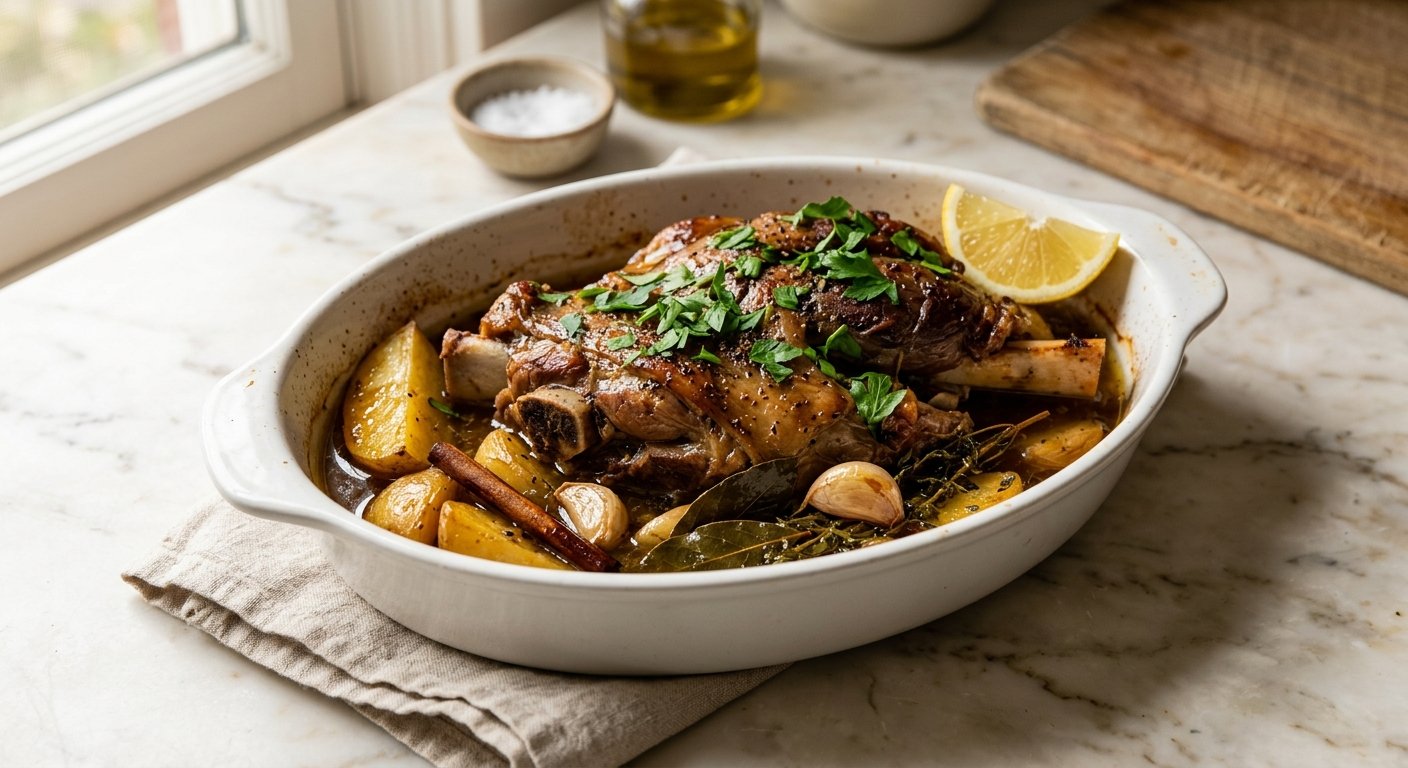
That is the promise of this dish. Kleftiko is not a complicated recipe. The technique is simple: season the lamb, wrap it tightly, put it in a low oven, and leave it alone. What makes it extraordinary is what happens inside the parcel. The lamb steams in its own juices. The lemon and garlic and herbs have nowhere to go. The collagen in the shoulder slowly breaks down over three and a half to four hours, and when you finally open the parcel — at the table, not in the kitchen — the meat falls from the bone at the touch of a fork, and the liquid pooled at the bottom of the parchment is already your sauce.
Table of Contents
What Is Kleftiko?
Kleftiko (κλέφτικο) is a Greek slow-cooked lamb dish in which the meat is sealed inside parchment paper — or, in older tradition, buried in a sealed clay pit — and cooked at low heat for several hours. The name comes from the Klephts, the Greek mountain brigands of the Ottoman period who cooked lamb in hidden, smokeless pits to avoid detection. The sealed cooking method meant no smoke, no fire visible above ground, and meat that was fall-apart tender by the time it was done.
Today, kleftiko is one of the great slow-cook dishes of Greek cuisine. The technique has moved from sealed earth pits to sealed parchment and foil in a domestic oven, but the principle is unchanged: complete enclosure, low heat, long time. The steam produced inside the parcel does the work. There is no basting, no checking, no opening mid-cook. The lamb, the lemon, the garlic, and the herbs are left to reach an understanding on their own.
What you get is fundamentally different from a standard lamb roast. A roasted leg of lamb slices cleanly and has a browned exterior. Kleftiko falls apart — the shoulder literally collapses when you press a fork against it — and the outside of the meat is soft, not crusted, because it has steamed rather than roasted. All the flavor that in a conventional roast would evaporate into the kitchen accumulates inside the parcel. The cooking juices are already a finished sauce. Nothing needs to be made separately.
Why This Recipe Works
- The seal is everything. Wrapping the lamb first in parchment, then in foil, creates a double barrier. The parchment holds the aromatics against the meat; the foil ensures the seal is airtight and the steam cannot escape. If the parcel leaks, you lose the effect. Wrap tightly and double-fold the edges.
- Low and slow is non-negotiable. 160°C (325°F) for three and a half to four hours is the target. Higher heat drives off moisture and toughens the protein before the collagen has time to break down.
- Shoulder over leg, if you have the choice. Shoulder has more intramuscular fat and connective tissue than leg. That fat bastes the meat from the inside as it renders, and the collagen becomes gelatin, giving the sauce its body.
- Overnight marinade pays dividends. The acid in the lemon begins to break down the surface proteins and carries the oregano and garlic flavor into the meat. Even four hours makes a difference.
Ingredients
Serves 6
For the lamb:
- 1.8–2 kg (4–4.4 lbs) bone-in lamb shoulder, cut into 6 large portions
- 6 garlic cloves, halved lengthwise
- 1 lemon, cut into thin wedges, plus juice of 1 additional lemon
- 80 ml (⅓ cup) extra-virgin olive oil
- 2 tsp dried oregano
- 1 tsp dried thyme
- 1½ tsp fine sea salt
- ½ tsp freshly ground black pepper
- 2 sprigs fresh rosemary
Optional additions (traditional in many households):
- 150 g (5 oz) Kefalotyri or Kefalograviera cheese, cut into thick slabs
- 2 medium potatoes, peeled and cut into large chunks
For wrapping:
- 6 large sheets of baking parchment (approximately 45 x 45 cm / 18 x 18 inches each)
- 6 large sheets of aluminum foil (same size)
Step-by-Step Instructions
Step 1 — Score and stud the lamb (day before, or at least 4 hours ahead).
Using a sharp paring knife, make 8–10 deep cuts across each piece of lamb — push the knife in about 3 cm (1.25 inches). Push a half-clove of garlic and a small wedge of lemon deep into each cut. The garlic and lemon should be fully inside the meat, not sitting on the surface.
Step 2 — Make the marinade and coat the lamb.
Whisk together the lemon juice, olive oil, oregano, thyme, salt, and pepper. Place the lamb pieces in a large baking dish or zip-lock bag and pour the marinade over them. Turn to coat thoroughly. Add the rosemary sprigs. Cover and refrigerate overnight, or for a minimum of 4 hours. Turn the pieces once if you think of it.
Step 3 — Bring to room temperature.
Remove the lamb from the refrigerator 45 minutes before cooking. Cold lamb in a sealed parcel takes longer to come up to temperature and can result in uneven cooking.
Step 4 — Preheat the oven.
Set your oven to 160°C (325°F) fan-forced, or 170°C (340°F) conventional. Place a rack in the lower-middle position.
Step 5 — Assemble the parcels.
Lay a sheet of parchment on a flat surface. If using potatoes, scatter a handful of chunks in the centre. Place one portion of lamb on top. Add a slab of Kefalotyri if using. Spoon any remaining marinade over the top. Add a small wedge of lemon.
Bring the long edges of the parchment together and fold them over twice to create a tight seam along the top. Fold the ends under the parcel. The goal is an airtight package — no gaps. Place the parchment parcel seam-side up onto a sheet of foil and repeat the folding process with the foil. Repeat for all six portions. Arrange the parcels in a large roasting tray.
Step 6 — Slow-roast.
Place the tray in the preheated oven and close the door. Do not open it. Do not check. Do not lift a corner of the foil. The entire point of kleftiko is the sealed environment. Set a timer for 3 hours 30 minutes. After 3 hours 30 minutes, test one parcel by gently pressing the foil — you should feel the meat yielding softly. If you have a large, whole shoulder, allow 4 hours minimum.
Step 7 — Rest in the parcel.
Remove the tray from the oven and allow the parcels to rest, still sealed, for 20 minutes. The steam inside continues cooking the meat gently during this rest. Do not skip this step.
Step 8 — Bring to the table and open.
Carry the parcels to the table on the tray. Let each person open their own parcel — the steam and the smell are the dramatic moment of the dish. The juices pooled at the bottom of the parcel are the sauce. They are already salted and concentrated. Spoon them over the meat.
Kleftiko: Greek Lamb in Parchment
Ingredients
For the lamb
- 1.8-2 kg bone-in lamb shoulder 4-4.4 lbs, cut into 6 large portions by butcher
- 6 clove garlic halved lengthwise
- 2 lemons 1 thinly sliced into wedges + juice of 1
- 80 ml extra-virgin olive oil 1/3 cup
- 2 tsp dried oregano
- 1 tsp dried thyme
- 1.5 tsp fine sea salt
- 0.5 tsp freshly ground black pepper
- 2 sprigs fresh rosemary
Optional additions (traditional)
- 150 g Kefalotyri or Kefalograviera cheese 5 oz, cut into thick slabs -- one per parcel
- 2 medium potatoes peeled and cut into large chunks (5-6 cm)
For wrapping
- 6 large sheets baking parchment approximately 45 x 45 cm / 18 x 18 inches each
- 6 large sheets aluminum foil same size as parchment
Instructions
- Using a sharp paring knife, make 8-10 deep cuts across each piece of lamb, about 3 cm / 1.25 inches deep. Push half a garlic clove and a small lemon wedge deep into each cut.
- Whisk together lemon juice, olive oil, oregano, thyme, salt, and pepper. Coat the lamb thoroughly. Add rosemary sprigs. Cover and refrigerate overnight, or for at least 4 hours. Turn pieces once during marinating.
- Remove the lamb from the refrigerator 45 minutes before cooking. Preheat oven to 160°C (325°F) fan-forced, or 170°C (340°F) conventional.
- For each portion: lay a parchment sheet flat. Scatter optional potato chunks in the centre. Place one lamb portion on top. Add a cheese slab if using. Spoon extra marinade over the top. Add a lemon wedge.
- Fold the parchment edges over tightly to form a sealed parcel with no gaps. Place seam-side up onto a sheet of foil and fold the foil tightly around it for a double seal. Repeat for all 6 portions.
- Arrange parcels in a large roasting tray. Place in the preheated oven and close the door. Do not open the oven. Roast for 3 hours 30 minutes.
- Remove from the oven. Leave parcels sealed for 20 minutes to rest. Do not skip this step -- the steam inside continues cooking the meat gently.
- Bring the parcels to the table. Open each one at the table, not in the kitchen -- the steam and smell are the dramatic moment of the dish. Spoon the accumulated juices over the meat and serve immediately.
Notes
Nutrition
Chef’s Notes
On the lamb cut: Bone-in shoulder is the cut I return to every time. Ask your butcher to cut a whole shoulder into 6 large portions. Bone-in matters — the bone conducts heat to the centre and contributes gelatin to the cooking juices. Boneless shoulder works but the sauce will be thinner.
On the cheese: Kefalotyri is the traditional choice — a hard, salty, aged sheep’s milk cheese. Kefalograviera is a reasonable substitute with a slightly milder, nuttier profile. If you cannot source either, halloumi will hold its shape inside the parcel. I would not use feta — it dissolves in the steam and makes the sauce quite salty.
On the potatoes: If you add potatoes, cut them large enough that they hold their shape over 3.5 hours of steaming — 5 to 6 cm chunks. Small dice will turn to mash. Large chunks will emerge tender and infused with the lamb juices. They are arguably the best part of the parcel.
Make-ahead and storage: Kleftiko can be assembled — marinated, wrapped in parchment and foil — up to 24 hours in advance and stored in the refrigerator. Take the tray out 45 minutes before cooking. Leftovers keep for 3 days refrigerated. Reheat gently in a 150°C (300°F) oven, still wrapped in foil, with a splash of water added to prevent drying.
Serving: Kleftiko is a complete meal in the parcel. Good bread to mop up the juices is not optional. If you want a side dish with some substance, my Classic Spanakorizo — Greek spinach and rice — absorbs the cooking juices beautifully. For the rest of the year, my Paidakia: Greek Grilled Lamb Chops gives you the same Greek flavor profile in a fraction of the time — the weeknight answer to kleftiko’s weekend patience. And for a full Greek feast centerpiece, see also Classic Greek Moussaka as a seasonal alternative.
FAQ
What does “kleftiko” mean in Greek?
Kleftiko (κλέφτικο) translates roughly as “in the style of the Klephts” or “stolen.” The Klephts were Greek mountain brigands of the Ottoman period who cooked lamb in sealed underground pits to avoid detection — no smoke meant no visible fire. The dish is named for that cooking method, not the meat itself.
Can I make kleftiko with lamb leg instead of shoulder?
Yes. Leg is leaner and will produce a slightly firmer result. A bone-in half-leg (roughly 1.8 kg) works well; increase the cooking time to 4 hours 15 minutes. Shoulder remains the traditional choice because its higher fat content and connective tissue break down into richer, more unctuous cooking juices.
Do I need to marinate the lamb overnight?
No, though overnight marinating improves the depth of flavor noticeably. A minimum of 4 hours gives the lemon acid time to begin tenderizing the surface. In a genuine emergency, you can season the lamb and go directly into the oven — the result will still be good because the sealed parcel does much of the flavor work regardless.
Why do I wrap in parchment AND foil?
Parchment is breathable and holds aromatics against the meat; foil provides the airtight seal that traps steam. Using both ensures the parcel stays sealed through the entire cook without the parchment burning or tearing. Foil alone works but can impart a slight metallic taste; parchment alone is insufficient to hold steam at this temperature for this duration.
Can I cook all the portions in one large parcel?
You can, though individual parcels are more reliable. A large single parcel is more likely to develop weak seams and lose steam. Individual parcels are also the traditional presentation — opening your own parcel at the table is part of the experience of kleftiko. If you cook a whole shoulder in one large parcel, allow at least 4 hours 30 minutes and rest for 25 minutes before opening.
What wine goes with kleftiko?
A medium-bodied red with some earthiness complements the lamb well — an Agiorgitiko from the Peloponnese, a Xinomavro from Naoussa, or a Cretan Kotsifali blend. If you prefer white, a full-bodied Assyrtiko from Santorini has enough structure to stand up to the richness of the cooking juices.